

The Guadalupe storm petrel is a small seabird of the storm petrel family Hydrobatidae. It bred only on Guadalupe Island off Baja California, Mexico, and presumably ranged throughout the region. It has been assessed as Critically Endangered or possibly extinct.
Region
Northeast Pacific Ocean
Typical Environment
Historically, it nested on Guadalupe Island and ranged pelagically over the surrounding Pacific waters off Baja California. At sea it occupied open-ocean habitats, often far from land, where it fed at the surface. Breeding occurred in burrows or crevices on the island, likely within cool, fog-influenced highland habitats. Outside the breeding season it dispersed widely over offshore waters. Any present-day distribution is uncertain due to the lack of recent verified records.
Altitude Range
Sea level to 1200 m
Climate Zone
Subtropical
Ease of Keeping
Beginner friendly: 1/5
This small, long-winged storm petrel bred only on Guadalupe Island, Mexico, and foraged widely over the adjacent Northeast Pacific. It was severely impacted by introduced predators (especially cats) and habitat degradation from goats on the island. No confirmed records exist since the early 20th century, and it is considered Critically Endangered and possibly extinct. Ongoing searches and restoration on Guadalupe offer a slim hope that an undetected remnant could persist.


Sitting on its nest, the Guadalupe storm petrel would have looked exactly the same as the Leach's storm petrel in this photo
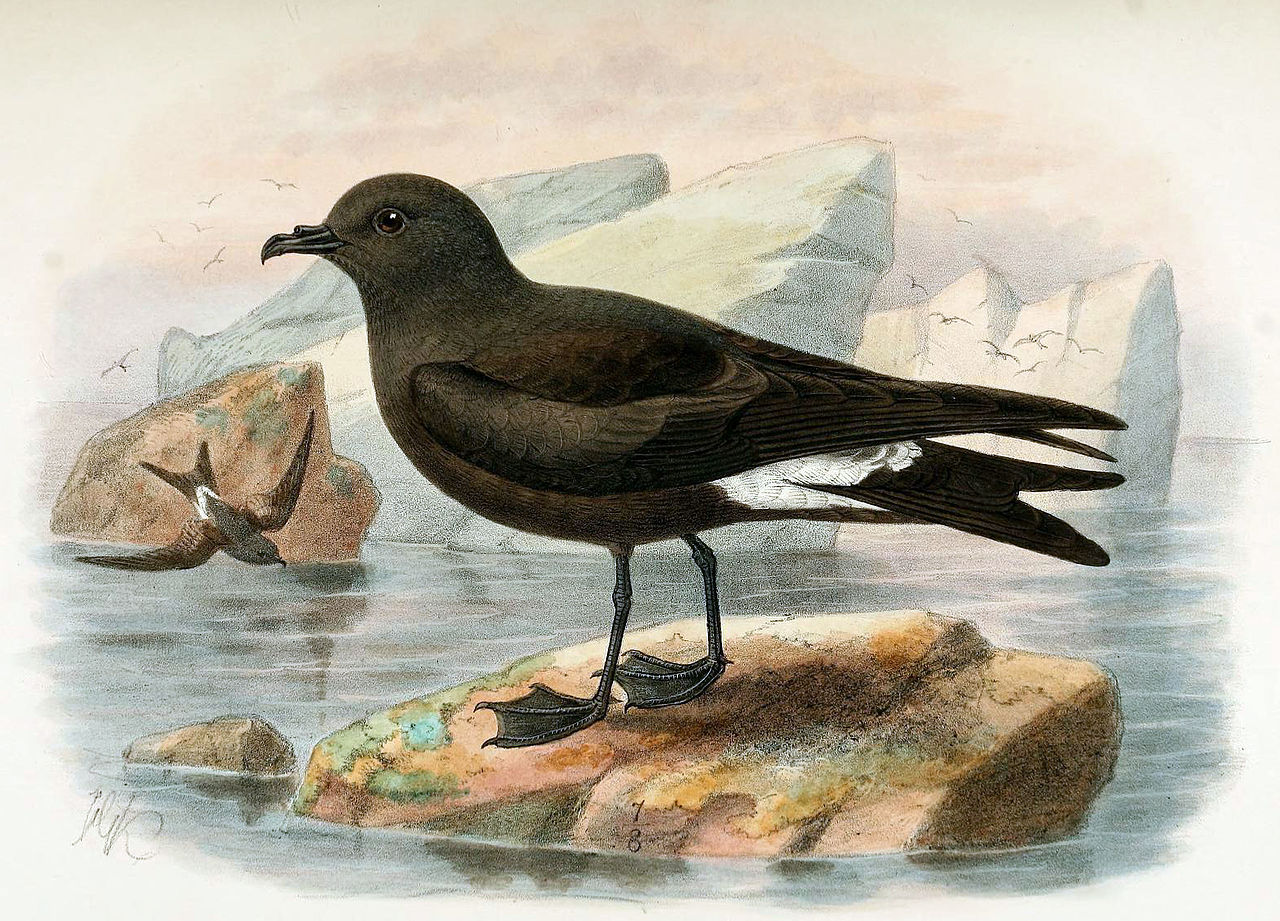
Illustration from 1907

Specimen in National Museum of Scotland
Temperament
solitary at sea, colonial when breeding
Flight Pattern
short rapid wingbeats with buoyant glides
Social Behavior
Breeds in loose to dense colonies, nesting in burrows, rock crevices, or under vegetation. Mostly nocturnal at colonies, arriving and departing under cover of darkness to avoid predators. Pairs exhibit strong nest-site fidelity and share incubation and chick-rearing duties.
Migratory Pattern
Seasonal migrant
Song Description
At colonies it gives soft, purring trills and chatter-like calls, usually at night from within burrows. Calls are used for pair communication and territory advertisement around nest sites.
Plumage
Sooty-brown to black overall with a contrasting white rump and a slightly forked tail; upperwings show a faint pale bar. Feathers are smooth and sleek, adapted for long-distance pelagic flight.
Diet
Feeds mainly on small fish larvae, squid, and planktonic crustaceans such as copepods and krill. It often picks prey from the surface while pattering its feet and hovering. May follow lines of floating debris or areas of upwelling where prey concentrates. Opportunistically takes oily scraps and natural marine slicks where scent cues help locate food.
Preferred Environment
Open pelagic waters, especially over productive currents and upwelling zones. Rarely approaches coasts except near the breeding island. Forages in light to moderate winds that support its buoyant flight.


