The grey-chested greenlet is a species of bird in the family Vireonidae. It is found in Bolivia, Brazil, Colombia, French Guiana, Peru, and Venezuela. Its natural habitats are subtropical or tropical moist lowland forests and heavily degraded former forest.
Region
Amazon Basin and Guiana Shield
Typical Environment
Found in lowland tropical forests of Bolivia, Brazil, Colombia, French Guiana, Peru, and Venezuela. It inhabits terra firme and seasonally flooded (várzea) forests, as well as forest edges and tall secondary growth. The species tolerates degraded habitats and edges better than many interior-forest specialists. It forages mainly in the midstory to canopy, occasionally descending to the understory along edges. Riparian corridors and gallery forests can also host this species.
Altitude Range
0–1000 m
Climate Zone
Tropical
Ease of Keeping
Beginner friendly: 1/5
A small vireonid, the grey-chested greenlet often joins mixed-species flocks, gleaning quietly in the midstory and canopy. Its gray-washed chest contrasts with olive-green upperparts, helping separate it from other greenlets. It builds a small, cup-shaped nest suspended from a forked twig. The species is generally unobtrusive but reveals itself with thin, high-pitched calls.


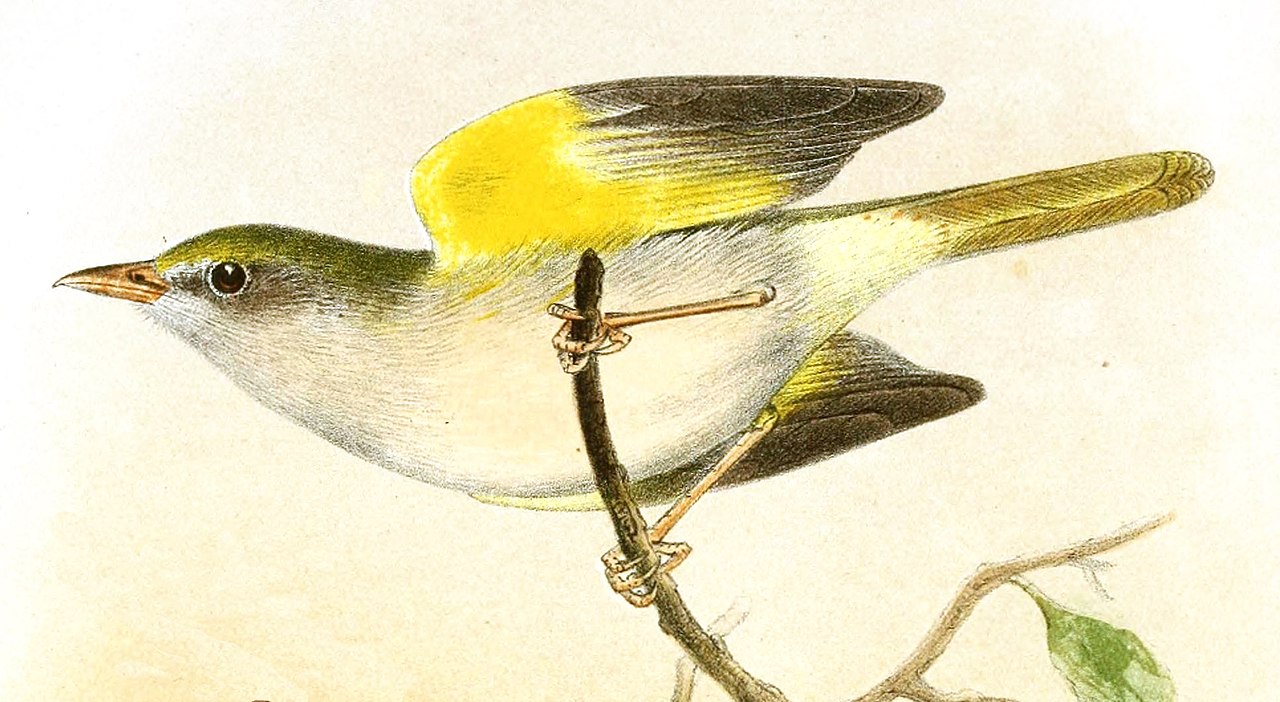
Hylophilus semicinereus; illustration by Smit, 1867
Temperament
quiet and unobtrusive
Flight Pattern
short rapid wingbeats between perches
Social Behavior
Usually seen in pairs or small family groups and frequently joins mixed-species flocks in the midstory. Likely monogamous, with both sexes participating in nest building and care. Nests are small cup structures suspended from forked twigs in low to mid-level vegetation.
Migratory Pattern
Resident
Song Description
Voice consists of thin, high-pitched whistles and sharp chips, often given from within foliage. Phrases are simple and repeated at intervals, making the bird easier to detect by ear than by sight.
Plumage
Olive-green upperparts with a contrasting gray-washed chest and paler, yellowish to off-white belly. Subtle, broken whitish eye ring and slightly paler lores. Feathers are smooth and sleek, suited to unobtrusive foliage-gleaning.
Diet
Primarily feeds on small arthropods such as caterpillars, beetles, and spiders, gleaned from leaves and twigs. Occasionally hawks short distances to snatch prey flushed from foliage. May take small berries opportunistically, especially in the non-breeding season.
Preferred Environment
Forages in the midstory and canopy of humid lowland forest, including along edges and in tall secondary growth. Often follows mixed-species flocks where it methodically searches leaves and fine branches. Riparian vegetation and gallery forests are also used.