The greater spotted eagle, also called the spotted eagle, is a large migratory bird of prey in the family Accipitridae.
Region
Palearctic (Eastern Europe to Central Asia)
Typical Environment
Breeds from the Baltic region, Belarus, and Ukraine east through Russia to western Siberia. Winters across the Middle East, the Indian Subcontinent, and parts of Southeast Asia, with scattered occurrences elsewhere. Prefers extensive wetlands such as marshes, bogs, floodplains, and wet woodland edges, often with old-growth trees for nesting. Uses river valleys, oxbow lakes, and reedbeds for foraging and roosting. Avoids heavily urbanized areas but may traverse agricultural landscapes near water.
Altitude Range
0–1500 m
Climate Zone
Temperate
Ease of Keeping
Beginner friendly: 1/5
The greater spotted eagle is a medium-large eagle of wetlands and damp forests, now globally Vulnerable due to habitat loss, electrocution, and persecution. It breeds from Eastern Europe through western Siberia and winters mainly in the Middle East, the Indian Subcontinent, and Southeast Asia. It can hybridize with the closely related lesser spotted eagle where their ranges overlap. Juveniles show more pale spotting than adults, which become darker and more uniform with age.


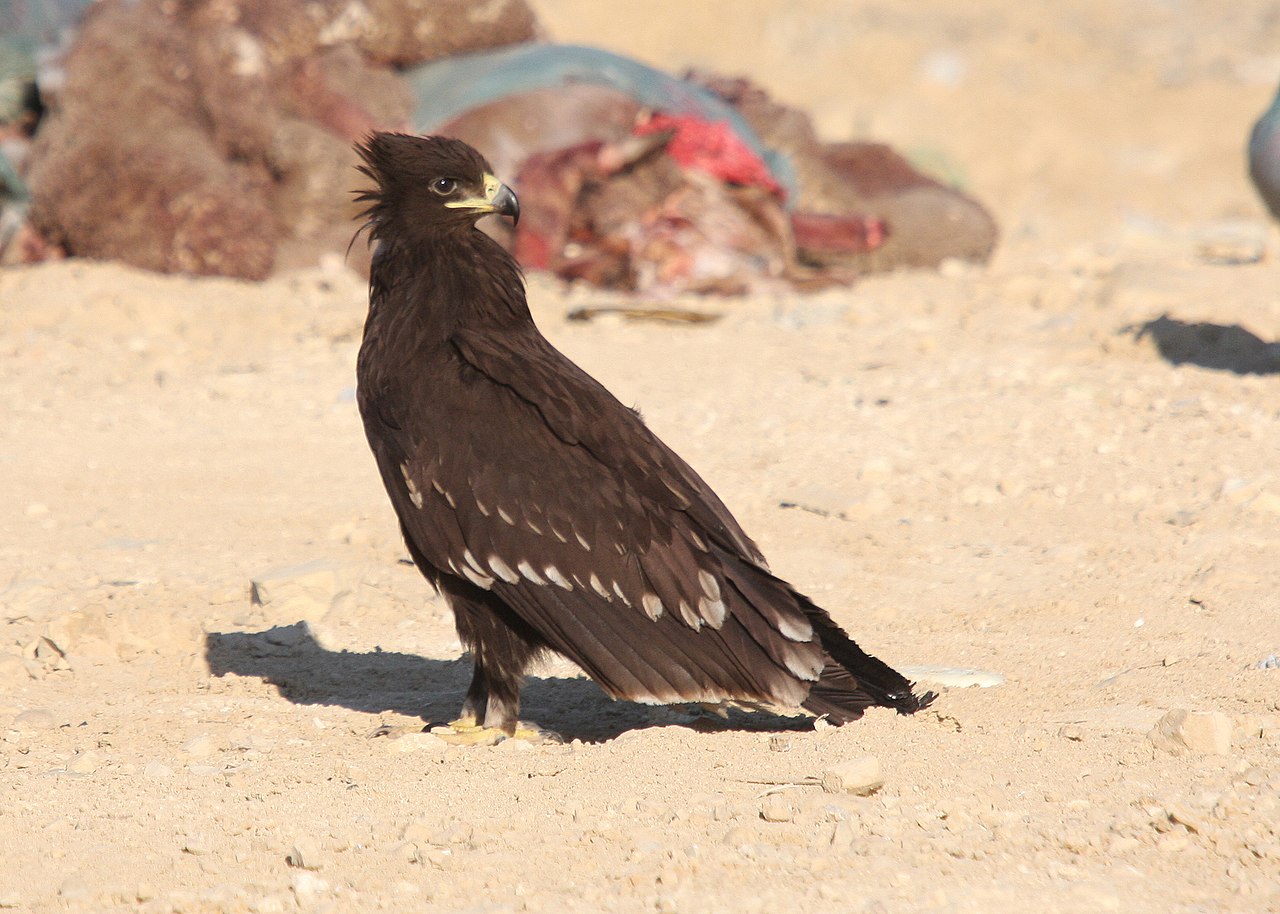
Adult wintering in Oman

A juvenile greater spotted eagle wintering in India exhibits the highly distinct fulvescens morph plumage.

Museum specimen of juvenile

Greater spotted eagles are large raptors and medium-sized eagles.

A characteristic young greater spotted eagle, showing its dark colouring and extensive white wing markings.

Greater spotted eagle in flight, wintering in Israel.

A greater spotted eagle in Karumady, Kerala, India. This species is often at home in wetland-type habitats.

Underside of adult wintering at Bharatpur (Rajasthan, India).

Upperside of adult wintering in Bharatpur (Rajasthan, India).Note the light wing stripes.

Large water-dwelling rodents such as European water voles are significant food for breeding greater spotted eagles, along with smaller upland vole species.

Water birds such as common moorhens are a common component of the diet of greater spotted eagles in almost any season.

A drongo mobs a wintering greater spotted eagles, which are predators of birds of various sizes.


Greater spotted eagle in Israel

Egg of greater spotted eagle (Collection Museum Wiesbaden)

Wintering greater spotted eagle in Israel

A couple of greater spotted eagles wintering in India
Temperament
solitary and territorial
Flight Pattern
soaring glider
Social Behavior
Generally solitary outside the breeding season, though loose aggregations can form at rich feeding sites or communal roosts in winter. Pairs nest in tall trees near wetlands, often reusing or refurbishing old nests. Clutches are typically 1–2 eggs, and sibling rivalry (including cainism) may occur in food-poor years. Both adults provide care, with the female brooding more during early chick development.
Migratory Pattern
Seasonal migrant
Song Description
Usually quiet away from the nest; most vocal during the breeding season. The call is a series of harsh, yelping barks and whistles, carrying over forest edges and wetlands.
Plumage
Mostly dark chocolate-brown with a slightly paler nape; juveniles show pale speckling and bars on upperwings and tail. In flight, wings are broad with a distinct pale 'comma' at the primaries and pale carpal patches more evident in younger birds. Adults appear more uniformly dark with subtle contrast.
Diet
Takes small to medium prey including voles and other small mammals, waterbirds and their chicks, amphibians, reptiles, and large insects. Will scavenge carrion opportunistically, especially in winter. Hunts by still-hunting from exposed perches, low quartering over marshes, or surprise attacks along reed edges. Prey choice varies seasonally with availability around wetlands.
Preferred Environment
Forages over marshes, flooded meadows, lake margins, and river floodplains, often near extensive reedbeds. Uses adjacent wet woodland and forest edges for perching and nesting.