
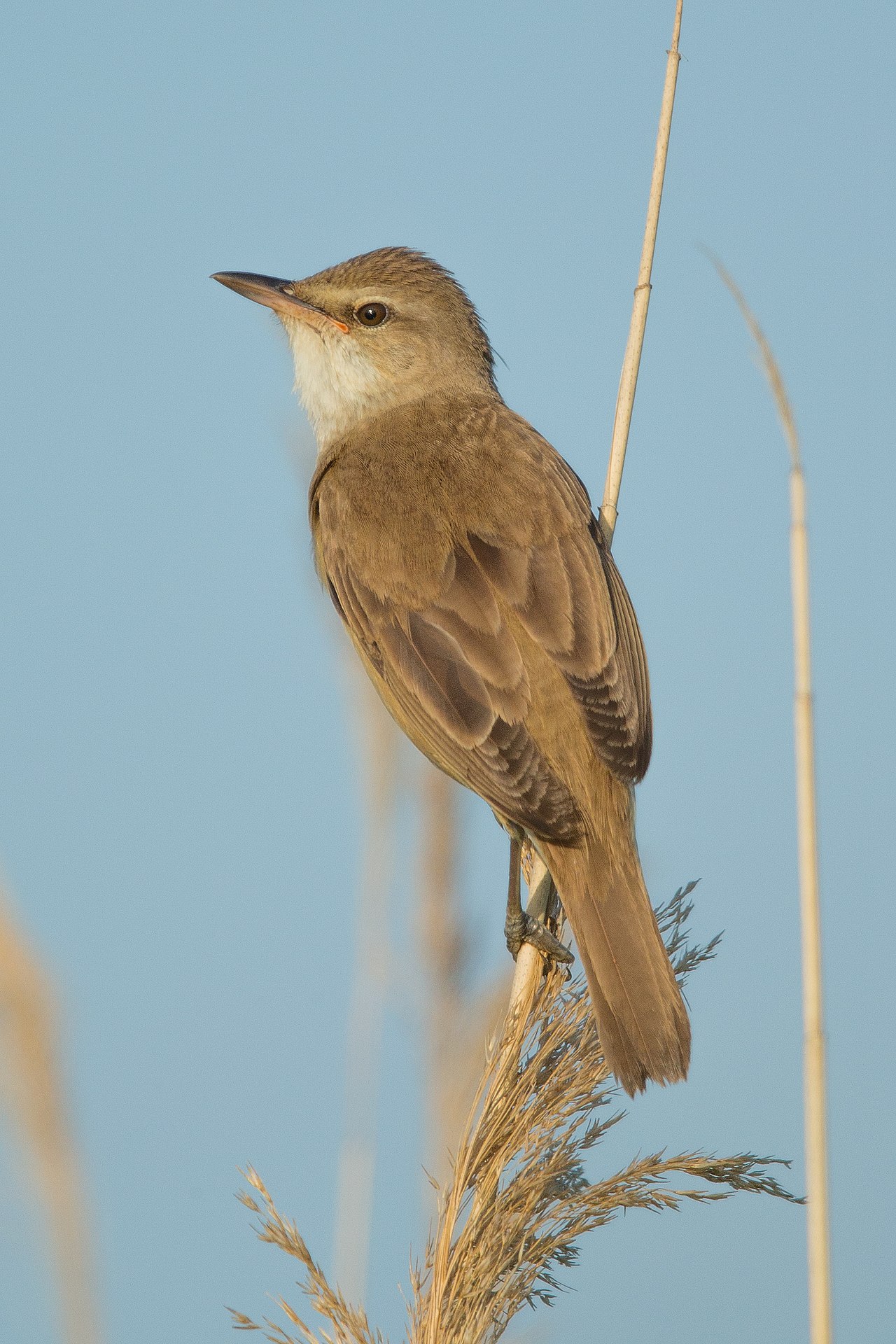
The great reed warbler is an insectivorous bird in the family Acrocephalidae. It is a medium-sized passerine bird and the largest of the European warblers. It breeds throughout mainland Europe and the Western Palearctic and migrates to sub-Saharan Africa in the winter. It favours reed beds during the breeding season, while living in reed beds, bush thickets, rice fields, and forest clearings during the winter. It exhibits relatively low sexual dimorphism, and the sexes are similar in appearance. This species mates both polygynously and monogamously.
Region
Europe and Western Palearctic; winters in sub-Saharan Africa
Typical Environment
Breeds widely across mainland Europe and into western and central Asia wherever large reedbeds occur, especially along lakes, slow rivers, marshes, and fishponds. Prefers tall stands of Phragmites with some open water and edges. In the nonbreeding season it occupies reedbeds, swampy thickets, papyrus and rice fields across sub-Saharan Africa. It avoids dense forests and very dry open country but uses riparian vegetation and wetland mosaics.
Altitude Range
Sea level to 2000 m
Climate Zone
Temperate
Ease of Keeping
Beginner friendly: 1/5
The great reed warbler is the largest European warbler and is famed for its loud, rasping song delivered from exposed reed stems. It breeds in extensive reedbeds and is a frequent host of brood parasitism by the common cuckoo. Males may hold large territories and can be polygynous, pairing with more than one female. Although globally not at risk, it declines locally where wetlands are drained or reedbeds are degraded.


Nest with clutch of eggs

Sonogram of a great reed warbler's song, recorded at Macta marsh (Algeria)

Nest containing a slightly larger common cuckoo egg and four warbler eggs (Apaj, Hungary)
Temperament
solitary and territorial
Flight Pattern
short rapid wingbeats, usually low over reeds
Social Behavior
During breeding, males establish and defend reedbed territories and sing conspicuously from tall stems. Nest is a deep, woven cup suspended between vertical reed stems, usually over water. The species can be polygynous, with some males mating with multiple females, and it is a frequent host for common cuckoo parasitism.
Migratory Pattern
Seasonal migrant
Song Description
Very loud, harsh, rhythmic song with rasping and chattering phrases delivered from exposed perches, often continuing into the night. Includes repetitive clacks, croaks, and grating notes, sometimes mixed with brief mimicry.
Plumage
Warm brown upperparts with slightly rufous wings and a paler buff underbody; throat whitish and underparts plain with minimal streaking. Feathers appear sleek and smooth, giving a clean, uniform look in good light.
Diet
Primarily hunts insects and other invertebrates such as beetles, dragonflies, flies, caterpillars, spiders, and aquatic larvae. Occasionally takes small amphibians, small fish, or snails, especially when feeding young. Feeds by gleaning from reed stems and leaves and by sallying short distances after flying insects.
Preferred Environment
Forages within dense reedbeds and along their edges, often just above the water surface. Also feeds in adjacent willow or tamarisk thickets, ditches, and rice fields during migration and winter.


