

The goldcrest is a very small passerine bird in the kinglet family. Its colourful golden crest feathers, as well as being called the "king of the birds" in European folklore, gives rise to its English and scientific names. The scientific name, R. regulus, means 'petty king' or prince. Several subspecies are recognised across the very large distribution range that includes much of the Palearctic and the islands of Macaronesia and Iceland. Birds from the north and east of its breeding range migrate to winter further south.
Region
Palearctic and Macaronesia
Typical Environment
Widely distributed across coniferous and mixed forests from Western Europe through Siberia, also occurring on islands such as the Canaries, Azores, and Madeira, and in Iceland. Prefers spruce, fir, and pine stands, but also uses parks, gardens, and shelterbelts with mature conifers. During winter it expands into a wider range of wooded habitats at lower elevations. It is absent from treeless deserts and the high Arctic.
Altitude Range
Sea level to 2300 m
Climate Zone
Temperate
Ease of Keeping
Beginner friendly: 1/5
Europe’s smallest bird, the goldcrest weighs only about 5–7 grams yet remains remarkably hardy. Its black-bordered golden crest gives the species its name and inspired folklore calling it the 'king of the birds.' It weaves a delicate, hammock-like nest suspended from conifer twigs using spider silk and moss. Northern birds often move south in winter, sometimes appearing in large influxes along coasts.


Subspecies R. r. himalayensis at Vinayak village in Uttarakhand, India

The nominate subspecies, R. r. regulus, in Belgium. The goldcrest has a bright crest and a relatively plain face. The orange tinge of the hindcrown indicates that this is a male.

Male in France displaying orange crest feathers that are set within a narrow rim of yellow feathers

Female R. r. regulus in England

R. r. japonensis in Japan

R. r. sikkimensis from Pangolakha Wildlife Sanctuary in Sikkim, India.

Probable male R. r. himalayensis has paler underparts than the European race.

The recently discovered subspecies R. r. ellenthalerae occurs in laurisilva forest on La Palma (above) and El Hierro in the Canary Islands.

The silver fir, a favoured nesting tree
![On foggy or overcast nights, goldcrests and other disorientated migrants can be attracted to lighthouses in large numbers.[5]](https://upload.wikimedia.org/wikipedia/commons/thumb/0/0c/John_o%27Groats_lighthouse_fog_1.jpeg/1280px-John_o%27Groats_lighthouse_fog_1.jpeg)
On foggy or overcast nights, goldcrests and other disorientated migrants can be attracted to lighthouses in large numbers.[5]

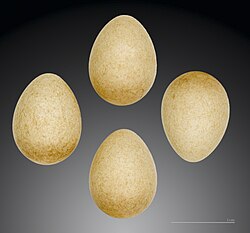


Springtails are a major dietary item
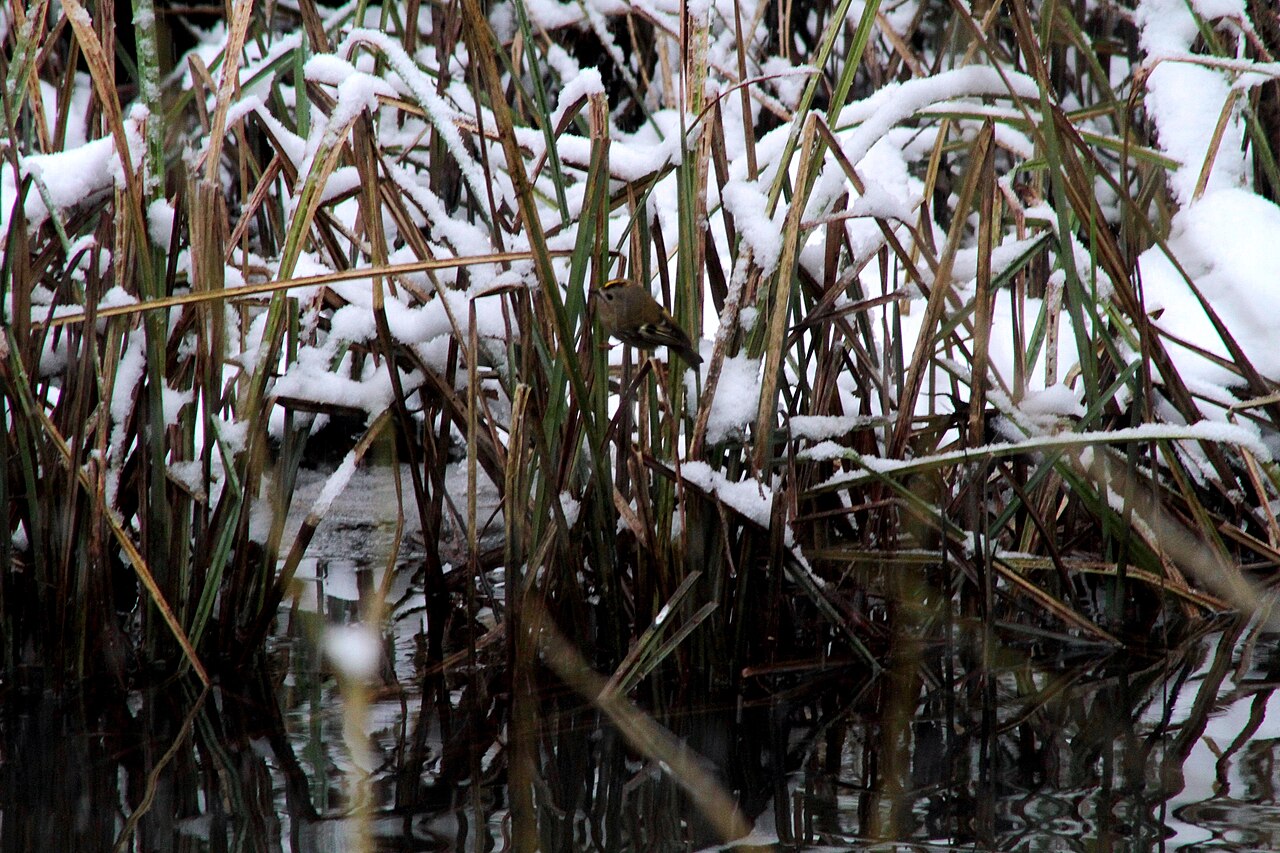
Goldcrest – Winter – Mote Park, Maidstone, Kent, UK

Fishing Boats Offshore by John Moore. Fishermen in Suffolk referred to the goldcrest as the "herring spink".
Temperament
highly active and restless
Flight Pattern
short rapid wingbeats with brief, fluttering sallies
Social Behavior
Breeds in conifer stands where it builds a deep, suspended nest and often raises two broods in good years. Typically monogamous within a season; the female incubates while the male helps feed. In autumn and winter it often joins mixed-species foraging flocks with tits and other small passerines, moving constantly through canopy layers.
Migratory Pattern
Partial migrant
Song Description
Very high-pitched, thin series of accelerating see-see-see notes culminating in a fast trill. Calls are similarly fine and seee-like, often given in rapid sequences while foraging.
Plumage
Olive-green upperparts with paler underparts, two bold white wingbars, and a neat, fine-feathered appearance. Crown shows a bright golden crest bordered by black; males often have an orange center within the crest. Face is plain with a fine dark eye-line and pale lores. Tail and wings are slightly darker with contrasting pale edges.
Diet
Primarily tiny arthropods such as spiders, springtails, aphids, and small caterpillars gleaned from conifer needles and twigs. It also hawks minute insects in short sallies. In harsh winters it may take small invertebrates from bark crevices and occasionally nibble soft plant matter or sap residues.
Preferred Environment
Feeds high in conifer canopies, especially spruce and fir, methodically searching needle clusters and branch tips. In parks and gardens it works ornamental conifers and mixed hedges. Often forages in mixed-species flocks to increase efficiency and predator vigilance.


