

The glossy black cockatoo, is the smallest member of the subfamily Calyptorhynchinae found in eastern Australia. Adult glossy black cockatoos may reach 50 cm (19.5 in) in length. They are sexually dimorphic. Males are blackish brown, except for their prominent sub-terminal red tail bands; the females are dark brownish with idiosyncratic yellow marking around the neck and prominent sub-terminal tail band of red with black bars. Three subspecies have been recognised, although this has been recently challenged, with a detailed morphological analysis by Saunders and Pickup 2023 finding there is cline in body dimensions over the latitudinal range of the species, with the birds from the north of the range smaller than the birds in the south. Saunders and Pickup argued that with no differentiation in bill morphology, little difference in genetic makeup, no differences in plumage pattern or colour, and no differences in diet, there is no justification in subdividing the species.
Region
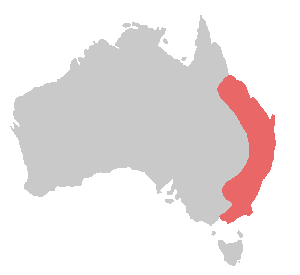
Eastern and southeastern Australia
Typical Environment
Occurs from southeast Queensland through New South Wales into eastern Victoria and southeast South Australia, with an isolated population on Kangaroo Island. Prefers open eucalypt woodlands, coastal heathlands, and forest edges where she-oaks (Allocasuarina) are abundant. Often feeds along ridgelines, coastal dunes, and creeklines with scattered she-oaks. Roosts in taller trees nearby and nests in large hollows of mature eucalypts within foraging distance of seed trees.
Altitude Range
Sea level to 1200 m
Climate Zone
Temperate
Ease of Keeping
Beginner friendly: 1/5
This specialist cockatoo feeds almost exclusively on the seeds of she-oaks (Allocasuarina), prying them from woody cones with a powerful bill and dexterous tongue. It nests in large hollows of mature eucalypts and has a low reproductive rate, usually raising a single chick. Several regional populations have declined due to habitat loss and fire, though focused recovery actions (notably on Kangaroo Island) have helped. Recent morphological work suggests little justification for splitting the species into multiple subspecies.



A pair of glossy black cockatoos

Glossy black cockatoos

Male, Kobble Creek, south-east Queensland
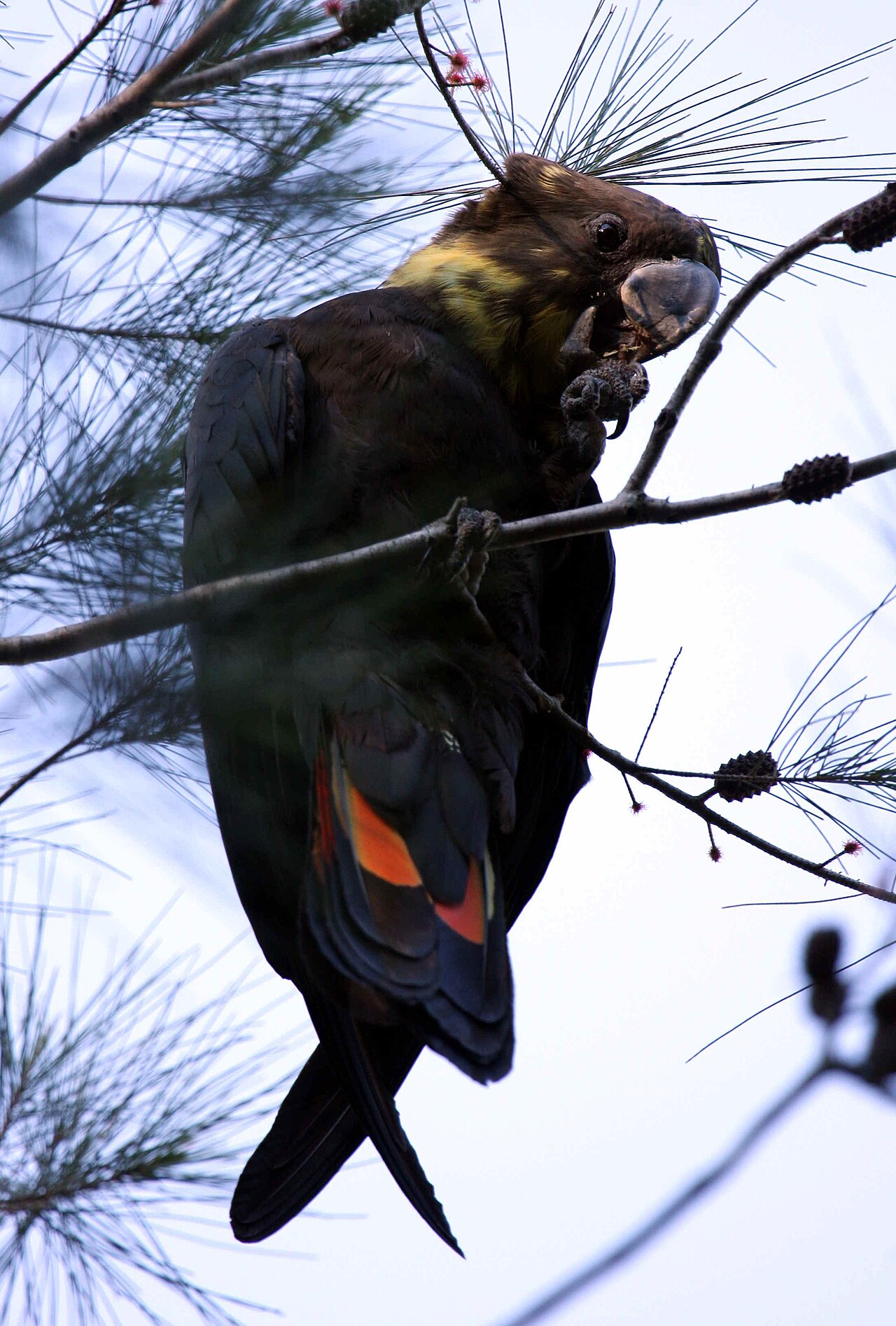
Female, Kobble Creek
Temperament
quiet, unobtrusive, and generally calm
Flight Pattern
strong flier with deep, deliberate wingbeats; slightly undulating
Social Behavior
Usually seen in pairs or small family groups; loosely gregarious at rich food sources and roosts. Monogamous pairs maintain long-term bonds. Nests are in large tree hollows, often high in mature eucalypts, and the clutch is typically a single egg with extended parental care.
Migratory Pattern
Resident
Song Description
Calls are soft, wheezy, and somewhat plaintive, including quiet ‘kreeek’ or ‘tarr’ notes. In flight they give mellow piping whistles; at feeding sites you may hear gentle contact calls and the crackling sound of cones being chewed.
Plumage
Overall dark, appearing blackish to chocolate-brown with a satin-gloss sheen; feathers can show subtle brown edging. Tail shows prominent colored panels with a subterminal band.
Diet
Feeds predominantly on the seeds of she-oaks (Allocasuarina), expertly shredding cones to reach the kernels. Mainland birds favor A. littoralis and A. torulosa, while Kangaroo Island birds rely heavily on A. verticillata. Occasionally takes seeds from other native trees and shrubs when she-oaks are scarce. Drinks at nearby water sources, especially during dry periods.
Preferred Environment
Forages in stands of she-oaks within open forest, woodland edges, and coastal heath. Often selects trees on ridgelines or along creeks where cone crops are reliable, and feeds while perched, dropping distinctive piles of shredded cone fragments beneath trees.


