

The Galápagos hawk is a large hawk endemic to most of the Galápagos Islands.
Region
Galápagos Archipelago
Typical Environment
Occurs on many of the Galápagos Islands, with strongest populations on less-inhabited islands and islets. It uses open habitats such as arid scrub, lava fields, coastal zones, and sparsely wooded highland edges where hunting visibility is high. Nest sites are placed on cliffs, lava outcrops, or in tall shrubs/trees with clear approaches. It is scarce or absent on heavily populated islands due to historical persecution and habitat disturbance.
Altitude Range
Sea level to 1500 m
Climate Zone
Tropical
Ease of Keeping
Beginner friendly: 1/5
The Galápagos hawk is the top terrestrial predator of the islands and is noted for its unusual cooperative polyandry: one female often mates with several males, all of whom help raise the young. It shows remarkable tameness and curiosity toward humans on uninhabited islands. Historically persecuted on settled islands, it is now protected, though its small, island-restricted population remains vulnerable.


Juvenile

Galapagos hawk in flight.

Hawk on Isabela Island, protecting its meal, a dead newborn sea lion pup

A possible breeding pair of adults on Santa Fe Island.
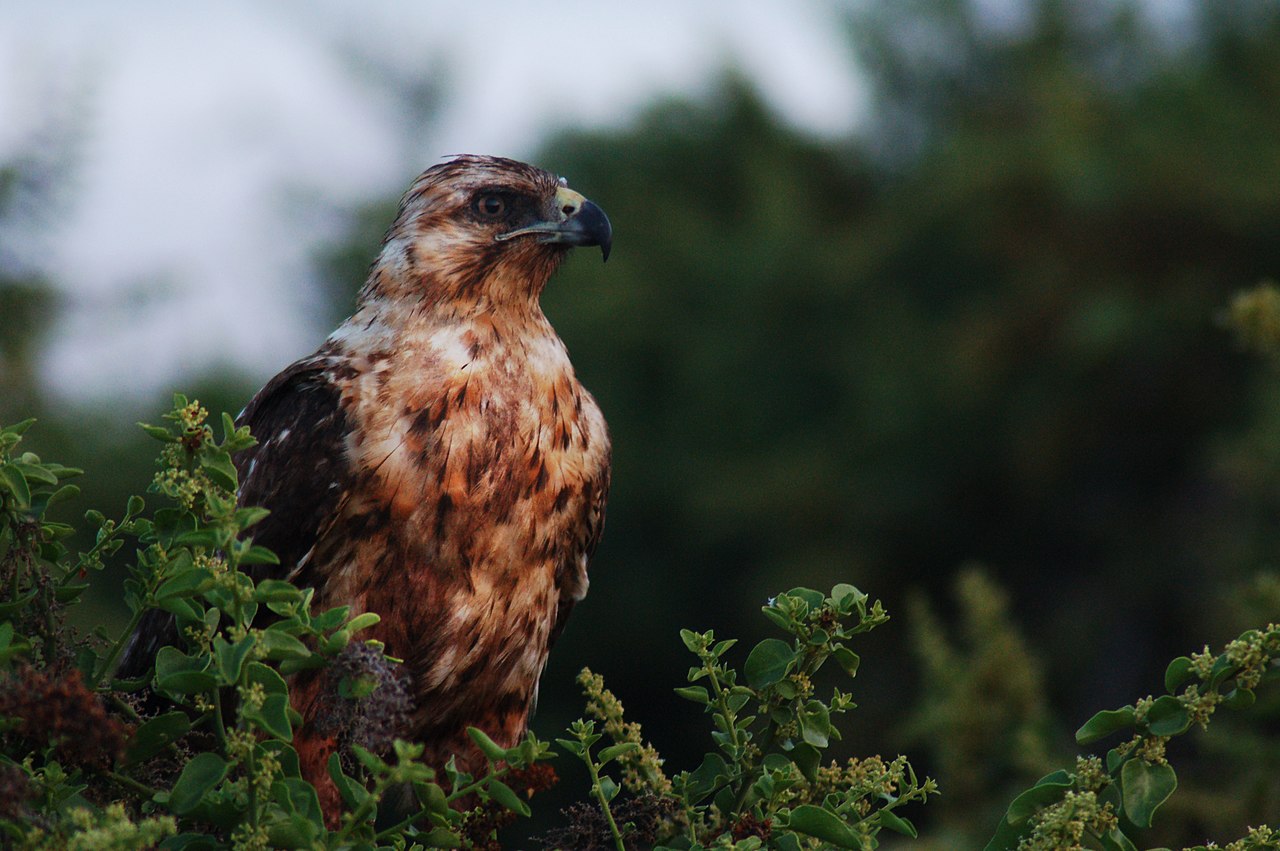
A young Galapagos hawk.
Temperament
bold and curious
Flight Pattern
soaring glider
Social Behavior
Territorial groups often consist of a single female attended by multiple males that share incubation and chick-rearing duties. Nests are reused and refurbished, and clutches are typically small. Pairs or groups defend territories vigorously against intruders.
Migratory Pattern
Resident
Song Description
Vocalizations include clear, high-pitched whistles and repeated, piercing keee or kreee calls, especially near nests. Alarm calls are harsher and more insistent when humans or other threats approach.
Plumage
Adults are largely uniform dark chocolate- to sooty-brown with slightly paler mottling on underwings and a faintly banded tail; juveniles are buffy to tawny with heavy streaking and mottling. Feathers appear dense and sleek, suited to soaring and maneuvering in open air.
Diet
An opportunistic predator and scavenger, taking lava lizards, small snakes, young marine and land iguanas, small birds and nestlings, and introduced rodents. It also consumes large insects, carrion, and occasionally sea lion afterbirth on beaches. Hunting is typically from exposed perches or while soaring, followed by rapid stoops.
Preferred Environment
Hunts in open arid zones, along rocky shores, and over lava fields where prey is visible. It frequently patrols nesting colonies of seabirds and iguanas and watches from prominent perches.


