

The Galápagos penguin is a penguin endemic to the Galápagos Islands of Ecuador. It is the only penguin found north of the equator. Most inhabit Fernandina Island and the west coast of Isabela Island. The cool waters of the Humboldt and Cromwell Currents allow it to survive despite the tropical latitude. The Galápagos penguin is one of the banded penguins, the other species of which live mostly on the coasts of Africa and mainland South America. Due to their warm environment, Galápagos penguins have developed techniques to stay cool. The feathers on their back, flippers, and head are black, and they have a white belly and a stripe looping from their eyes down to their neck and chin. Each penguin keeps only one mate, and breeds year-round. Because there are no soft areas to nest, their nests are typically in caves and crevices which also provide protection against predators and the harsh environment. The Galápagos penguin has a lifespan of 20 years, but due to predation, life expectancy in the wild could be significantly reduced. They have been critically impacted to the point of endangerment by climate change and pollution caused by plastic waste due to tourism and urbanization.
Region
Galápagos Archipelago
Typical Environment
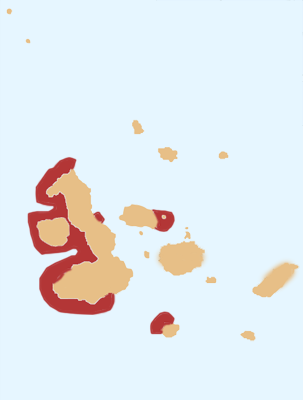
Most birds occur along the western shores of Isabela and on Fernandina, where nutrient-rich upwellings create productive feeding grounds close to shore. Smaller colonies occur on nearby islands in suitable rocky coastal habitat. They roost and nest in shaded lava tubes, crevices, and coastal caves just above the high-tide line. At sea they remain nearshore, generally within a few kilometers of the coast, using cool surface waters to forage.
Altitude Range
Sea level to 50 m
Climate Zone
Tropical
Ease of Keeping
Beginner friendly: 1/5
The Galápagos penguin is the only penguin species found north of the equator, surviving thanks to the cool upwelling of the Humboldt and Cromwell Currents. It nests in lava crevices and caves that offer shade from tropical sun and protection from predators. Pairs are typically monogamous and can breed year-round when food is abundant. Populations fluctuate strongly with El Niño events and are threatened by climate change and marine pollution.


A colony of Galápagos penguins together on a rock in the Galápagos Islands. One penguin can be seen molting.

Galápagos penguin swimming in water.

Juvenile before it has banding markings

Adult penguin on Isabela Island.
Temperament
social and active
Flight Pattern
flightless; agile underwater pursuit swimmer
Social Behavior
Forms small colonies on rocky coasts, with pairs often remaining together across multiple breeding attempts. Nests are in shaded crevices or lava caves to avoid overheating. Both parents incubate and feed the young. Breeding is opportunistic year-round, peaking when food availability is high.
Migratory Pattern
Resident
Song Description
Vocalizations include braying, honking, and growling calls reminiscent of other Spheniscus penguins. Calls are used for mate recognition, territorial defense at nest sites, and parent–chick communication.
Plumage
Banded penguin pattern with black head, back, and flippers contrasting with a white belly and a narrow black breast band.
Diet
Primarily small schooling fish such as anchovies and sardines, supplemented by small mullet and occasionally cephalopods and crustaceans. They hunt by pursuit-diving, often close to the surface or in the upper water column. Foraging success and breeding are tightly linked to cool, nutrient-rich upwelling conditions.
Preferred Environment
Feeds in nearshore waters along the west coasts of Isabela and Fernandina where upwellings concentrate prey. Often forages in groups, taking advantage of bait balls near rocky shorelines and channel edges.


