

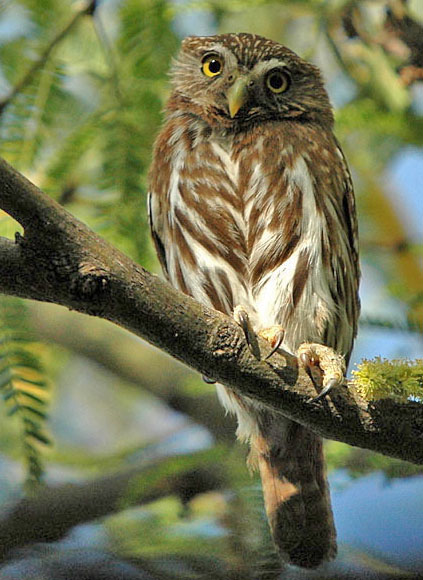
The ferruginous pygmy owl is a small owl that breeds in south-central Arizona and southern Texas in the United States, south through Mexico and Central America, to South America into Brazil, Bolivia, Paraguay and Argentina.
Region
Central and South America; southwestern United States
Typical Environment
Occurs from south-central Arizona and southern Texas through much of Mexico and Central America into South America, reaching Brazil, Bolivia, Paraguay, and northern Argentina. It favors open woodlands, thorn scrub, riparian corridors, savannas, and forest edges, and readily uses semi-urban parks and ranchlands where scattered trees and cavities are available. In the Sonoran Desert it uses desert riparian areas and saguaro stands. It generally avoids dense, unbroken rainforest interiors, preferring edge habitats with good visibility for perch-hunting.
Altitude Range
Sea level to 1500 m
Climate Zone
Tropical
Ease of Keeping
Beginner friendly: 1/5
Despite being an owl, it is often active by day and at dusk, which makes it more frequently seen than many other owls. It has bold dark 'eyespots' on the back of the neck that can deter attackers, and it is famously mobbed by small birds that recognize it as a predator. It nests in natural cavities or old woodpecker holes, including in cacti such as saguaro in the Sonoran Desert.



Temperament
solitary and territorial
Flight Pattern
short rapid wingbeats with low, direct flights from perch to perch
Social Behavior
Typically solitary outside the breeding season and defends small territories. Nests in tree cavities or old woodpecker holes; clutch size commonly 2–5 eggs. Both parents provision the young, and the species is frequently mobbed by small birds near nest and hunting perches.
Migratory Pattern
Resident
Song Description
A series of evenly spaced hollow whistles or toots, often given in pairs and repeated for long bouts, especially at dawn and dusk. Also emits sharp kip notes and softer contact calls between mates.
Plumage
Compact, rufous to brown owl with fine streaking below and barring on the tail; smooth crown and no ear tufts. Nape shows conspicuous dark eyespots bordered in white. Underparts whitish with brown streaks; upperparts ferruginous to brown with faint spotting.
Diet
An opportunistic predator taking large insects, small birds, lizards, and small mammals. Hunts from low to mid-level perches, scanning and then pouncing on prey on the ground or in vegetation. Will cache excess prey in cavities or dense foliage.
Preferred Environment
Forages along woodland edges, thorn scrub, riparian corridors, and semi-open desert with scattered trees or cacti. Often hunts near clearings, roadsides, and ranchlands where prey is exposed.


