

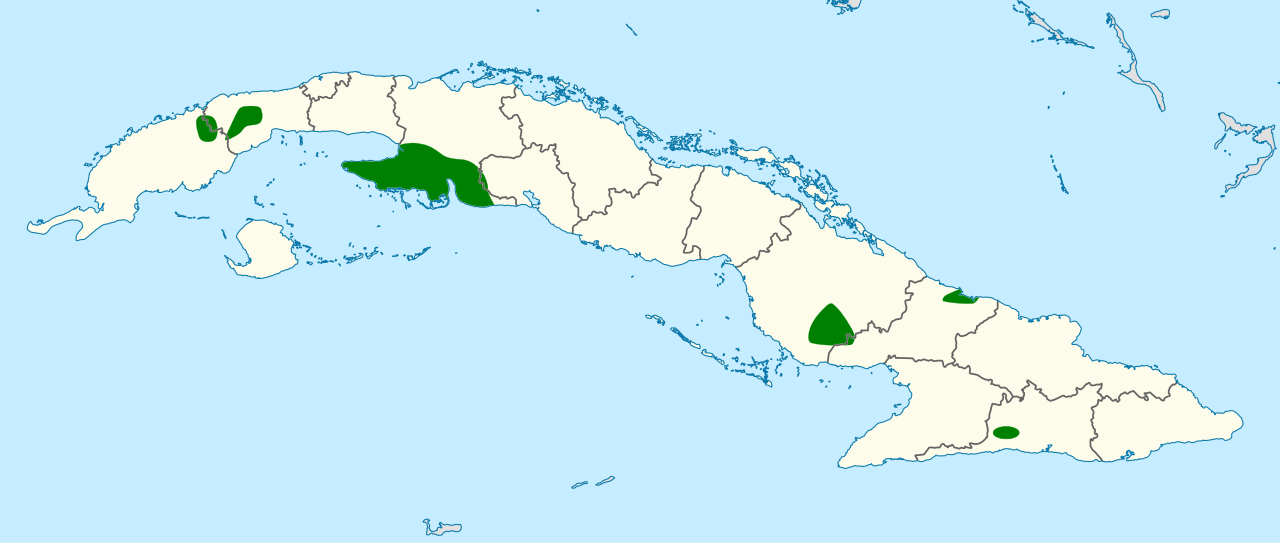
Fernandina's flicker is a species of bird and type of woodpecker, in the family Picidae. Endemic to Cuba, it has a small population of 600–800 birds, which makes it one of the most endangered species of woodpecker in the world. It is mostly threatened by habitat loss.
Region
Caribbean (Cuba)
Typical Environment
Occurs patchily in lowland Cuba, favoring open or lightly wooded palm savannas, pine savannas, and edges of wetlands. It uses seasonally flooded grasslands with scattered palms and hedgerows, and occasionally forages along forest margins and coastal scrub. Nesting typically occurs in cavities of dead royal palms, which are a critical resource. The species avoids dense closed-canopy forest and heavily urbanized areas.
Altitude Range
Sea level to 300 m
Climate Zone
Tropical
Ease of Keeping
Beginner friendly: 1/5
Fernandina's flicker is one of the rarest woodpeckers in the world, confined to a few lowland sites in Cuba. It often nests in cavities of dead or decaying royal palms, making it highly sensitive to the removal of these trees. Habitat loss, palm cutting, and fragmentation are its chief threats, and ongoing conservation focuses on protecting palm savannas and key breeding areas.

Temperament
wary and moderately territorial
Flight Pattern
undulating flight with short rapid wingbeats and bounding glides
Social Behavior
Usually seen singly or in pairs, especially during the breeding season, and occasionally in small family groups. It excavates or reuses cavities in dead palms; both sexes participate in nest defense and provisioning. Monogamous pairs raise a single brood, with clutch size typically small for a woodpecker.
Migratory Pattern
Resident
Song Description
Gives a series of sharp, ringing kik or klee notes and a rolling wicka-wicka rattle. Drumming is relatively soft but used for territory advertisement during the breeding season.
Plumage
Buff to pale brown overall with dense black barring above and spotted to barred underparts, and a distinct black crescent on the upper breast. The face is pale with a contrasting malar stripe; wings and tail show yellowish linings visible in flight. A white rump patch flashes when it takes off.
Diet
Primarily consumes ants, termites, beetle larvae, and other ground-dwelling insects. It also takes occasional fruits and berries, especially when insect prey is scarce. Foraging is done by probing soil, leaf litter, rotting wood, and palm trunks with its long sticky tongue.
Preferred Environment
Feeds in open savannas, along pasture edges, and among scattered palms where bare ground and ant colonies are accessible. It also works decaying stumps and fallen logs at the margins of wetlands and thickets.


