

The fairy pitta is a small and brightly colored species of passerine bird in the family Pittidae. Its diet mainly consists of earthworms, spiders, insects, slugs, and snails. The fairy pitta breeds in East Asia and migrates south to winter in Southeast Asia. Due to various habitat and anthropogenic disruptions, such as deforestation, wildfire, hunting, trapping, and cage-bird trade, the fairy pitta is rare and the population is declining in most places. Listed on the Convention on International Trade in Endangered Species of Wild Fauna and Flora (CITES) Appendix II, this bird is classified as vulnerable on the IUCN Red List of Threatened Species.
Region
East and Southeast Asia
Typical Environment
Breeds in subtropical broadleaf and mixed forests of eastern China, Korea, Taiwan, and Japan, favoring dense understory near moist ravines and streams. During the non-breeding season it winters farther south in lowland tropical forests of Southeast Asia. It uses secondary growth, bamboo thickets, and forest edges if sufficient leaf litter and cover are present. The species forages mainly on the ground, preferring damp soils where earthworms and snails are abundant.
Altitude Range
Sea level to 1200 m
Climate Zone
Subtropical
Ease of Keeping
Beginner friendly: 1/5
Often called the “eight-colored jewel,” the fairy pitta is famed for its vivid multi-hued plumage and secretive habits on the forest floor. It builds a domed nest of twigs on low branches or banks and is a long-distance nocturnal migrant between East and Southeast Asia. Habitat loss, trapping, and collisions have contributed to its decline, and it is listed as Vulnerable globally.

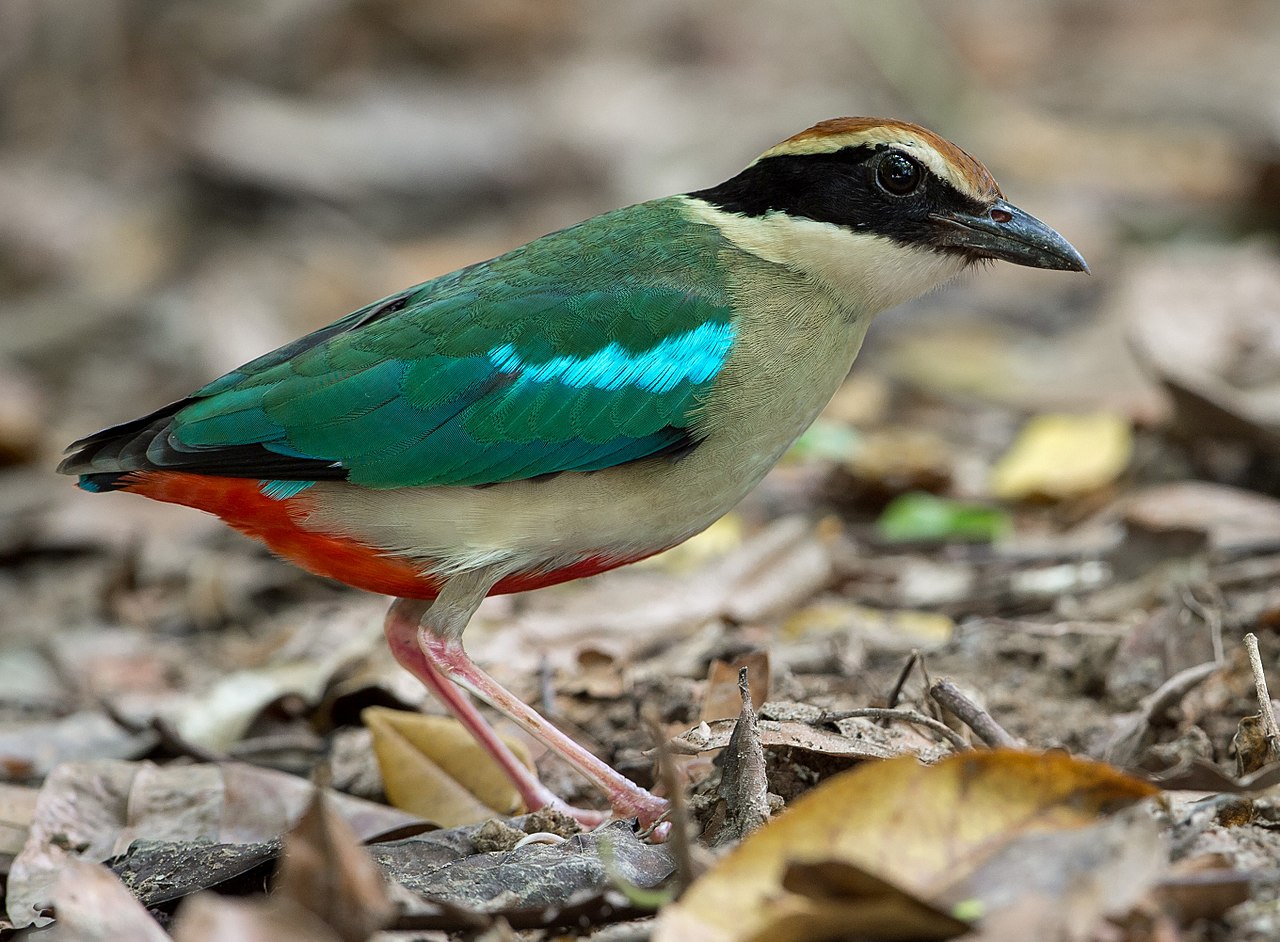
Fairy pitta in southern Thailand
Temperament
secretive and territorial
Flight Pattern
short, direct flights with rapid wingbeats, usually low through understory
Social Behavior
Typically solitary or in pairs during the breeding season, holding well-defined territories. Builds a domed nest of twigs and leaves placed low in trees, shrubs, or banks. Both parents participate in incubation and feeding of the chicks.
Migratory Pattern
Seasonal migrant
Song Description
A clear, resonant two-note whistle often rendered as 'wee-doo' or 'tu-whee', carrying far through dense forest. Calls include sharp chips and soft contact notes given from hidden perches.
Plumage
Compact, short-tailed pitta with glossy green upperparts, bright blue wing panel, buff underparts, and a vivid red lower belly and vent; head shows chestnut crown with a bold black eye-stripe and pale supercilium.
Diet
Primarily consumes earthworms, beetles, ants, spiders, slugs, and snails, taken from leaf litter and soft soil. It probes and flips leaves with its stout bill and may hammer snails to extract the soft body. During wet conditions it focuses on earthworms; in drier periods it shifts more to insects and other invertebrates.
Preferred Environment
Feeds on the shaded forest floor, especially in damp gullies, along stream edges, and in dense understory with abundant leaf litter. Will also forage at forest edges and in secondary growth if cover is adequate.


