

The Falkland steamer duck is a species of flightless duck found on the Falkland Islands in the South Atlantic Ocean. The steamer ducks get their name from their unconventional swimming behaviour in which they flap their wings and feet on the water in a motion reminiscent of an old paddle steamer. The Falkland steamer duck is one of only two bird species endemic to the Falkland Islands, the other being Cobb's wren.
Region
South Atlantic (Falkland Islands)
Typical Environment
Occurs around rocky coasts, kelp-fringed bays, and sheltered inlets throughout the Falkland archipelago. It favors areas with abundant intertidal mussel beds and tidal pools, rarely ranging far offshore. Nesting sites are typically in tussac grass or dense coastal vegetation close to water. Birds use nearshore shallows for foraging and loafing and avoid exposed open ocean.
Altitude Range
Sea level to 100 m
Climate Zone
Temperate
Ease of Keeping
Beginner friendly: 1/5
This hefty, flightless duck is one of only two birds endemic to the Falkland Islands. Its name comes from its distinctive ‘steaming’ across the water, using rapid paddling feet and wing-beats like a paddle steamer. Pairs are strongly territorial year-round and will aggressively defend shorelines from intruders. It nests near the coast in dense grass or tussac, often close to sheltered bays.


Falkland steamer duck pair at Whale Bone Cove, Falkland Islands.

Tachyeres brachypterus - MHNT
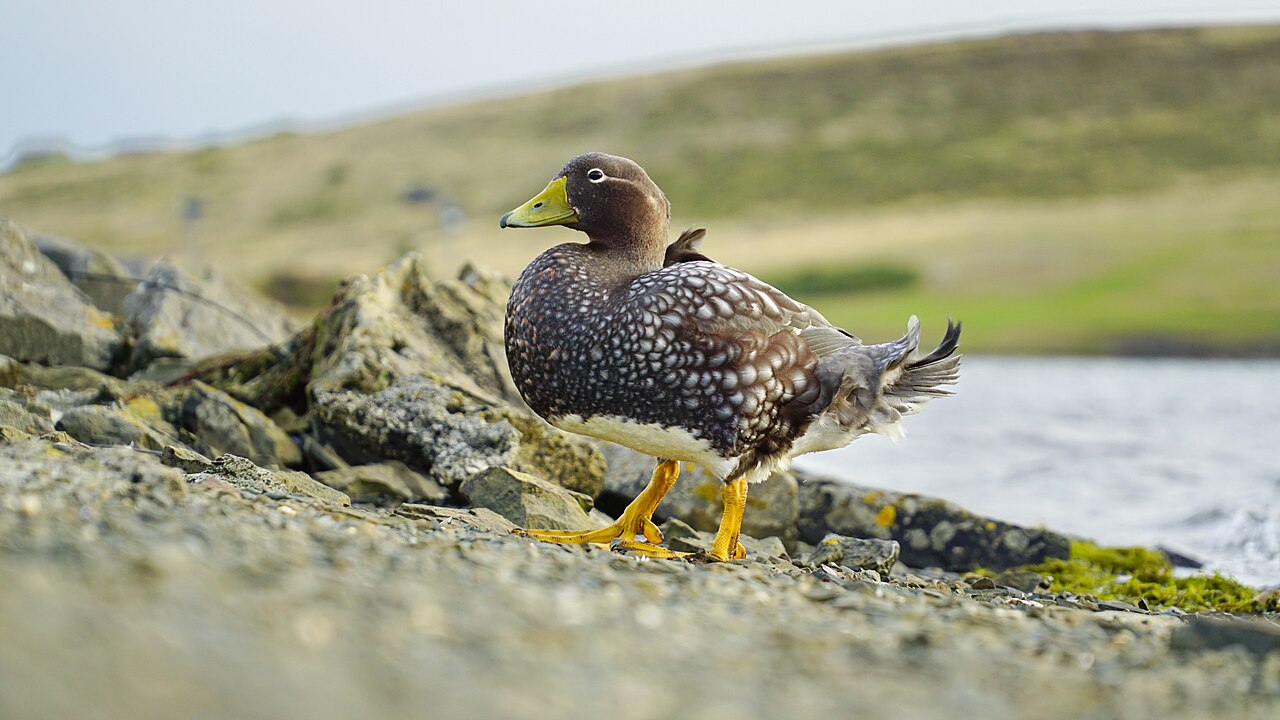
The Falkland steamer duck is primarily found on rugged coastlines.
Temperament
aggressive and territorial
Flight Pattern
flightless; propels itself with rapid paddling and wing-slapping across the surface
Social Behavior
Usually found in pairs or small family groups, maintaining territories year-round along stretches of shoreline. Nests are placed in dense coastal vegetation; the female incubates while the male guards nearby waters. Broods are escorted and vigorously defended against other ducks and predators.
Migratory Pattern
Resident
Song Description
Vocalizations include harsh grunts and rattling calls; males give loud, wheezy whistles during displays. Females produce deeper, gruff quacks, especially when alarmed or defending chicks.
Plumage
Bulky, grey to brown-grey body with fine vermiculations; head often slightly darker; underparts paler with subtle barring. Prominent white wing patch (secondaries) visible when wings are spread. Females tend to be browner and more mottled than males.
Diet
Primarily takes marine invertebrates such as mussels, limpets, crabs, and other crustaceans pried from rocks or picked in tidal pools. It forages by diving and up-ending in shallow coastal waters, often among kelp beds. Small fish and occasional plant material may be taken opportunistically.
Preferred Environment
Shallow rocky shorelines, kelp-fringed bays, and intertidal zones with rich mussel beds. Often feeds in protected coves and tidal pools where prey is abundant and wave action is moderate.


