

The European storm petrel, also known as British storm petrel, or just storm petrel, is a species of seabird in the northern storm petrel family, Hydrobatidae. The small, square-tailed bird is entirely black except for a broad, white rump and a white band on the under wings, and it has a fluttering, bat-like flight. The large majority of the population breeds on islands off the northern coasts of Europe, with the greatest numbers in the Faroe Islands, United Kingdom, Ireland, and Iceland. The Mediterranean population is a separate subspecies whose strongholds are Filfla Island (Malta), Sicily, and the Balearic Islands. This subspecies is indiscernible at sea from its Atlantic relatives.
Region
Northeast Atlantic and Mediterranean
Typical Environment
Breeds on offshore islets and cliffy islands from Iceland, the Faroe Islands, the United Kingdom, and Ireland south to Iberia, with a separate population on Mediterranean islets such as Filfla, Sicily, and the Balearics. Outside the breeding season it disperses widely over the eastern Atlantic, especially off northwest and west Africa. It forages mostly over open ocean and continental shelf edges, concentrating where upwellings and fronts increase productivity. Birds are rarely seen close to land except near colonies or driven inshore by storms.
Altitude Range
Sea level to 100 m
Climate Zone
Temperate
Ease of Keeping
Beginner friendly: 1/5
This tiny seabird nests in crevices and burrows on remote islands and visits colonies only at night to avoid predators. At sea it feeds by fluttering and pattering its feet on the surface, picking tiny prey items. It has a remarkable sense of smell to locate rich feeding areas. The Mediterranean population is often treated as a subspecies and looks essentially the same at sea.


Composite from The Crossley ID Guide
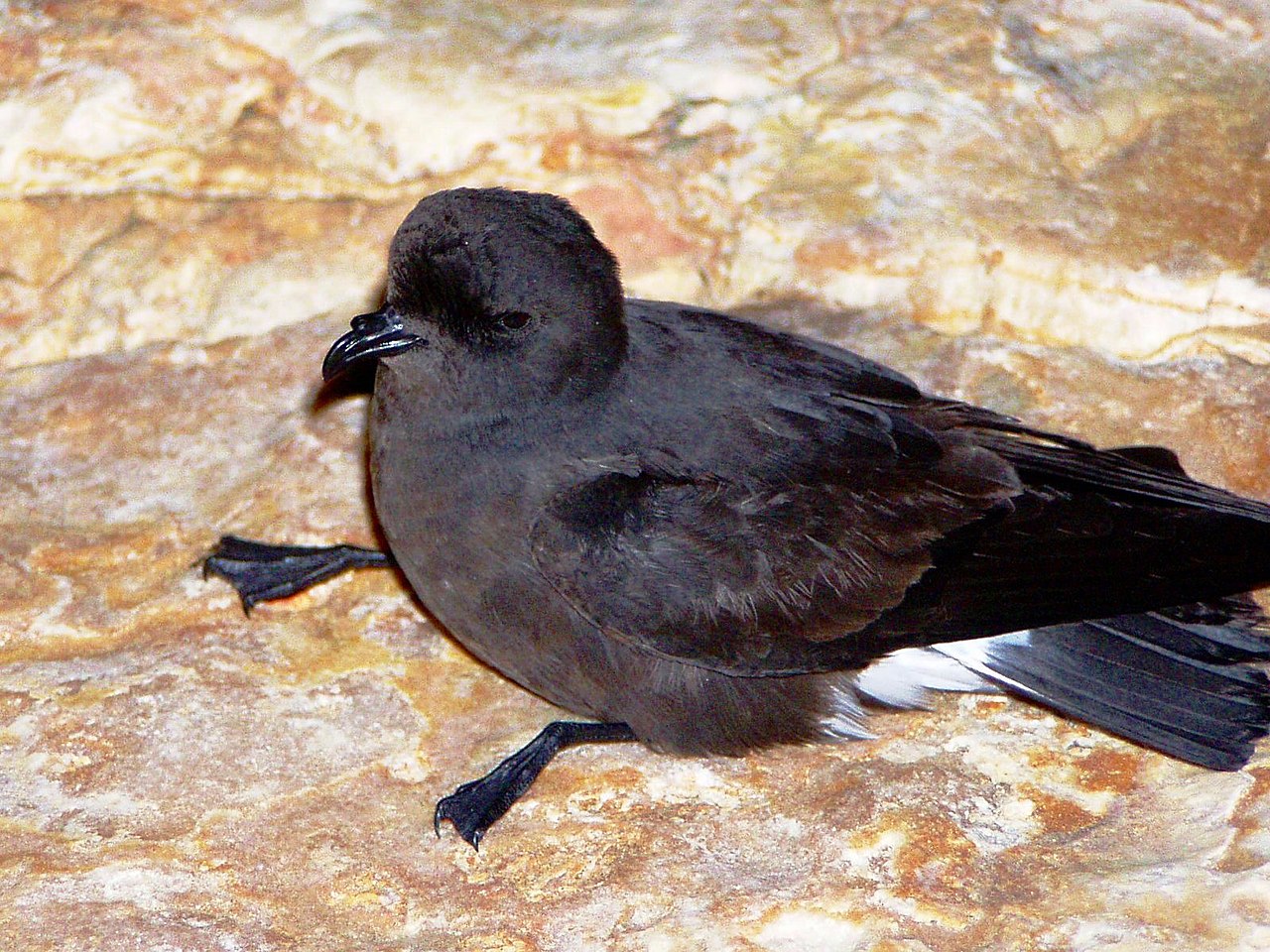
Storm petrels cannot walk on land; they shuffle on their tarsi.
![Old illustrations, such as this one by John Gould, were painted from skins, and showed petrels in improbable standing positions.[17]](https://upload.wikimedia.org/wikipedia/commons/4/4a/Oceanite.tempete.jogo.jpg)
Old illustrations, such as this one by John Gould, were painted from skins, and showed petrels in improbable standing positions.[17]

Ringing at Cape Wrath
![The by-the-wind sailor is a small jellyfish eaten by storm petrels.[46]](https://upload.wikimedia.org/wikipedia/commons/thumb/5/54/Velella_Bae_an_Anaon.jpg/960px-Velella_Bae_an_Anaon.jpg)
The by-the-wind sailor is a small jellyfish eaten by storm petrels.[46]

The Eleanora's falcon is a local predator on some Mediterranean islands.

"Mother Carey and her chickens". Lithograph by J. G. Keulemans, 1877.

Mother Carey. Illustration by Howard Pyle, 1902.
Temperament
solitary at sea, highly colonial at breeding sites
Flight Pattern
short rapid wingbeats with fluttering, bat-like flight low over waves
Social Behavior
Nests in dense colonies, using rock crevices or burrows; pairs are largely monogamous and share incubation and chick rearing. Adults visit colonies only at night, communicating with purring calls from within the nest. They lay a single egg per season and feed the chick by regurgitation.
Migratory Pattern
Seasonal migrant
Song Description
At colonies, emits a soft, purring or churring series of notes delivered from within the burrow, often at night. At sea it is mostly silent, with occasional thin chirps in close proximity to other birds.
Plumage
Mostly sooty-black with a conspicuous white rump; wings narrow and square-ended with a faint pale panel on the underwing coverts; tail square to slightly rounded.
Diet
Takes planktonic crustaceans such as copepods and amphipods, along with small fish and squid. Often seizes prey from the surface while pattering its feet. Uses olfaction to locate productive slicks and may follow fishing vessels for offal. Feeding is typically in scattered groups over frontal systems and upwellings.
Preferred Environment
Forages over open ocean and along continental shelf edges, tidal fronts, and areas of convergence. Nearshore appearances usually occur around colonies or during storms that push birds landward.


