

The dusky-billed parrotlet, also known as Sclater's parrotlet, is a small species of parrot in the family Psittacidae. It is the nominate species.
Region
Western Amazon Basin
Typical Environment
Occurs in lowland Amazonia of eastern Colombia, eastern Ecuador, northeastern Peru, northwestern Bolivia, and western Brazil. Prefers riparian woodlands, varzea floodplain forest, and river islands with young secondary growth. Often along forest edges, clearings, and in disturbed habitats near waterways. Readily adapts to mosaic landscapes of shrubs, palms, and scattered trees where seed resources are abundant.
Altitude Range
0–900 m
Climate Zone
Tropical
Ease of Keeping
Beginner friendly: 2/5
The dusky-billed parrotlet, also known as Sclater's parrotlet, is a tiny Amazonian parrot of the genus Forpus. It frequents river edges and floodplain forests, often forming small, noisy flocks. Males show subtle blue patches on the wings and rump, while females are more uniformly green. They sometimes visit clay licks to obtain minerals.


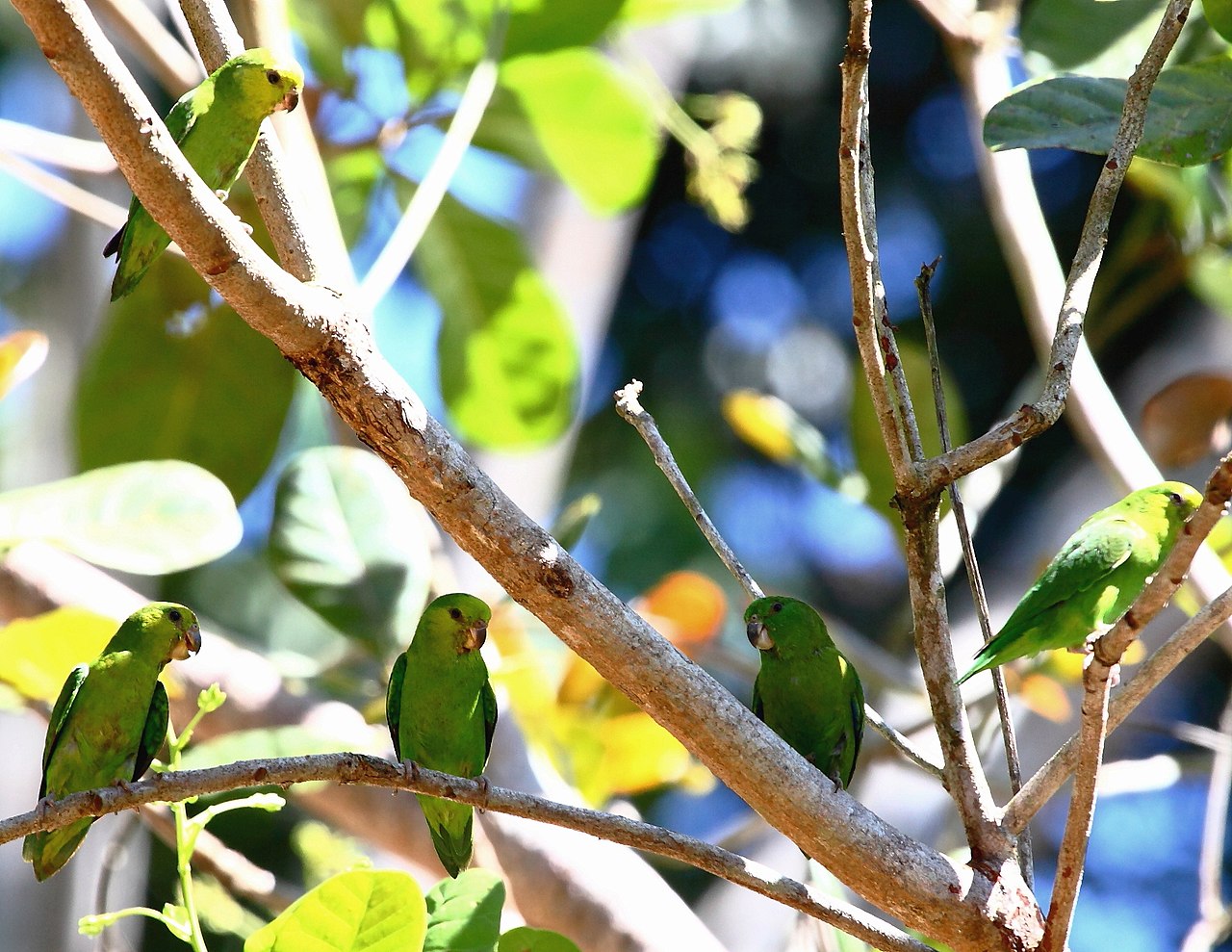
Dusky-billed parrotlets feeding in a group

Forpus modestus plate by Keulemans, 1891
Temperament
social and active
Flight Pattern
short rapid wingbeats
Social Behavior
Usually in pairs or small flocks, sometimes gathering in larger groups at feeding sites and communal roosts. Nests in natural tree cavities and sometimes in old termitaria or holes in dead wood. Pairs maintain close contact calls while foraging and show cooperative vigilance in flocks.
Migratory Pattern
Resident
Song Description
Calls are high-pitched twitters and sharp chit notes, delivered in rapid series. The overall vocalization is a constant chatter when in flight, with softer, buzzy notes while perched.
Plumage
Compact, mostly green plumage with a dusky horn-colored bill. Males show limited blue on the primaries and rump; females are greener and lack strong blue tones. Feathers appear smooth and tight, giving a neat, glossy look.
Diet
Feeds mainly on small seeds from grasses and herbaceous plants, along with buds, flowers, and soft fruits such as Cecropia. Will take seeds from shrubs and river-island pioneer vegetation. Occasionally visits clay licks to ingest minerals and neutralize plant compounds.
Preferred Environment
Forages along river margins, in floodplain forest edges, secondary growth, and on river islands. Often feeds in the canopy and upper shrub layer but will descend to seed-rich clearings.


