
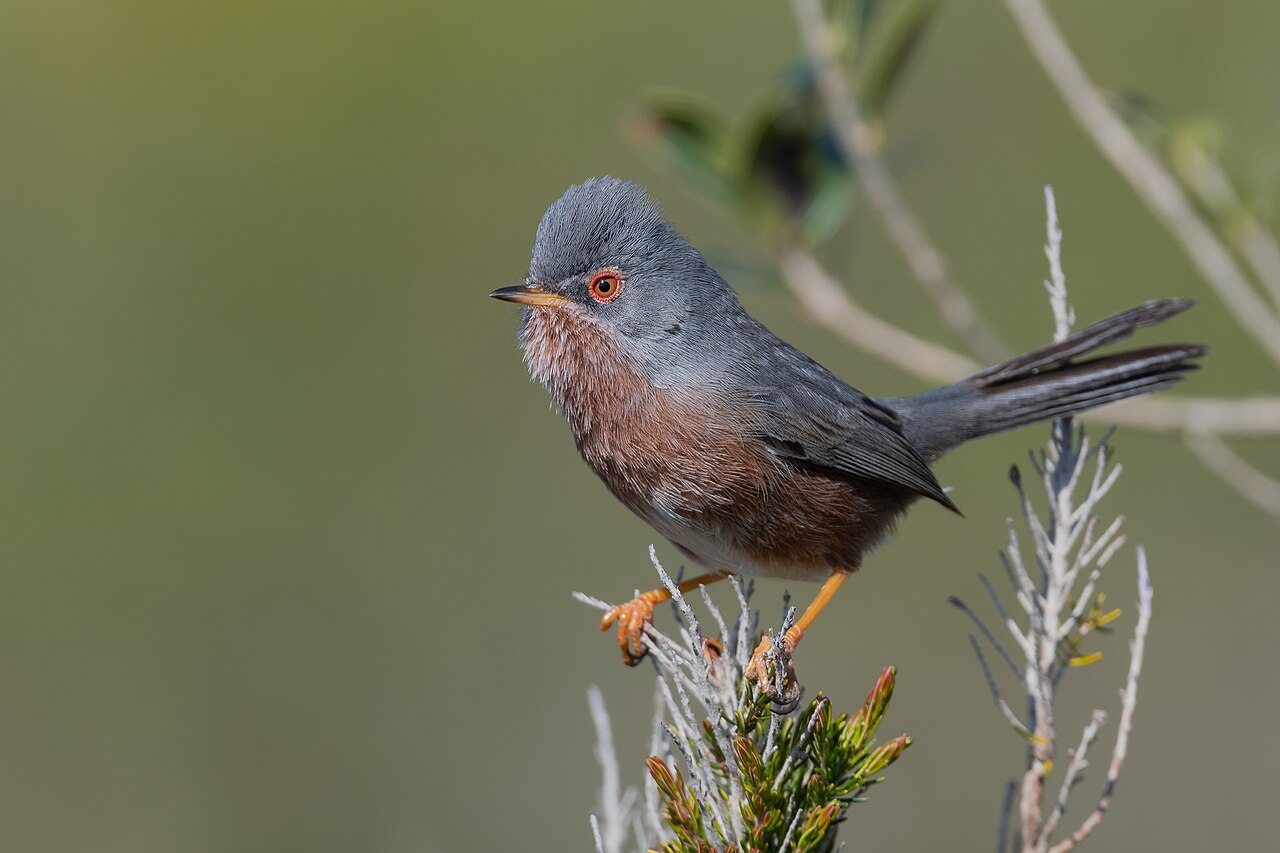
The Dartford warbler is a Sylviid warbler from the warmer parts of western Europe and northwestern Africa. It is a small warbler with a long thin tail and a thin pointed bill. The adult male has grey-brown upperparts and is dull reddish-brown below except for the centre of the belly which has a dirty white patch. It has light speckles on the throat and a red eye-ring. The sexes are similar but the adult female is usually less grey above and paler below.
Region
Western Europe and Northwest Africa
Typical Environment
Occurs locally across the Iberian Peninsula, southern and western France (including Corsica), and patchily in southern England, with populations in coastal and upland Mediterranean scrub. Also found in northwest Africa from Morocco to northern Algeria and Tunisia. Prefers low, dense heathland and Mediterranean maquis dominated by gorse, broom, and heather. In Britain it is strongly associated with extensive lowland heaths, while in the south it frequents dry, shrubby slopes and coastal scrub.
Altitude Range
Sea level to 1800 m
Climate Zone
Temperate
Ease of Keeping
Beginner friendly: 1/5
Named after Dartford Heath in Kent, this skulking warbler is tightly tied to dense heathland with gorse and heather. Populations can crash after severe winters, especially at the northern edge of the range, then recover during milder periods. Conservation depends on maintaining extensive, unfragmented heath and controlling wildfires and scrub succession.


Eggs

Male at Thursley

Plate from photographs by Smith Whiting, of an adult bird and a nest in the New Forest, England, from the book The Birds Of Hampshire (1905) by J. E. Kelsall & Philip W. Munn. The authors stated this to be the first photograph of a Dartford warbler in the wild.
Temperament
skulking but active
Flight Pattern
short rapid wingbeats, low fluttering flights between shrubs
Social Behavior
Typically seen as pairs holding year-round territories in dense scrub. Nests are low in gorse or heather; clutches and timing vary with weather, and pairs may attempt multiple broods in good years. Displays include tail-flicking and brief song-flights from prominent shrubs.
Migratory Pattern
Resident
Song Description
A fast, scratchy warble with churring scolds, delivered from within cover or during a short song-flight. Calls include sharp tacks and rattling scolds when alarmed.
Plumage
Adult males show slate-grey to grey-brown upperparts with dull reddish-brown underparts and a lightly speckled whitish throat; tail is long and often cocked. Females are similar but browner above and paler below, with less contrast. Both sexes have fine, silky body feathers suited to moving through dense scrub.
Diet
Feeds mainly on small insects and other arthropods, including beetles, caterpillars, spiders, and flies gleaned from foliage. In winter it supplements its diet with small berries such as gorse and heather fruits. Foraging is mostly low and hidden in dense shrubs, where it picks prey from twigs and leaves.
Preferred Environment
Dense, thorny or resinous shrubs like gorse, heather, and Mediterranean maquis provide foraging substrates and cover. Often works along the interior and edges of scrub patches and heath mosaics.


