

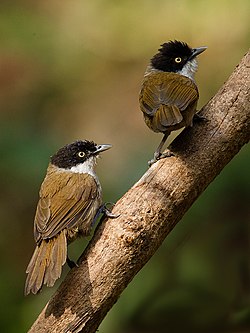
The dark-fronted babbler is an Old World babbler found in the Western Ghats of India and the forests of Sri Lanka. They are small chestnut brown birds with a dark black cap, a whitish underside and pale yellow iris. They forage in flocks in the undergrowth of forests constantly making calls and uttering alarm calls when disturbed.
Region
South Asia
Typical Environment
Occurs in the Western Ghats of peninsular India and across forested regions of Sri Lanka. Prefers dense undergrowth in moist evergreen and semi-evergreen forests, as well as secondary growth, bamboo thickets, and shaded ravines. It also uses scrub and forest edges near streams where cover is thick. The species keeps low, typically within a few meters of the ground, moving through tangles and leaf litter.
Altitude Range
Sea level to 1800 m
Climate Zone
Tropical
Ease of Keeping
Beginner friendly: 1/5
This skulking babbler is easiest to detect by its constant chattering calls from dense undergrowth. The striking pale yellow iris and dark cap stand out in the gloom, making identification straightforward at close range. It forages in small parties, often joining mixed-species flocks, and gives loud alarm calls when disturbed.



Temperament
social and skulking
Flight Pattern
short rapid wingbeats with low, direct dashes between thickets
Social Behavior
Usually found in small groups that maintain contact with frequent calls and often accompany mixed-species undergrowth flocks. Nests are typically domed or ball-shaped structures placed low in dense vegetation, with both parents participating in care. Territorial displays involve persistent chattering and short chases through cover.
Migratory Pattern
Resident
Song Description
A series of sharp chacks, chatters, and scolding trills delivered repeatedly from cover. Pairs and group members often engage in antiphonal calling, creating a continuous, busy-sounding chorus.
Plumage
Warm chestnut-brown upperparts with paler, whitish to buff underparts; the forehead and crown are dark, forming a distinct 'dark front.' Feathers appear smooth and sleek, aiding its furtive movement through brush.
Diet
Feeds mainly on insects and other small arthropods such as beetles, caterpillars, ants, and spiders. It occasionally takes small berries or seeds when available. Prey is gleaned from leaves, twigs, and the forest floor, with brief sallies to snatch disturbed insects.
Preferred Environment
Forages in dense understory, bamboo clumps, vine tangles, and at forest edges with thick shrub layers. Often works close to the ground or within the lower two meters of vegetation, exploiting shaded, humid microhabitats.


