
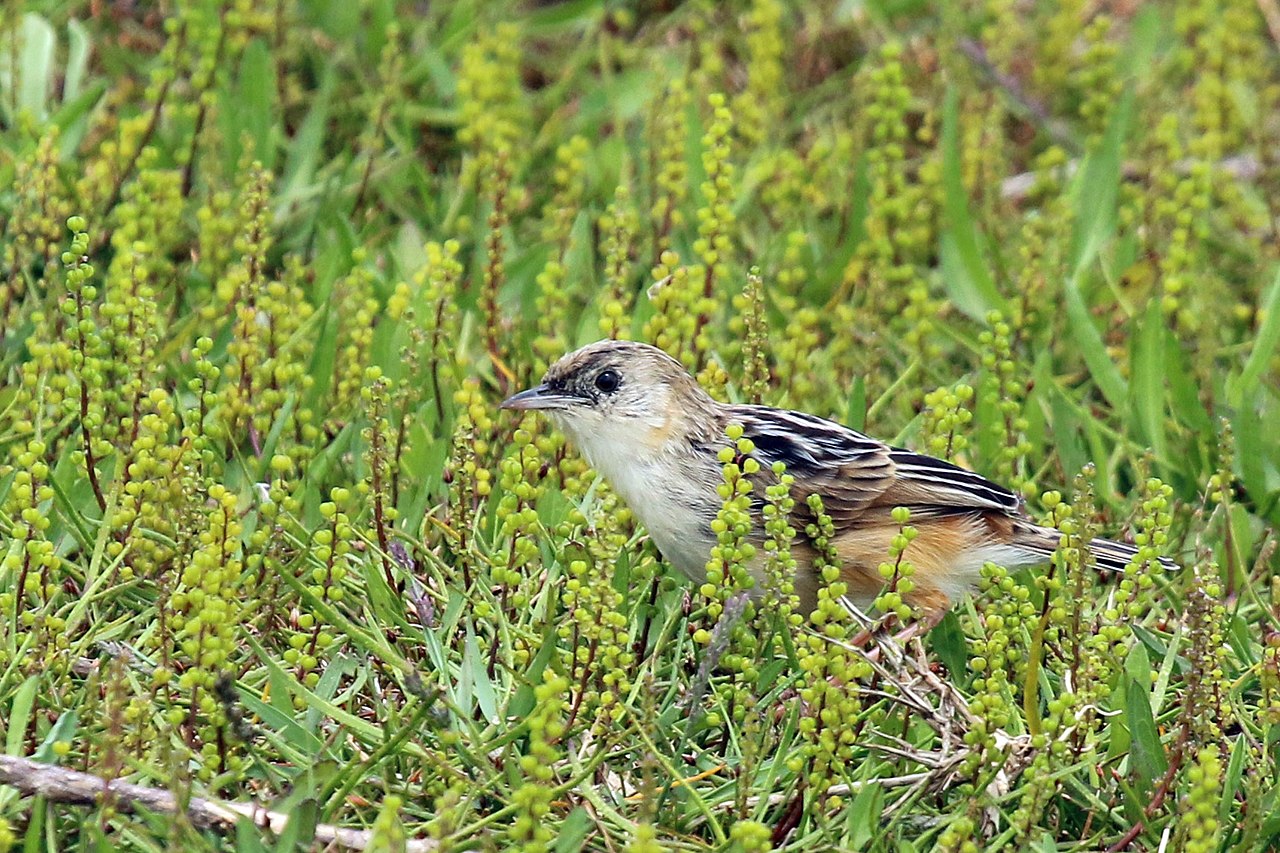
The croaking cisticola is an Old World warbler in the family Cisticolidae. It is a resident breeder in Africa south of the Sahara. The croaking cisticola is an insectivorous passerine that is found in rank grassland habitats, often near swamps or water. Male cisticolas are polygamous; the female builds a discreet nest deep in the grasses, often binding living leaves into the soft fabric of felted plant-down, cobwebs, and grass. The croaking cisticola's nest is a ball shape with a side entrance; 2-4 eggs are laid.
Region
Sub-Saharan Africa
Typical Environment
Occurs widely across Africa south of the Sahara wherever tall, rank grass persists, including floodplains, marsh and swamp margins, moist savannas, and fallow or overgrown agricultural fields. It favors areas with dense, waist-high to shoulder-high grasses that provide cover and nesting material. Often found near water but also occupies seasonally wet grasslands and dambo edges. Avoids dense forest and true desert.
Altitude Range
Sea level to 2000 m
Climate Zone
Tropical
Ease of Keeping
Beginner friendly: 1/5
Named for the former Natal region of South Africa, the croaking cisticola is famous for its harsh, frog-like song that carries over tall grass. Males are polygamous and perform display flights, while females weave a discreet, ball-shaped nest deep in rank grasses, binding live leaves with plant down and spider silk. It often reveals itself by voice rather than sight, popping up briefly atop grass stems to sing.

Temperament
secretive but active
Flight Pattern
short rapid wingbeats with low, bouncing flights
Social Behavior
Usually solitary or in loose pairs within the breeding season; males are polygamous and hold small singing territories. The female builds a ball-shaped nest with a side entrance, hidden deep in tall grass. Clutches typically contain 2–4 eggs; both adults are unobtrusive around the nest.
Migratory Pattern
Resident
Song Description
A distinctive, harsh, frog-like croak delivered from a grass stem or during a brief display flight, often given in repeated series. Calls include dry ticks and churrs used for contact and alarm.
Plumage
Coarsely streaked brown upperparts with rufous tones on the wings and mantle; underparts buffy to off-white with a pale throat. Short, graduated tail shows dark barring and pale tips. Overall appearance is compact with a slightly heavy-looking head for a small cisticola.
Diet
Feeds primarily on small insects such as grasshoppers, beetles, bugs, ants, and caterpillars, as well as spiders. Prey is gleaned from grass stems, picked from leaves, or snatched during short sallies. Occasionally takes small seeds incidentally while foraging among seed heads.
Preferred Environment
Forages within dense, tall grasses, especially along the edges of wetlands, floodplains, and damp pastures. Also uses roadside verges, rice fields, and overgrown fields where cover is abundant.


