
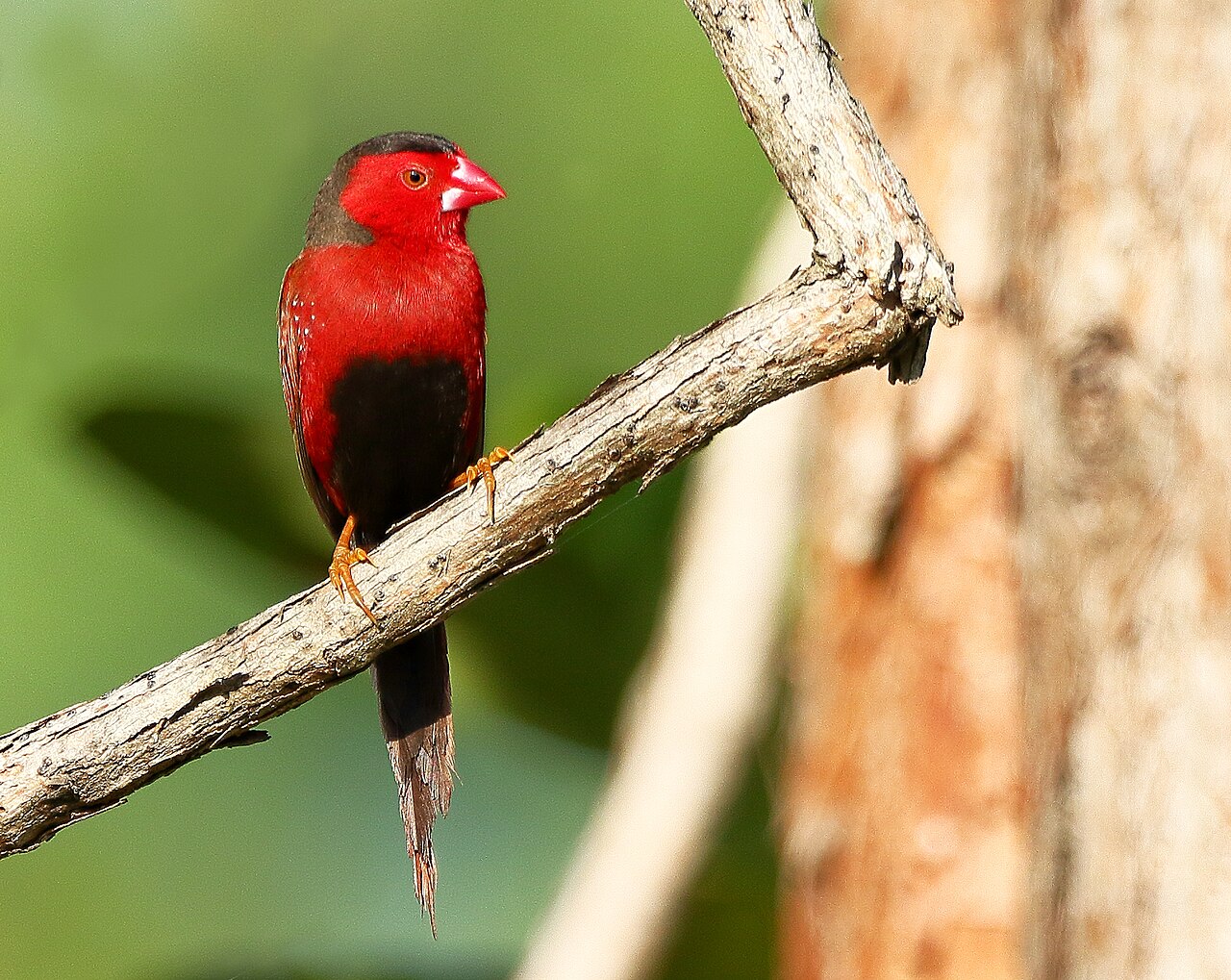
The crimson finch is a species of bird in the family Estrildidae. It is found throughout Northern Australia as well as parts of southern New Guinea. Crimson finches feature a distinctively bright crimson coat and are known for their aggression.
Region
Northern Australia and southern New Guinea
Typical Environment
Crimson finches inhabit tropical riparian zones, floodplains, and savanna edges with dense, tall grasses and reeds. They are strongly associated with permanent or seasonal watercourses, pandanus stands, canegrass, and paperbark fringes. Outside the breeding season they gather in small flocks and move locally following seeding grasses. They tolerate disturbed sites and pastoral areas if rank grass and water remain nearby.
Altitude Range
0–600 m
Climate Zone
Tropical
Ease of Keeping
Beginner friendly: 2/5
The crimson finch is a striking estrildid noted for its bright red plumage and relatively long, pointed tail. It is often bold and surprisingly aggressive for its size, especially around feeding sites and nesting territories. Pairs nest in dense grasses near water, building globular nests with side entrances. Subspecies differ, with some males showing a dark (blackish) belly while others have a pale belly.


Temperament
assertive and often aggressive
Flight Pattern
short rapid wingbeats with bounding undulations
Social Behavior
Usually seen in pairs or small groups, with larger aggregations outside the breeding season. Strong pair bonds form during breeding, and nests are built low in dense grasses or reeds near water. They roost communally and defend favored feeding patches vigorously.
Migratory Pattern
Resident
Song Description
Song is a series of thin, tinkling notes and twitters delivered from exposed perches. Calls include sharp chips and metallic tinks used for contact and alarm.
Plumage
Males are predominantly bright crimson with contrasting darker areas on the face and underparts depending on subspecies; females are duller brownish with crimson highlights on the rump and face. Feathers are sleek and smooth, giving a glossy appearance in good light. The tail is relatively long and pointed.
Diet
Primarily takes grass seeds from native and introduced grasses, often stripping seedheads. During the breeding season they supplement with small insects and other invertebrates for added protein. They also pick fallen seeds from the ground and occasionally take fresh shoots.
Preferred Environment
Feeds along river margins, floodplain grasslands, and reedbeds where seeding grasses are abundant. Often forages low in dense cover or on the ground near water, moving to open perches to husk seeds.


