

The crested caracara is a bird of prey (raptor) in the falcon family, Falconidae. It was formerly placed in the genus Polyborus before being given in its own genus, Caracara. It is native to and found in the southern and southeastern United States, Mexico and the majority of mainland Latin America, as well as some Caribbean islands. The crested caracara is quite adaptable and hardy, for a species found predominantly in the neotropics; it can be found in a range of environments and ecosystems, including semi-arid and desert climates, maritime or coastal areas, subtropical and tropical forests, temperate regions, plains, swamps, and even in urban areas. Documented, albeit rare, sightings have occurred as far north as Minnesota and the Canadian provinces of Alberta, Ontario, and Prince Edward Island. The southern extent of the crested caracara's distribution can reach as far as Tierra del Fuego and Magallanes Region, Chile.
Region
Neotropics and southern North America
Typical Environment
Occurs from the southern United States through Mexico and Central America across much of South America to Patagonia and Tierra del Fuego, with populations on some Caribbean islands. Favors open and semi-open habitats such as savannas, pastures, scrub, deserts, marsh edges, and coastal flats, including ranchlands and roadsides. Common around human-modified landscapes and will forage at carcasses, dumps, and fishing sites. In the south it occupies pampas and Chaco mosaics, and it also ranges into Andean foothills.
Altitude Range
Sea level to 3500 m
Climate Zone
Subtropical
Ease of Keeping
Beginner friendly: 1/5
Unlike most falcons, crested caracaras often walk and run on the ground to forage, and they readily scavenge alongside vultures. Their bare facial skin can flush from yellow to orange-red during excitement. They are bold, adaptable birds frequently seen on fence posts and along roadsides, and they sometimes pirate food from other birds. Bill-clattering and dramatic head-throwing displays are characteristic during social interactions.


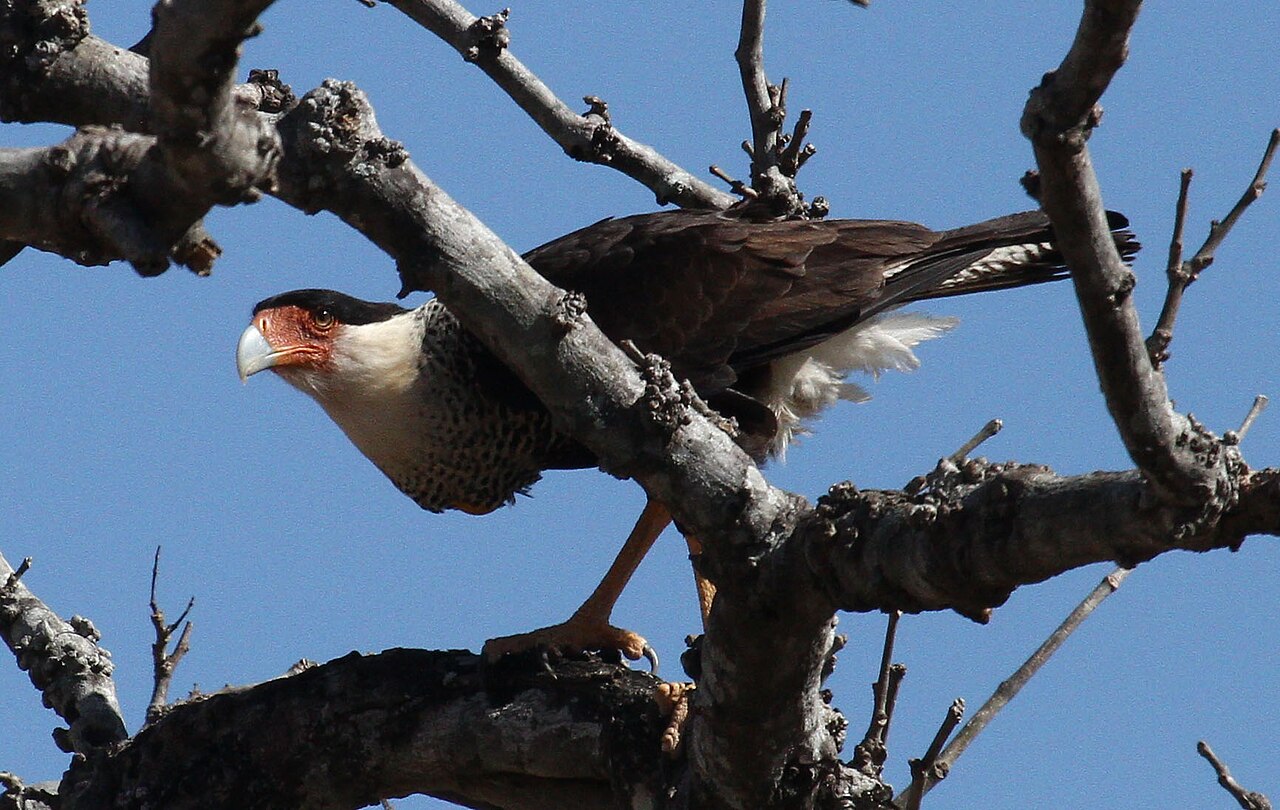
Palo Verde Nat'l. Park, Costa Rica.


Temperament
bold and opportunistic
Flight Pattern
soaring glider with steady, shallow wingbeats
Social Behavior
Often seen in pairs or small family groups and may gather at carcasses with vultures. Builds a bulky stick nest in trees, palms, or cacti; 2–3 eggs are typical, with both sexes incubating and feeding young. Forms communal roosts outside the breeding season and defends territories near nest sites.
Migratory Pattern
Partial migrant
Song Description
Vocalizations are harsh, rattling cackles and croaks, often delivered with head thrown back and accompanied by rapid bill-clattering. Calls are loud and carry over open country but are not melodious. Soft conversational grunts may be heard at close range.
Plumage
Dark brown to blackish body with pale buff to whitish neck and rump, strongly barred breast, and a bold white tail with a broad black terminal band. A shaggy crest forms a dark cap, contrasting with bare orange-red facial skin and a pale bluish bill. Underwings show striking light and dark contrast in flight.
Diet
An opportunistic feeder that takes carrion, roadkill, fish scraps, small mammals, reptiles, amphibians, nestlings, and eggs. Frequently hunts large insects and other invertebrates, flipping dung and debris with the bill or feet. Will pirate food from other birds and occasionally consumes fruits. Forages both on foot and by low aerial sorties to pounce on prey.
Preferred Environment
Usually feeds in open pastures, fields, coastal flats, and marsh edges, as well as along roads and near ranches. Readily exploits human-altered areas, landfills, and fishing docks where scraps and carcasses are available.


