

Cooper's hawk is a medium-sized hawk native to the North American continent and found from southern Canada to Mexico. This species was formerly placed in the genus Accipiter. As in many birds of prey, the male is smaller than the female. The birds found east of the Mississippi River tend to be larger on average than the birds found to the west. It is easily confused with the smaller but similar sharp-shinned hawk.
Region
North America
Typical Environment
Breeds across most of the United States and southern Canada and winters throughout much of the U.S. and into northern Mexico. Prefers mixed and deciduous forests, wooded riparian corridors, and forest edges. Increasingly common in urban and suburban neighborhoods with mature trees. Uses dense cover for hunting and nesting and often patrols along edges where prey activity is concentrated.
Altitude Range
Sea level to 3000 m
Climate Zone
Temperate
Ease of Keeping
Beginner friendly: 1/5
Cooper's hawk is a woodland raptor adept at surprise attacks, often weaving through trees with a flap-flap-glide flight. It has adapted well to suburbs and frequently hunts birds attracted to backyard feeders. Heavily affected by DDT in the mid-20th century, it has rebounded strongly since pesticide restrictions. Often confused with the smaller sharp-shinned hawk, it shows a larger head and a more rounded tail tip.


Adults may be either brown-grey or blue-grey above, with a distinctive, sizable head

A juvenile Cooper's hawk in Brooklyn, New York

An adult Cooper's hawk illustrates its mid-sized frame and very long tail


Composite image of Cooper's hawks for identification

Comparison of a male Cooper's hawk (left) with prey and a female sharp-shinned hawk (right) with prey. Both prey items are about one third the weight of the respective hawks.
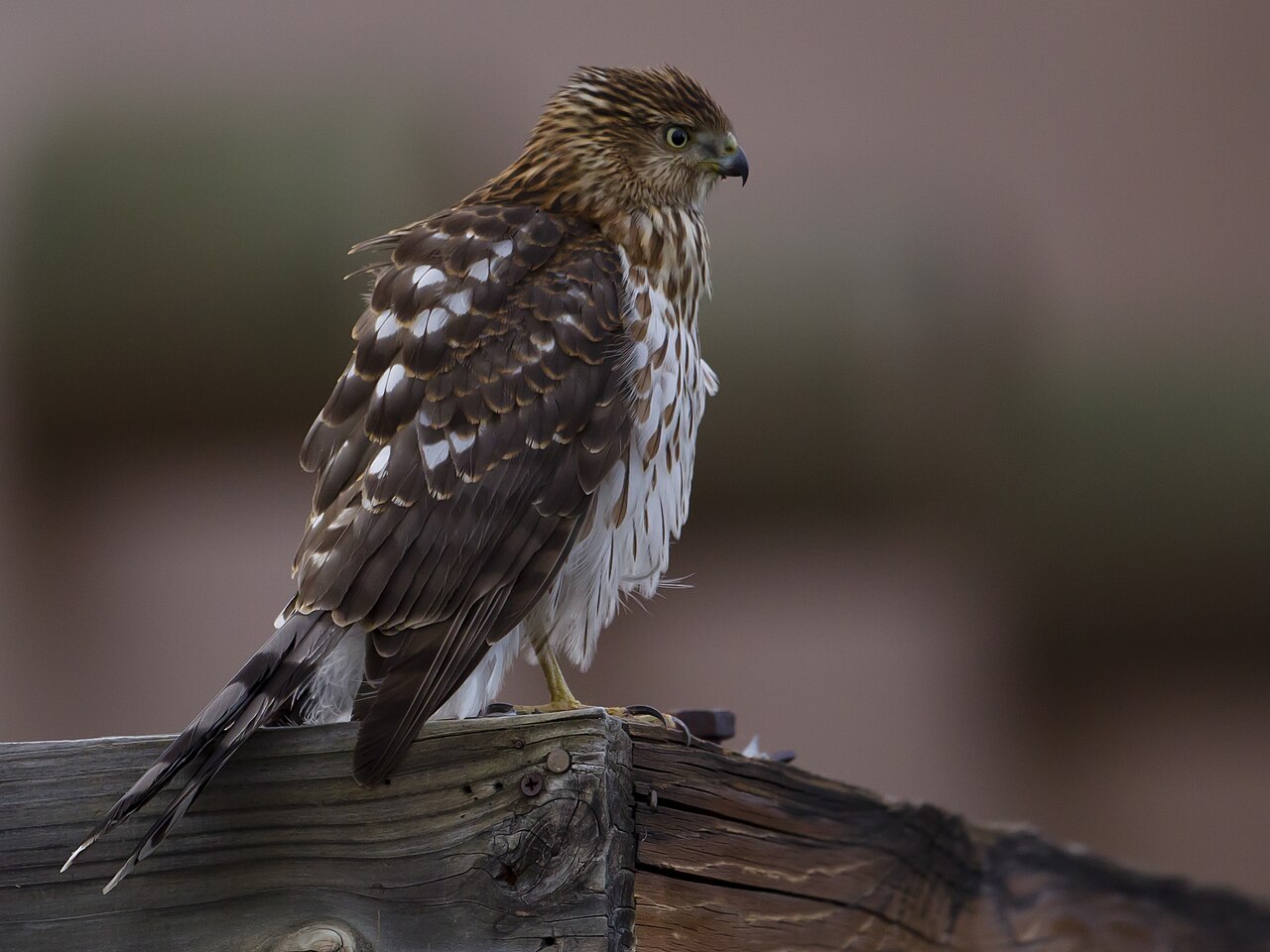
A juvenile Cooper's hawk making use of a temporary perch in the open

Cooper's hawk are regular in wintery, snowy areas in the cooler months

A young Cooper's hawk makes use of a large roadside puddle as a bath

The distinctive long-tailed, large headed form of Cooper's hawk in flight; short wings, seen when flapping, are also characteristic.

An adult Cooper's hawk with a typical bird kill, appearing to be a male house sparrow.

A Cooper's hawk with a common grackle as its prey

An adult Cooper's hawk that has caught a common starling, one of the most widely taken prey for this species.

Eating a finch in a backyard with feeders

An immature Cooper's hawk who has caught a pigeon

A tree squirrel is an ample meal for a juvenile Cooper's hawk

Other raptors can be intolerant of sharing resources with Cooper's hawks, the likely reason this northern harrier is chasing this young Cooper's hawk.

A mockingbird flying in to dive-bomb a Cooper's hawk

A breeding pair of Cooper's hawks, consisting of an adult male and an immature female.

The large, bulky nest of a Cooper's hawk with the female perched on it.

The second row shows the unmarked eggs of Cooper's hawks, compared to those of American kestrels (line 1), red-shouldered hawks (line 3) and red-tailed hawks (line 4).

A large nestling Cooper's hawk peers out of the nest

Juvenile sibling Cooper's hawks are loosely social shortly after dispersal

Immature Cooper's hawk in winter

A high risk of wire collision is present for Cooper's hawks dwelling in urban vicinities.

A Cooper's hawk of the ample Tucson population.


Temperament
solitary and territorial
Flight Pattern
rapid flap-flap-glide through cover; powerful bursts with agile maneuvering
Social Behavior
Typically solitary outside the breeding season. Pairs are seasonally monogamous and perform display flights and vocalizations during courtship. Nests are built high in trees, often near forest edges or in suburban groves, with clutches of 2–5 eggs. Adults are strongly defensive of nest sites.
Migratory Pattern
Partial migrant
Song Description
Vocalizations include a repeated, sharp kek-kek-kek used in alarm and territorial contexts. Males give higher-pitched, faster series, while females produce deeper, harsher calls. Generally quiet when hunting.
Plumage
Adults are blue-gray above with a darker cap and finely barred rufous underparts; tail is banded with a pale tip. Juveniles are brown above with coarse brown streaking on whitish underparts and a banded tail.
Diet
Primarily hunts medium-sized birds such as doves, pigeons, starlings, robins, and jays. Also takes small mammals including chipmunks, mice, and juvenile squirrels, and occasionally reptiles or large insects. Employs surprise ambush from concealed perches or swift contour-hugging flights. Plucks prey before feeding and may cache remains.
Preferred Environment
Hunts along forest edges, riparian woodlands, and wooded suburbs where cover meets open spaces used by prey. Commonly targets birds at backyard feeders, exploiting high prey densities.


