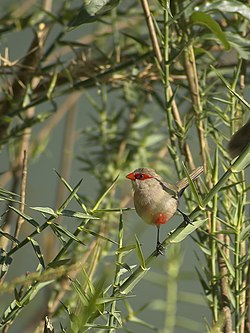
The common waxbill, also known as the St Helena waxbill, is a small passerine bird belonging to the estrildid finch family. It is native to sub-Saharan Africa but has been introduced to many other regions of the world and now has an estimated global extent of occurrence of 10,000,000 km2. It is popular and easy to keep in captivity.
Region
Sub-Saharan Africa
Typical Environment
Common in open grasslands, marshy edges, reedbeds, and savanna clearings, often near water. It readily occupies agricultural fields, roadsides, and urban parks where seeding grasses are abundant. Outside its native range it thrives in mild coastal climates and insular habitats with ample rank grass. Flocks often forage on the ground and on seeding stems, retreating to dense cover when disturbed.
Altitude Range
0–2500 m
Climate Zone
Tropical
Ease of Keeping
Beginner friendly: 5/5
The common waxbill is a tiny estrildid finch with a bright red bill and eye-stripe, often seen in lively flocks. Native to sub-Saharan Africa, it has been widely introduced to islands and warm-temperate regions, including Macaronesia and parts of Iberia. It builds neat, domed grass nests and is a known host of the brood-parasitic pin-tailed whydah. Popular in aviculture, it is hardy and adapts well to human-altered landscapes.


Estrilda astrild - MHNT



Temperament
social and active
Flight Pattern
short rapid wingbeats with low, undulating flight
Social Behavior
Usually in small to large flocks outside the breeding season and often forages in tight groups. Pairs form within flocks; both sexes build a domed grass nest placed low in dense vegetation. Clutches typically contain 4–6 eggs, with shared incubation and chick rearing. Roosting communally is common, and colonies may nest close together.
Migratory Pattern
Resident
Song Description
Soft, tinkling trills and high, sibilant ‘tsit’ calls delivered frequently while feeding. Males perform a gentle, buzzy song during courtship, often accompanied by a hopping display. Vocalizations are quiet but constant when birds are active.
Plumage
Fine gray-brown plumage with delicate dark barring, paler underparts, and darker tail; rump and undertail show reddish tones.
Diet
Primarily small grass seeds plucked from seed heads or taken from the ground. Supplements diet with tiny insects such as termites, aphids, and other invertebrates, especially in the breeding season. Will take cultivated millets and weed seeds around farms and gardens. Water is taken regularly, often at safe, shallow edges.
Preferred Environment
Feeds in rank grass, reed margins, and weedy patches along fields, paths, and wetlands. Often chooses areas with dense cover nearby for quick retreat and group roosting. In introduced ranges, frequents ornamental grasses in parks and gardens.