
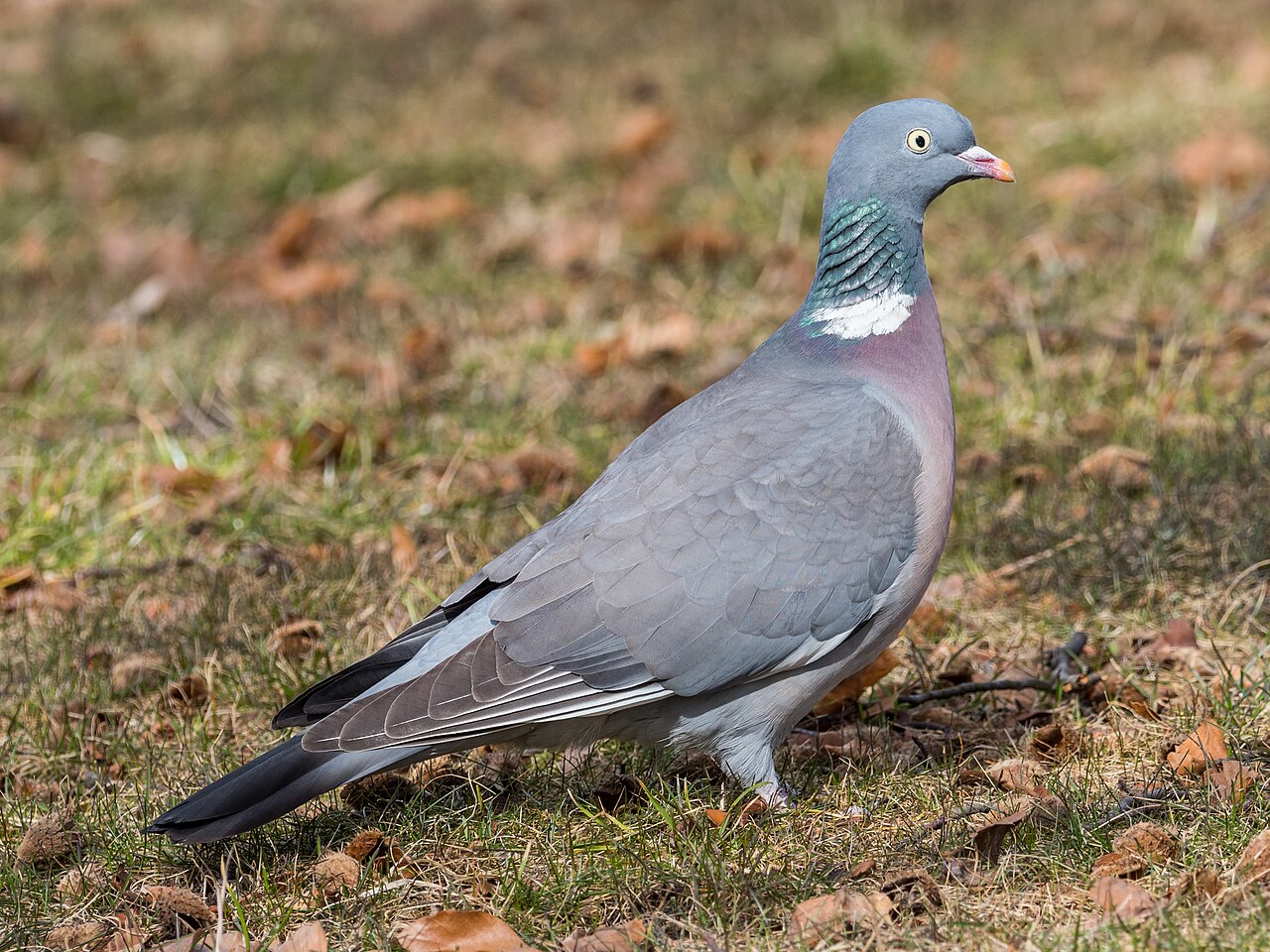
The common wood pigeon, also known simply as the wood pigeon, is a large species in the dove and pigeon family (Columbidae), native to the western Palearctic. It belongs to the genus Columba, which includes closely related species such as the rock dove. It has a flexible diet, feeding mainly on plant material, including cereals, and is therefore considered an agricultural pest. Wood pigeons are extensively hunted over much of their range, but this does not appear to have a major impact on their population numbers.
Region
Western Palearctic
Typical Environment
Found widely across Europe, western Asia, and parts of North Africa, occupying woodlands, forest edges, farmland, parks, and gardens. It favors mosaic landscapes with trees for nesting and open ground for feeding. In winter, birds concentrate in agricultural areas and stubble fields to exploit spilled grain. Urban and suburban populations are common and expanding. Northern and eastern breeders may move southwest in winter to milder areas.
Altitude Range
Sea level to 2000 m
Climate Zone
Temperate
Ease of Keeping
Beginner friendly: 2/5
The common wood pigeon is the largest pigeon in much of Europe, instantly recognized by its bold white neck patches and wing bars. Its loud clapping takeoff and repetitive five-note coo are characteristic of parks and farmland. It can raise multiple broods per year and sometimes forms very large winter flocks on arable land. Although often considered an agricultural pest, its overall population remains robust.


Common wood pigeon perched on a fence. Photograph taken in Cambridge, England

Adult common wood pigeon, photograph taken in Birmingham, England

Adult sitting on its nest in a tree

Egg

Hatching of a common wood pigeon

Two young Columba palumbus in a nest
Temperament
wary but adaptable
Flight Pattern
strong flier
Social Behavior
Outside the breeding season it forms flocks, sometimes numbering in the hundreds or more. Pairs are monogamous and build a flimsy stick platform nest in trees or large shrubs. Typical clutches are two white eggs, and multiple broods can be raised in a season. Both parents feed nestlings with nutrient-rich crop milk.
Migratory Pattern
Partial migrant
Song Description
A loud, repetitive five-note cooing phrase often rendered as ‘coo-COO coo, coo-coo,’ with brief pauses. Males sing from prominent perches or during display flights. Wing clattering on takeoff is also a characteristic sound.
Plumage
Mostly blue-grey with a pinkish breast, iridescent green-purple sheen on the neck, bold white patches on the sides of the neck, and broad white wing bars visible in flight. The tail is grey with a contrasting dark terminal band. Juveniles are duller and lack the full white neck patches.
Diet
Primarily consumes seeds and grains, including cereals, oilseed rape, and legumes. It also eats buds, young leaves, flowers, berries, and acorns, and will visit gardens for spillage. Occasional invertebrates may be taken incidentally, but plant matter dominates its diet. Grit is ingested to aid grinding food in the gizzard.
Preferred Environment
Feeds mostly on the ground in open fields, pasture, and lawns, often commuting from nearby woodlots or urban trees. Hedgerows and field margins provide foraging and cover. In cities, it readily exploits bird feeders and park lawns.


