

The common starling, also known simply as the starling in Great Britain and Ireland, and as European starling in North America, is a medium-sized passerine bird in the starling family, Sturnidae. It is about 20 cm (8 in) long and has glossy black plumage with a metallic sheen, which is speckled with white at some times of the year. The legs are pink and the bill is black in winter and yellow in summer; young birds have browner plumage than the adults. Its gift for mimicry has been noted in literature including the Mabinogion and the works of Pliny the Elder and William Shakespeare.
Region
Europe and western Asia
Typical Environment
Native across much of temperate Eurasia, it occupies open habitats including farmland, pastures, urban parks, gardens, and coastal areas. It readily exploits human environments and is common around settlements and livestock. Large communal roosts form in reedbeds, woodlots, and city structures. It has been widely introduced to North America, Australia, New Zealand, and southern Africa, where it is now widespread.
Altitude Range
Sea level to 2300 m
Climate Zone
Temperate
Ease of Keeping
Beginner friendly: 2/5
Common starlings are noted mimics, weaving whistles, clicks, and imitations of other birds and human-made sounds into their songs. They form spectacular pre-roost murmurations with thousands of birds wheeling in synchronized patterns. Highly adaptable, they thrive in human-altered landscapes from farms to cities. In some introduced regions they are considered invasive and can compete with native cavity-nesting birds.


An immature in Paris, France. It has partly moulted into its first-winter plumage; however, juvenile brown plumage is prominent on its head and neck

A common starling (S. v. porphyronotus, in Kazakhstan) using the protractor muscles in its jaw to force apart a cowpat to search for insect larvae

Singing Sturnus vulgaris, Wrocław, Poland.

Adult male singing and displaying its long throat feathers

Composite of five images showing a starling dropping an insect then diving to try to recapture it

A flock foraging at a farm in Northern Ireland

A parent feeding a chick
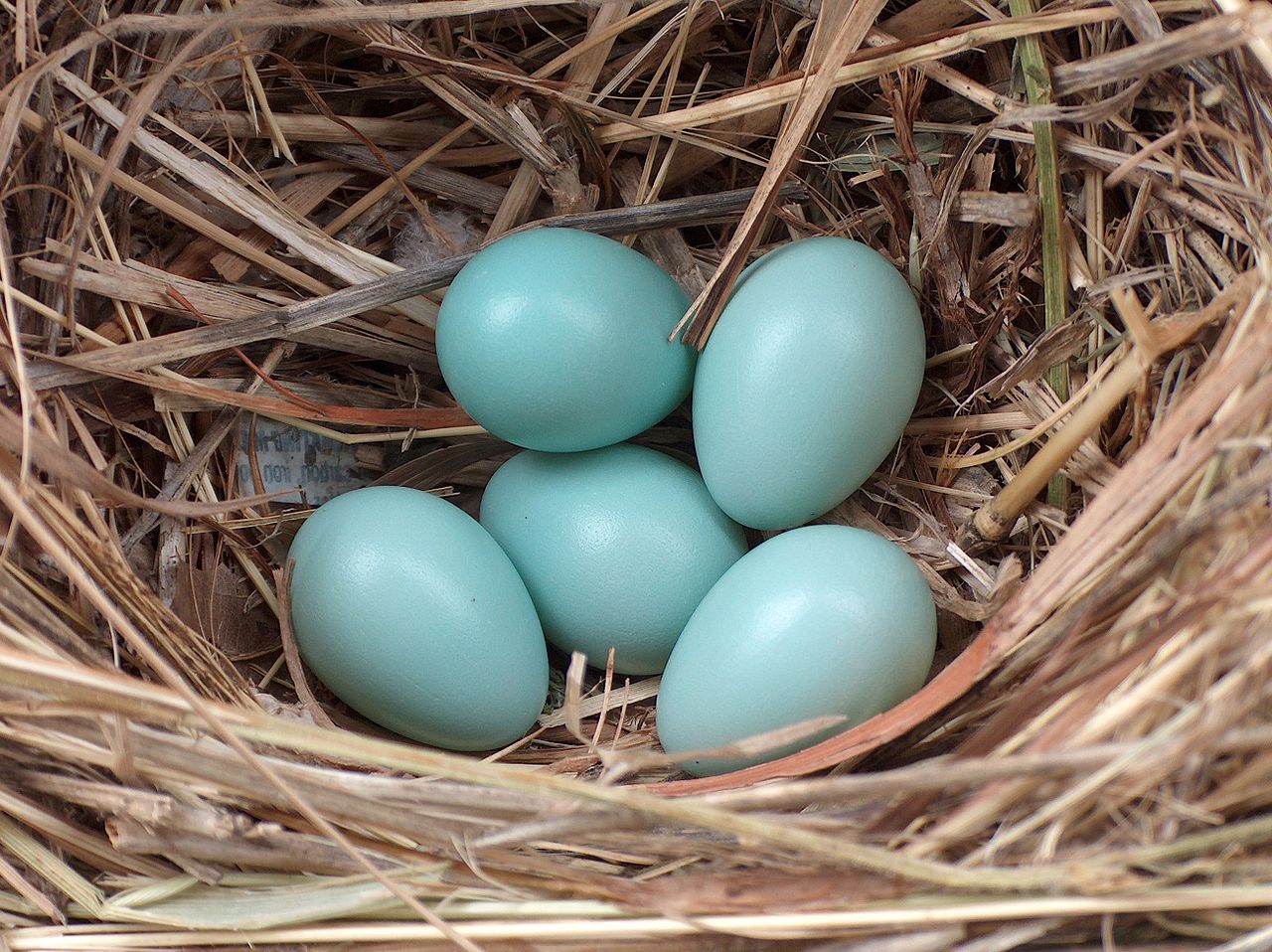
Five eggs in a nest

Eggs, Collection Museum Wiesbaden, Germany

Chicks waiting to be fed at the entrance of their nest made in a gap in a wall in Galway, Ireland

Dermanyssus gallinae, a parasite of the common starling

A flock resting on a pine tree during migration

Flock in the Napa Valley, California

At Half Moon Bay, California

A European starling in flight, suburban St. Louis, Missouri

Congregating on wires in France

Feeding on a windfall apple

Visiting a bird feeder. The adult has a black beak in the winter.

Pet in a cage
Temperament
social and active
Flight Pattern
short rapid wingbeats with agile turns; strong flier
Social Behavior
Highly gregarious outside the breeding season, forming large flocks and communal roosts. Nests in cavities such as tree holes, buildings, and nest boxes; pairs are typically seasonally monogamous but may be opportunistic. Roosting murmurations can number in the tens of thousands and shift locations with food availability.
Migratory Pattern
Partial migrant
Song Description
A varied, scratchy, and melodic series of whistles, clicks, and rattles interspersed with accurate mimicry of other species and sounds. Males sing from prominent perches and near nest sites, often incorporating new elements each season.
Plumage
Glossy black with metallic green and purple sheen, heavily speckled with pale spots in non-breeding season; juveniles are brown and lack iridescence.
Diet
Eats insects, spiders, and other invertebrates, especially beetles, caterpillars, and earthworms during the breeding season. Also consumes fruits and berries such as cherries, elder, and ivy, and takes grains and seeds opportunistically. In urban areas it scavenges food scraps and exploits outdoor feeding sites. Uses a characteristic open-bill probing technique to pry apart soil and turf.
Preferred Environment
Forages on short grass, lawns, pastures, and agricultural fields, often near livestock that stir up insects. In winter it feeds in orchards, hedgerows, reedbeds, and urban green spaces, moving in flocks between food patches.


