
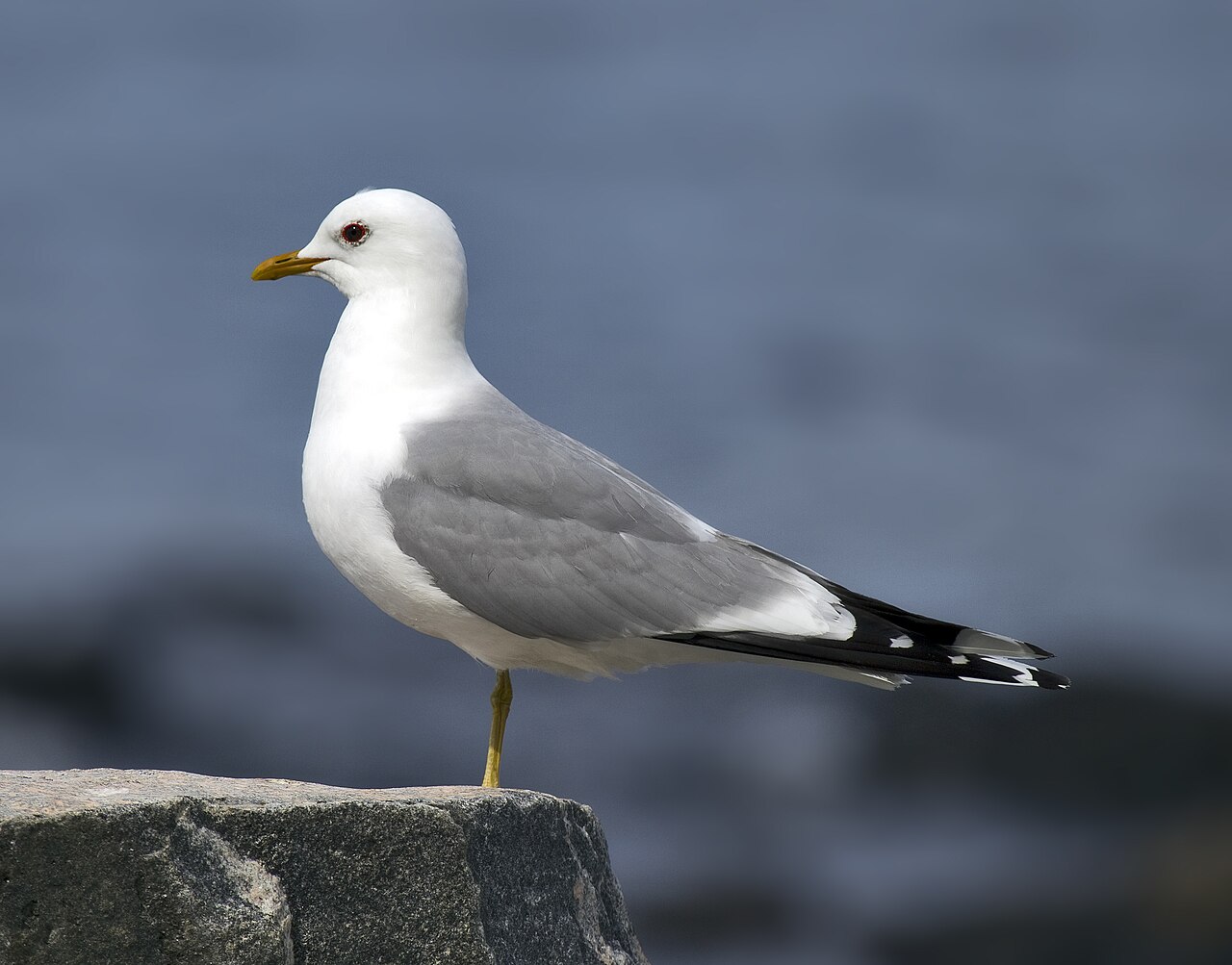
The common gull is a medium-sized gull that breeds in cool temperate regions of the Palearctic from Iceland and Scotland east to Kamchatka in the Russian Far East. Most common gulls migrate further south in winter, reaching the Mediterranean Sea, the southern Caspian Sea, and the seas around China and Japan; northwest European populations are at least partly resident. The closely related short-billed gull was formerly often included in this species, which was then sometimes known collectively as "mew gull".
Region
Palearctic
Typical Environment
Breeds from Iceland and the British Isles across Scandinavia and northern Russia to Kamchatka, using coastal cliffs, islands, and inland wetlands. In winter it disperses to temperate coasts, estuaries, large lakes, and urban harbors around Europe and East Asia. It frequents agricultural fields, shorelines, and fish-rich waters, readily foraging at landfills and ports. Inland breeders often use lakes, bogs, and marshy meadows, while coastal populations nest on low islands or grassy headlands.
Altitude Range
0–1500 m
Climate Zone
Temperate
Ease of Keeping
Beginner friendly: 1/5
Also known as the mew gull in some regions, the common gull breeds across northern Eurasia and winters farther south. It is often confused with the similar ring-billed gull but has darker eyes and greenish-yellow legs. The short-billed gull of North America was formerly included in this species but is now treated as separate. In winter, subtle head streaking and slightly darker wingtips help with identification.


Winter plumage


Adult breeding plumage, Norway

Breeding adults have red rings around dark eyes Kizhi Island, Russia

Eggs, Collection Museum Wiesbaden

Temperament
social and opportunistic
Flight Pattern
strong flier with steady wingbeats; buoyant glides
Social Behavior
Typically nests in loose colonies on the ground near water, using grass or seaweed to build shallow nests. Pairs are seasonally monogamous, with both sexes incubating and tending chicks. Outside the breeding season, it forms mixed-species flocks at feeding sites and roosts.
Migratory Pattern
Partial migrant
Song Description
Vocal repertoire includes mewing, yelping calls and nasal kek notes, especially around colonies. Display calls are softer and more melodious than many larger gulls, giving rise to the name 'mew' gull.
Plumage
Adult shows a pale grey mantle with white head and underparts; black wingtips with neat white mirrors. In non-breeding plumage the head is lightly streaked. Juveniles and immatures are mottled brown, gradually acquiring grey mantle and cleaner underparts.
Diet
An opportunistic omnivore taking insects, earthworms, mollusks, small fish, and crustaceans. It also scavenges carrion and fish offal and will exploit human refuse and discards. During breeding it often forages in fields for invertebrates; in winter it shifts more to coastal and urban food sources. It may occasionally take eggs or small chicks of other birds.
Preferred Environment
Feeds along shorelines, tidal flats, estuaries, lakeshores, and harbors, as well as ploughed fields and pastures. Common at piers, fish markets, and landfills where food is concentrated.


