

The chukar partridge, or simply chukar, is a Palearctic upland gamebird in the pheasant family Phasianidae. It has been considered to form a superspecies complex along with the rock partridge, Philby's partridge and Przevalski's partridge and treated in the past as conspecific particularly with the first. This partridge has well-marked black and white bars on the flanks and a black band running from the forehead across the eye down the head to form a necklace that encloses a white throat. Native to Asia, the species has been introduced into many other places and feral populations have established themselves in parts of North America, Malta and New Zealand. This bird can be found in parts of Middle East and temperate Asia.
Region
Central and West Asia
Typical Environment
Native from the eastern Mediterranean and Middle East across Iran, Pakistan, and the Himalayan foothills to western China and Mongolia. It favors open, rocky hillsides, steppe, and dry shrublands with sparse cover and nearby water. The species has been introduced and established in parts of western North America (especially the Great Basin), New Zealand, and locally in Europe including Malta. In mountainous regions it often uses talus slopes and canyon rims, descending to feed and roosting on ledges.
Altitude Range
Sea level to 4000 m
Climate Zone
Arid
Ease of Keeping
Beginner friendly: 4/5
The chukar is a hardy upland gamebird of rocky hillsides and arid slopes, famous for its bold face mask and barred flanks. It readily forms coveys outside the breeding season and was widely introduced for hunting, establishing feral populations in North America and New Zealand. In Pakistan it is considered a national bird and features in regional folklore.


Chukar Patridge from United Arab Emirates
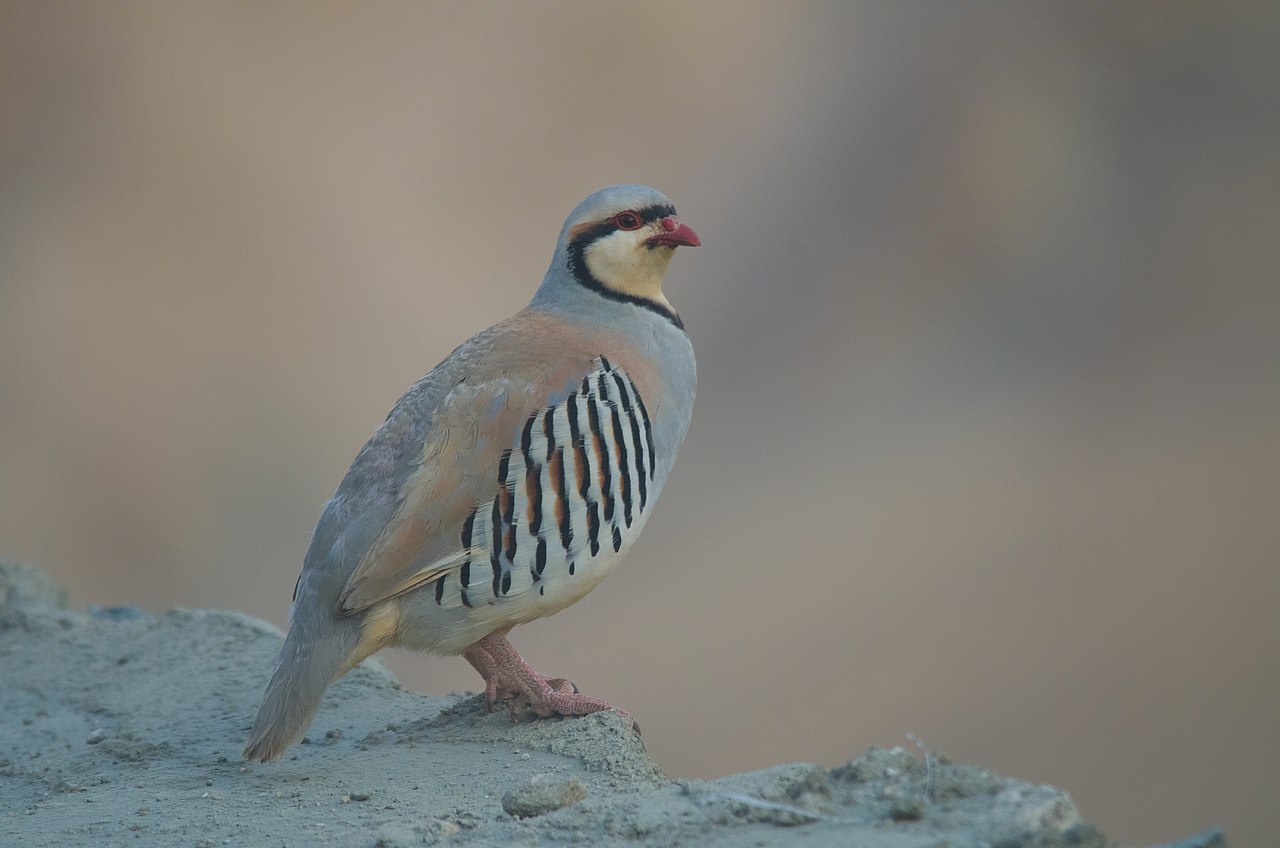
Chukar at Chang La, Ladakh.

Illustration from Hume and Marshall's Game Birds of India, Burma and Ceylon

Alectoris chukar

Chukar partridge (right) in the Antelope Island State Park, Utah, US

Chukar from Jebel Al Lawz, Saudi Arabia

A chukar in a 17th-century Persian encyclopedia


Temperament
social and wary
Flight Pattern
short rapid wingbeats with gliding descents
Social Behavior
Outside the breeding season chukars gather in coveys that forage and roost together. Pairs form in spring, with ground nests concealed under shrubs or rocks. Both parents attend the precocial chicks, which can run and feed shortly after hatching.
Migratory Pattern
Resident
Song Description
The voice is a loud, accelerating chuk-chuk-chukar call that carries across rocky slopes. It also gives clucking contact notes within coveys and harsh alarm calls when flushed.
Plumage
Sandy-brown to gray-brown upperparts with a smooth, clean gray breast and buff belly; bold black-and-white barring on the flanks.
Diet
Primarily seeds, grasses, and green shoots, supplemented with buds and cultivated grains where available. They also take berries and other plant matter seasonally. Chicks consume a higher proportion of insects such as beetles and ants to meet protein needs.
Preferred Environment
Feeds on open ground along rocky benches, talus edges, and sparsely vegetated slopes with scattered shrubs. Often forages near water sources and along field margins in arid and semi-arid landscapes.


