

The Cape wagtail, also known as Wells's wagtail, is a small insectivorous bird which is widespread in southern Africa. It frequents water's edge, lawns and gardens. It is a mostly resident, territorial species, but has been known to undertake limited altitudinal migration or form flocks outside of the breeding season. Like other wagtails they are passerine birds of the family Motacillidae, which also includes the pipits and longclaws.
Region
Southern Africa
Typical Environment
Found widely across South Africa, Lesotho, Eswatini, Namibia, Botswana, Zimbabwe, and Mozambique, especially near water. It frequents riverbanks, streams, lakeshores, wetlands, estuaries, and coastal edges, as well as irrigated fields, parks, and gardens. The species favors open ground with short vegetation interspersed with perches and consistently avoids dense forest interiors. It readily utilizes artificial water features in urban and agricultural settings. Very arid areas far from permanent water are generally avoided.
Altitude Range
Sea level to 3000 m
Climate Zone
Subtropical
Ease of Keeping
Beginner friendly: 2/5
The Cape wagtail is a southern African wagtail that constantly pumps its long tail while walking or pausing to forage. It thrives in human-altered landscapes, often hunting insects on lawns, golf courses, and riverbanks in towns and farms. Outside the breeding season it may roost communally and form loose flocks. It undertakes limited altitudinal movements, descending from highlands in colder months.


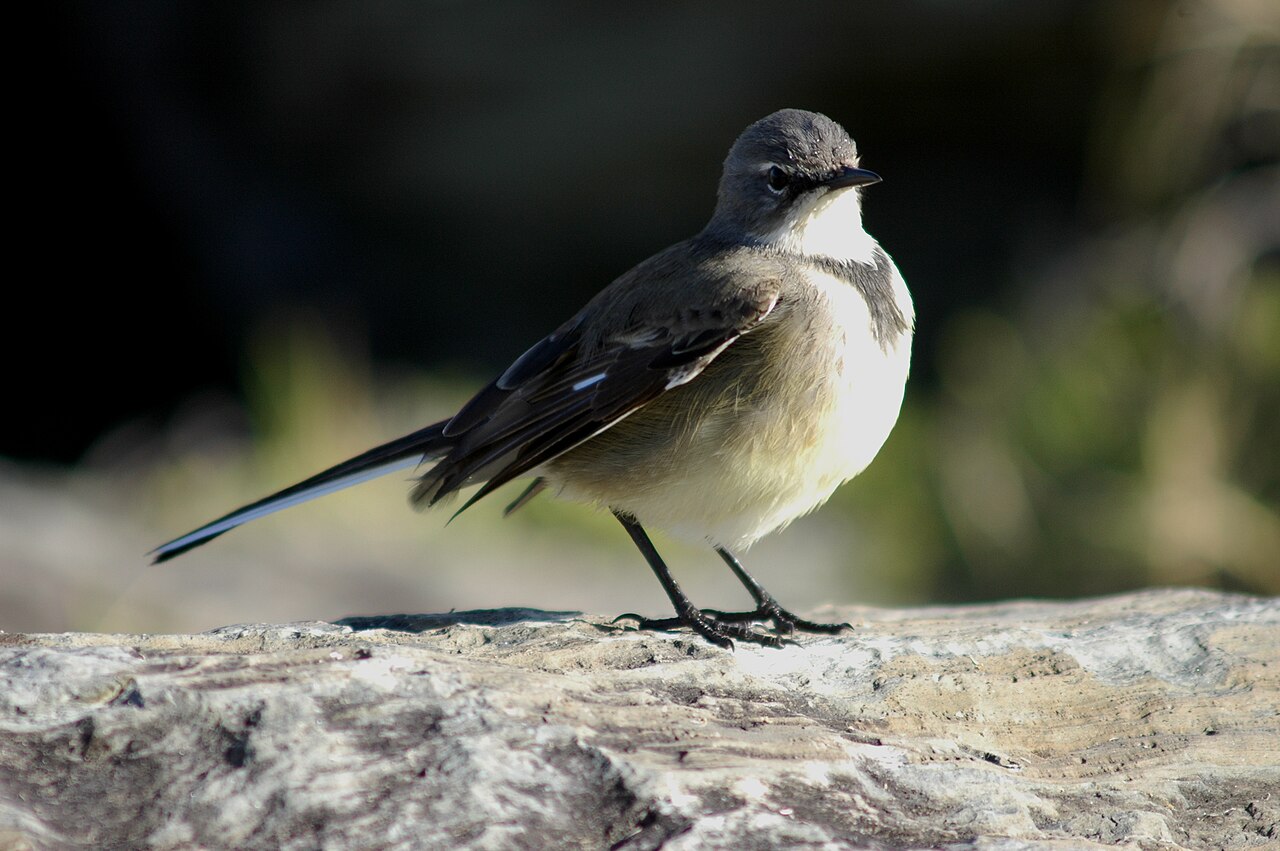
M. c. capensis on the South African south coast


Temperament
alert and moderately tame, territorial in breeding season
Flight Pattern
short rapid wingbeats with bounding undulations
Social Behavior
Typically seen singly or in pairs on territories during breeding. Nests are cup-shaped and placed on ledges, riverbanks, culverts, buildings, or dense vegetation near water. After breeding, birds may gather in loose foraging groups and use communal roosts.
Migratory Pattern
Partial migrant
Song Description
Song is a soft, sweet twittering delivered from perches or in short display flights. Calls include sharp tsip notes and thin seep contact calls given while foraging or in flight.
Plumage
Smooth grey-brown upperparts with paler grey underparts and a whitish throat; faint buff wash on the breast and flanks. Long tail with contrasting white outer tail feathers and darker central feathers. Subtle pale eyebrow and dusky malar stripes frame the face.
Diet
Primarily takes small insects such as flies, beetles, ants, and aquatic invertebrates. It also snaps up small spiders and occasionally small crustaceans along estuaries. Prey is mostly gleaned from the ground or water margins, with short sallies to catch flying insects.
Preferred Environment
Feeds on short grass, sand, mud, and stony margins along rivers, dams, lakes, and estuaries. Often forages in parks, pastures, and gardens where insects are abundant, especially near water.


