

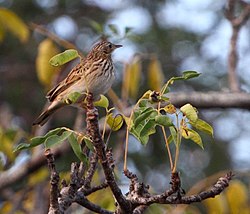
The bushveld pipit, also known as bush pipit or little pipit, is a species of bird in the pipit and wagtail family Motacillidae. It is found in Angola, Botswana, Eswatini, Ethiopia, Kenya, Malawi, Mozambique, South Africa, Tanzania, Zambia, and Zimbabwe. Its natural habitats are subtropical or tropical dry forests and dry savanna.
Region
Southern and Eastern Africa
Typical Environment
Occurs patchily from the bushveld and miombo edges of southern Africa north through mopane and acacia savannas into parts of East Africa. Prefers open woodland, dry savanna, and grassy glades with scattered shrubs. It favors areas with short to medium grass and bare patches for ground foraging. After rains it may appear more widely where termites and other insects emerge. Human-altered mosaics such as lightly grazed pastures and roadside verges can also be used.
Altitude Range
200–1800 m
Climate Zone
Subtropical
Ease of Keeping
Beginner friendly: 1/5
A small, cryptically patterned pipit that often goes unnoticed as it forages quietly in short grass and open bush. It frequently flicks its tail, flashing white outer tail feathers in short, low flights. Often confused with Plain-backed and Buffy pipits, it is best told by its finer, more delicate build and soft, high-pitched call. Local movements track rainfall and insect flushes after storms.



Temperament
shy and inconspicuous
Flight Pattern
short rapid wingbeats with brief, low undulations
Social Behavior
Usually solitary or in pairs, becoming more loosely associated in suitable feeding areas after rains. Nests are shallow grass cups placed on or near the ground, well concealed among tufts. Pairs are likely monogamous within a season and defend small territories during breeding.
Migratory Pattern
Partial migrant
Song Description
Song is a soft, thin series of high-pitched tsee-tsee notes delivered from a low perch or during a short display flight. Calls include a sharp, tzip contact note and a very thin seep that can be hard to localize.
Plumage
Fine, streaked brown upperparts with a warmer buff wash and paler, lightly streaked underparts across the breast fading to whitish belly. Feathers are smooth and sleek, giving a neat, delicate appearance. White outer tail feathers show clearly in flight.
Diet
Feeds mainly on small insects such as beetles, ants, termites, grasshoppers, and caterpillars. Will take small spiders and other arthropods opportunistically. Occasionally picks at small seeds when insect prey is scarce. After rains, it often exploits termite alate emergences.
Preferred Environment
Forages on the ground in short grass, along paths, and in open patches beneath scattered shrubs and trees. Uses quick runs with pauses to scan and pick prey, often near cover for rapid retreat.


