

The blue-faced honeyeater, also colloquially known as the bananabird, is a passerine bird of the honeyeater family, Meliphagidae. It is the only member of its genus, and it is most closely related to honeyeaters of the genus Melithreptus. Three subspecies are recognised. At around 29.5 cm (11.6 in) in length, the blue-faced species is large for a honeyeater. Its plumage is distinctive, with olive upperparts, white underparts, and a black head and throat with white nape and cheeks. Males and females are similar in external appearance. Adults have a blue area of bare skin on each side of the face readily distinguishing them from juveniles, which have yellow or green patches of bare skin.
Region
Northern and eastern Australia and southern New Guinea
Typical Environment
Found across tropical northern Australia, extending down the eastern seaboard into eastern Queensland and northern New South Wales, and in southern New Guinea. It frequents open forests, eucalypt woodlands, riverine corridors, mangroves, savanna edges, and urban parks and gardens. It avoids dense closed-canopy rainforest interiors but readily uses edges and clearings. In towns it is a common visitor to flowering street trees and backyard feeders.
Altitude Range
Sea level to 1200 m
Climate Zone
Tropical
Ease of Keeping
Beginner friendly: 2/5
Also called the bananabird, it frequently visits gardens and campsites to feed on fruit and nectar. Adults show striking patches of bare blue facial skin, while juveniles have greenish-yellow facial skin that turns blue as they mature. It often follows flowering eucalypts and grevilleas and readily adapts to human-modified habitats.


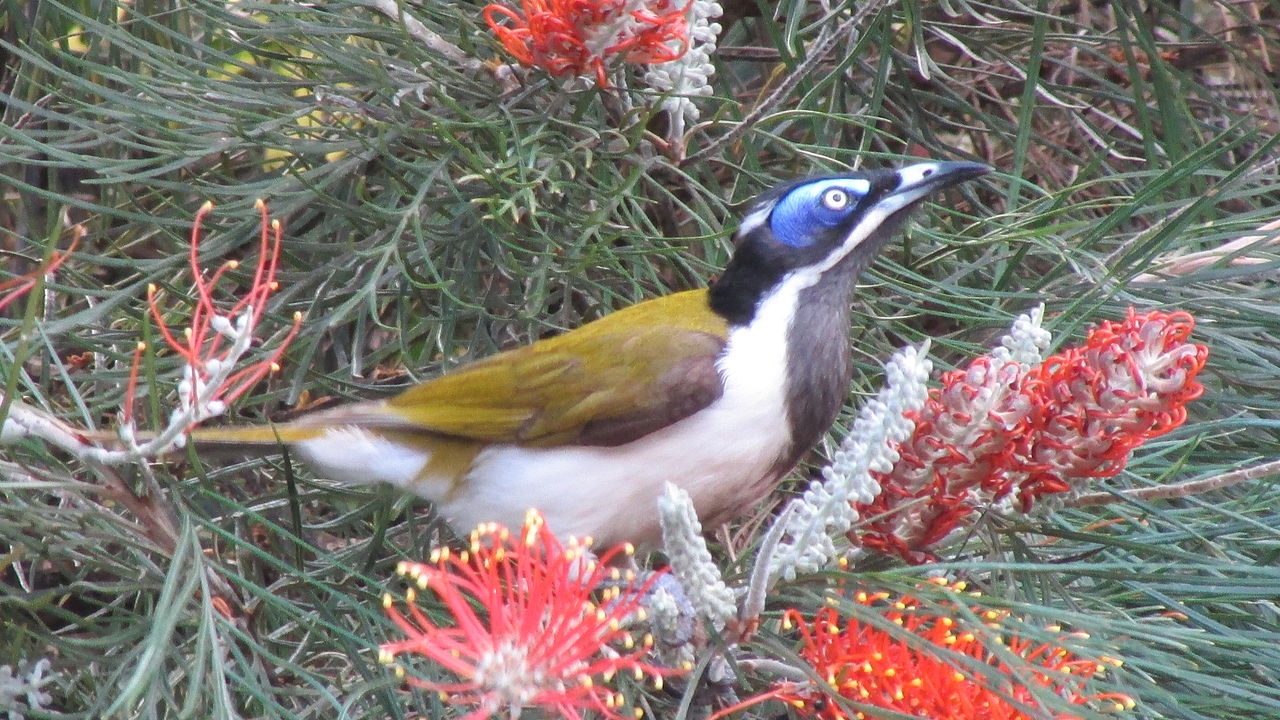
Blue-faced honeyeater - Canungra - Queensland - Australia

Blue-faced honeyeater (Intermediate) - Fogg Dam - Middle Point - Northern Territory - Australia

Subspecies cyanotis, juvenile, near Eumundi, Queensland

Subspecies albipennis, Katherine, Northern Territory

Blue-faced honeyeater at Edinburgh Zoo

Subspecies cyanotis feeding, southeastern Australia
Temperament
social and assertive
Flight Pattern
short rapid wingbeats; strong, direct flier
Social Behavior
Usually seen in pairs or small, noisy groups that defend rich nectar sources. Breeding pairs build a cup nest in tree forks or on branches, often near human habitation. Both parents tend the young, and birds may aggressively mob intruders near the nest.
Migratory Pattern
Resident
Song Description
Calls are loud, ringing chacks and nasal yelps, often delivered in repeated phrases. It also gives chattering contact calls while foraging in groups.
Plumage
Olive-green upperparts with clean white underparts, a black head and throat, and a contrasting white nape patch. Adults have bare, vivid blue skin around the eye and face. Wings and tail show olive tones with darker flight feathers.
Diet
Primarily feeds on nectar from eucalypts, grevilleas, and bottlebrush, supplemented with insects, spiders, and fruit. It often gleans insects from foliage and bark and will hawk small prey from the air. In towns it readily takes soft fruits and scraps, which explains its frequent visits to campsites and gardens.
Preferred Environment
Forages in flowering trees and shrubs, especially along forest edges, open woodlands, and urban plantings. It also exploits riparian corridors and mangroves where nectar and insects are abundant.


