

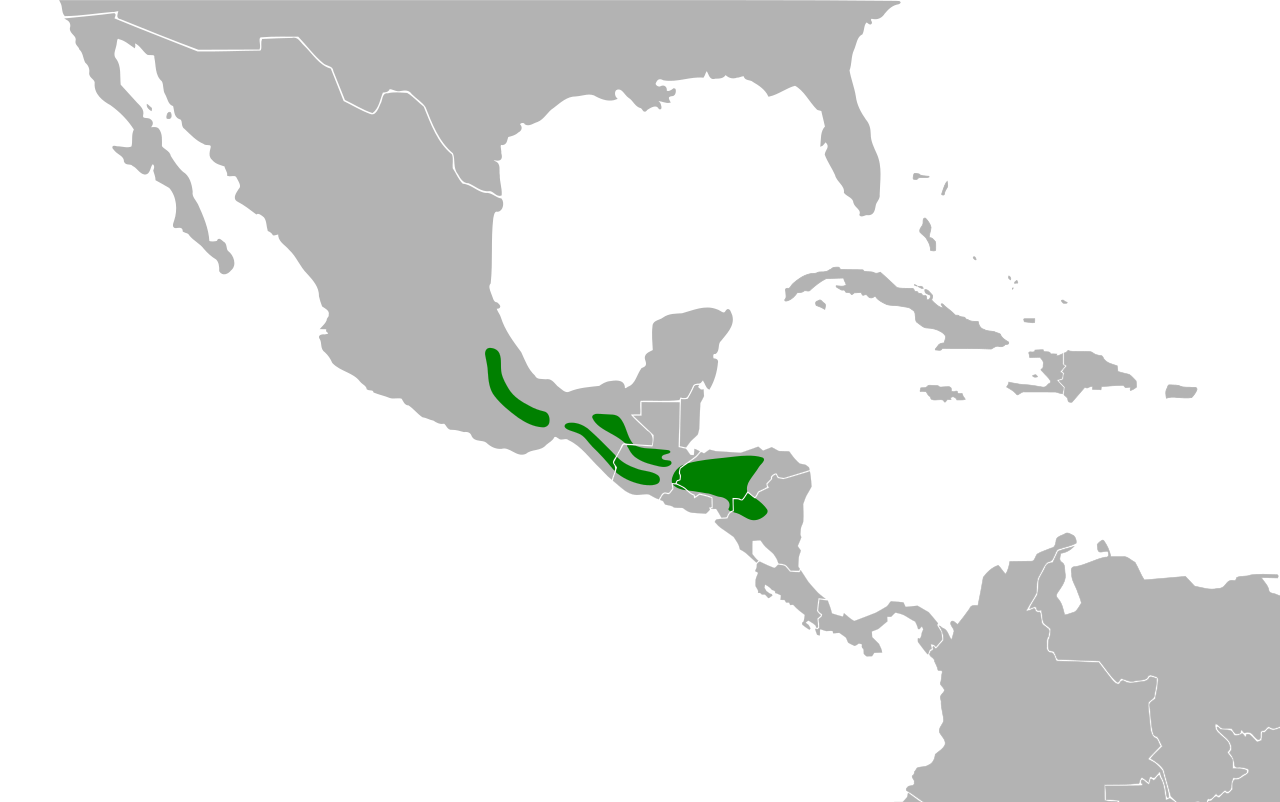
The blue-crowned chlorophonia is a species of bird in the family Fringillidae. It is found in El Salvador, Panama, Guatemala, Honduras, Mexico, and Nicaragua. Its natural habitat is subtropical or tropical moist montane forest.
Region
Central America
Typical Environment
Occurs from southern Mexico through Guatemala, El Salvador, Honduras, and Nicaragua to western Panama. It favors subtropical and tropical moist montane forests, especially areas rich in epiphytes and fruiting trees. Birds are most often seen in the mid- to upper canopy, along forest edges, and in secondary growth with tall trees. Locally, it may descend into foothills when fruit is abundant. Some populations make short altitudinal movements following seasonal fruiting.
Altitude Range
800–2500 m
Climate Zone
Highland
Ease of Keeping
Beginner friendly: 2/5
A small, vividly colored finch of humid highland forests, the blue-crowned chlorophonia often travels in pairs or small groups, quietly gleaning fruit in the canopy. Males are striking with a turquoise-blue crown set against bright green plumage, while females are duller green. It frequently associates with fruiting trees and may join mixed-species flocks. Nests are typically neat, domed structures tucked into mossy tangles or epiphytes.

Temperament
social and active
Flight Pattern
short rapid wingbeats
Social Behavior
Usually found in pairs or small family groups, sometimes joining mixed-species foraging flocks in the canopy. Courtship includes soft calls and close pair-following. The nest is a compact, domed structure placed in moss or dense epiphytes, and both parents help feed the young.
Migratory Pattern
Resident
Song Description
Song consists of soft, sweet, high-pitched whistles delivered in brief sequences. Calls are thin, tinkling notes used to keep contact while foraging. Vocalizations can be subtle and are often given from within leafy cover.
Plumage
Male with bright green upperparts, vivid turquoise-blue crown and nape, and yellow to yellow-green underparts; female is overall greener with a less distinct or absent blue crown and duller underparts. Plumage appears smooth and glossy in good light, with no wing bars.
Diet
Primarily consumes small fruits and berries, including mistletoe and other canopy fruits. It occasionally supplements its diet with small insects or other invertebrates, especially during breeding. Foraging is deliberate, with birds gleaning and plucking fruit from clusters. Seasonal movements track local fruiting peaks.
Preferred Environment
Feeds mostly in the mid- to upper canopy of humid montane forest and mature secondary growth. Regularly visits fruiting trees at forest edges and along ridges. Will use shaded coffee plantations or orchards when suitable fruit is available nearby.


