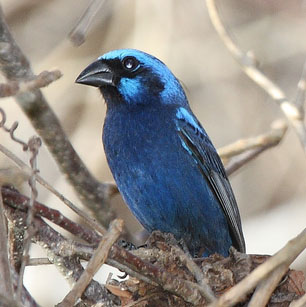
The blue bird-of-paradise is a large species of bird-of-paradise. It is the only species in the genus Paradisornis, but was previously included in the genus Paradisaea.
Region
New Guinea Highlands
Typical Environment
Occurs in mid-montane rainforests and forest edges in the central and eastern highlands of Papua New Guinea. It favors mature evergreen forests with a dense midstory and access to fruiting trees. The species also uses secondary forest and forest edge, especially where large vines and display perches are available. Activity is mostly in the canopy and subcanopy, with occasional foraging at forest margins.
Altitude Range
1400–2200 m
Climate Zone
Highland
Ease of Keeping
Beginner friendly: 1/5
The blue bird-of-paradise is the sole member of the genus Paradisornis, formerly placed in Paradisaea. Males perform spectacular upside-down displays from hanging vines, fanning vivid blue plumage to attract females. The species was named in honor of Crown Prince Rudolf of Austria. It is threatened by habitat loss and hunting for its ornamental feathers.


19th century illustration by Richard Bowdler Sharpe

Nominate male specimen at the Naturalis Biodiversity Center. More of its sexual ornamentation can be seen ventrally.

A male specimen preserved in its display posture. The bird arranges itself upside down and spreads out its glorious "fountain" of blue flank plumes, with a black and red-edged oval in or near the center of the figure, and two elongated, bulbous-tipped tail wires flailing around its body.


Temperament
solitary and territorial
Flight Pattern
short rapid wingbeats between canopy perches
Social Behavior
Males maintain traditional display sites, often a hanging vine or exposed perch, where they perform elaborate courtship for visiting females. They are generally solitary outside of breeding, with males polygynous and females solely responsible for nesting and chick rearing. Nests are placed in concealed sites within midstory vegetation.
Migratory Pattern
Resident
Song Description
Calls are mellow, ringing whistles interspersed with sharper notes, carrying well through montane forest. During displays, males add rhythmic clicks and wing sounds to accentuate visual signals.
Plumage
Male is velvety black with rich iridescent blue mantle and wing coverts, and long flowing flank plumes; has elongated tail wires. Female is brown to cinnamon with barred underparts and a pale belly, adapted for camouflage.
Diet
Primarily frugivorous, taking a wide variety of rainforest fruits and berries, especially figs and laurels. Supplements diet with arthropods such as beetles, caterpillars, and small spiders gleaned from foliage. Foraging often involves methodical picking and short sallying flights between fruiting branches.
Preferred Environment
Feeds mainly in the canopy and subcanopy of mature montane forest, concentrating at fruiting trees. Also visits forest edges and gaps where fruit is abundant and visibility is higher.