
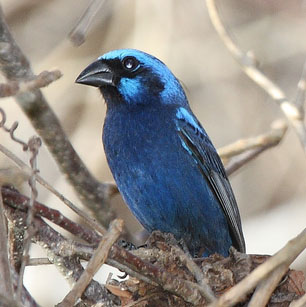
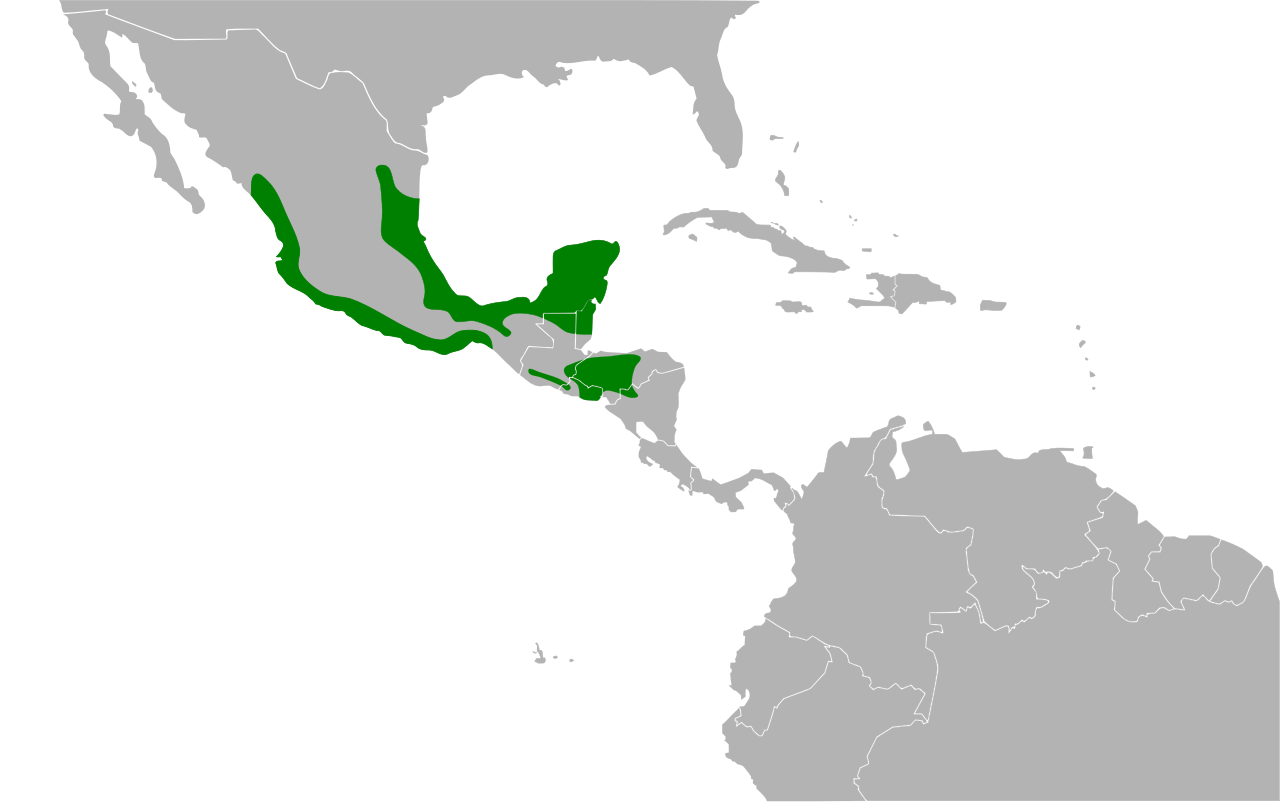
The blue bunting is a species of passerine in the family Cardinalidae, the cardinals or cardinal grosbeaks. It is found in Belize, El Salvador, Guatemala, Honduras, Mexico, and Nicaragua.
Region
Mesoamerica
Typical Environment
Occurs from the Gulf and Pacific slopes of southern Mexico south through Belize, Guatemala, Honduras, El Salvador, and into Nicaragua. It favors dense thickets, forest edges, second-growth scrub, and shaded plantations such as coffee and cacao. Often stays low, foraging within 0–3 m above ground in tangled understory near streams and clearings. It avoids very open habitats but persists in semi-disturbed mosaics with sufficient cover.
Altitude Range
Sea level to 1500 m
Climate Zone
Tropical
Ease of Keeping
Beginner friendly: 2/5
The blue bunting is a shy, understory-dwelling cardinalid often detected by its sweet, thin song rather than by sight. Males are a rich cobalt-blue with a dusky facial mask, while females are warm brown with a buffy eyebrow. It occurs from southern Mexico into northern Central America and favors dense second growth and forest edges. Several subspecies show subtle differences in shade and intensity of blue.


Temperament
shy and skulking
Flight Pattern
short rapid wingbeats, low direct flights between cover
Social Behavior
Usually solitary or in pairs, keeping to dense cover. Nests low in shrubs or thickets; the cup nest is placed well-hidden. Clutches are typically small, and both adults are thought to attend the young. It sometimes joins mixed-species flocks at forest edges.
Migratory Pattern
Resident
Song Description
Song is a series of thin, sweet, musical warbles delivered from a concealed perch. Calls include a sharp, metallic tik and soft chips given while foraging.
Plumage
Male is rich cobalt to deep blue with a dusky to blackish facial mask and lores; lacks wingbars and appears fairly uniform. Female is warm brown with a rufous wash below and a pale buffy supercilium; underparts duller and lightly washed cinnamon. Plumage is smooth, with a compact, bunting-like silhouette and a relatively thick, conical bill.
Diet
Consumes small seeds, soft fruits and berries, and a variety of arthropods such as beetles, caterpillars, and spiders. It gleans prey from foliage and twigs and also picks items from the ground. During the breeding season it may increase insect intake for protein.
Preferred Environment
Feeds in dense understory, vine tangles, and shrubby edges of humid forest and second growth. Also forages along shaded trails, riparian thickets, and within coffee or cacao plantations where cover is ample.


