

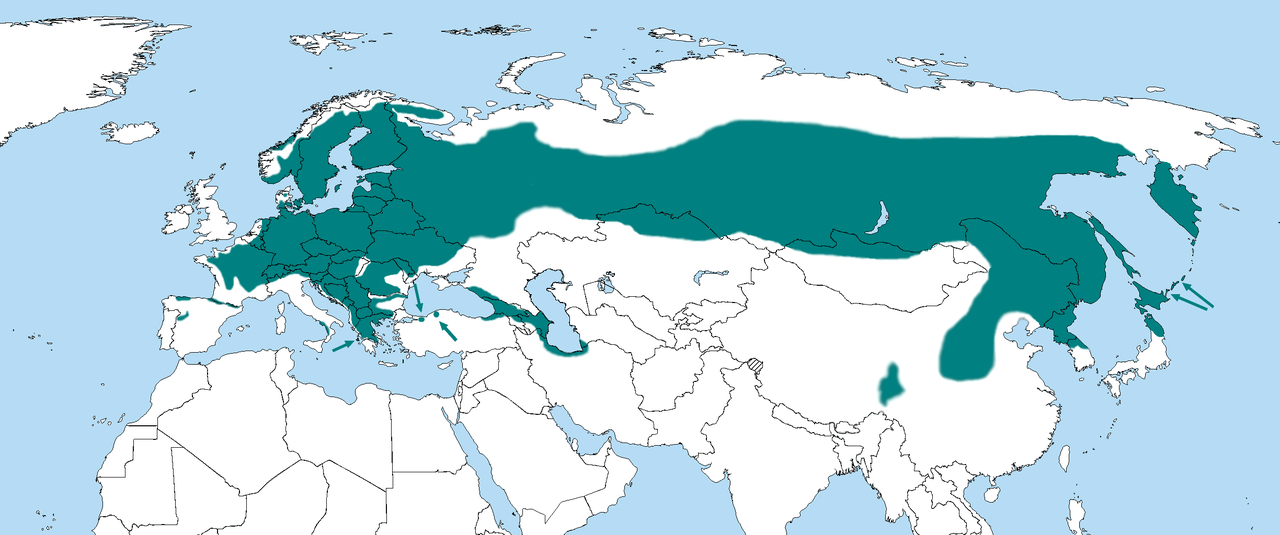
The black woodpecker is a large woodpecker that lives in mature forests across the northern Palearctic. It is the sole representative of its genus in that region, and its range is expanding. The black woodpecker is easily the largest woodpecker species in Europe as well as in the portion of Asia where it lives and is one of the largest species worldwide. This non-migratory species tends to make its home in old-growth forest or large forest stands and excavates a large tree hole to reside in. In turn, several species rely on black woodpeckers to secondarily reside in the holes made in trees by them. This woodpecker's diet consists mostly of carpenter ants. This species is closely related to, and fills the same ecological niche in Europe as, the pileated woodpecker of North America and the lineated woodpecker of South America, also being similar to the white-bellied woodpecker which is distributed to the south somewhat of the black woodpecker in Asia.
Region
Northern Palearctic
Typical Environment
Occurs from western and northern Europe through central and northern Asia to the Russian Far East, northeastern China, the Korean Peninsula, Sakhalin, and Hokkaido. Prefers mature coniferous, mixed, and broadleaf forests with large-diameter trees and abundant deadwood. Often uses old-growth stands but can occupy extensive secondary forests and large managed forest blocks if suitable nest trees are available. Frequently forages on trunks, stumps, fallen logs, and forest edges, and sometimes on the ground at ant nests.
Altitude Range
Sea level to 2000 m
Climate Zone
Temperate
Ease of Keeping
Beginner friendly: 1/5
A keystone cavity-excavator, the black woodpecker creates large nest holes that are later used by owls, ducks, and other forest wildlife. It is the largest woodpecker in Europe and a close ecological counterpart to the pileated woodpecker of North America. Its deep, resonant drumming and piercing calls carry far through mature forests. Populations have expanded in parts of Europe where continuous forest cover has increased.



Skull of a black woodpecker

A black woodpecker taking anting bath in Hungary

Tree work by black woodpecker

Egg, Collection Museum Wiesbaden

The black woodpecker in the coat of arms of Pielisjärvi, Finland
Temperament
shy and wary
Flight Pattern
strong, direct flight with deep wingbeats and brief bounding
Social Behavior
Primarily seen singly or in pairs; pairs defend territories year-round. Monogamous, with both sexes excavating a large cavity high in a mature tree and sharing incubation and chick-rearing. Outside the breeding season it roosts in cavities and may reuse multiple holes within its territory.
Migratory Pattern
Resident
Song Description
Gives loud, ringing calls such as a clear, fluty 'klee-ya' that carries over long distances. Drumming is powerful, resonant, and relatively long in duration compared to smaller woodpeckers.
Plumage
Uniformly black, with a satiny sheen; males show an all-red crown, females a red patch confined to the hindcrown. Large, straight, pale bill and stiff, wedge-shaped tail used for support on trunks.
Diet
Feeds mainly on ants, especially carpenter ants, which it extracts from trunks, stumps, and ant mounds using powerful chiseling blows and a long, sticky tongue. Also takes wood-boring beetle larvae and other insects found in decaying wood. Occasionally consumes berries and other soft plant matter when insect prey is scarce.
Preferred Environment
Forages on standing deadwood, fallen logs, and large live trees with decayed sections. Frequently searches on the ground at ant nests and along forest edges, clearings, and windthrows within extensive forest tracts.


