

The black turnstone is a species of small wading bird. It is one of two species of turnstone in the genus Arenaria, the ruddy turnstone being the other. It is now classified in the sandpiper family, Scolopacidae, but was formerly sometimes placed in the plover family, Charadriidae. It is native to the west coast of North America and breeds only in Alaska.
Region
Pacific coast of North America
Typical Environment
Breeds on low coastal tundra, river deltas, and wet meadows across western and southwestern Alaska. Outside the breeding season it inhabits exposed rocky shorelines, wave-washed reefs, and harbor jetties from southern Alaska through British Columbia to California and northern Baja California. It favors intertidal zones with plentiful barnacles, mussels, and kelp wrack. Occasional wintering birds reach as far south as northwestern Mexico.
Altitude Range
Sea level to 200 m
Climate Zone
Temperate
Ease of Keeping
Beginner friendly: 1/5
Black turnstones are robust shorebirds specialized for prying and hammering open intertidal prey, often flipping stones and kelp to expose invertebrates—hence their name. They breed only in western Alaska and show strong site fidelity, returning to the same territories annually. In winter they concentrate on rocky Pacific shorelines and man-made jetties, where they can be remarkably confiding and active in rough surf.


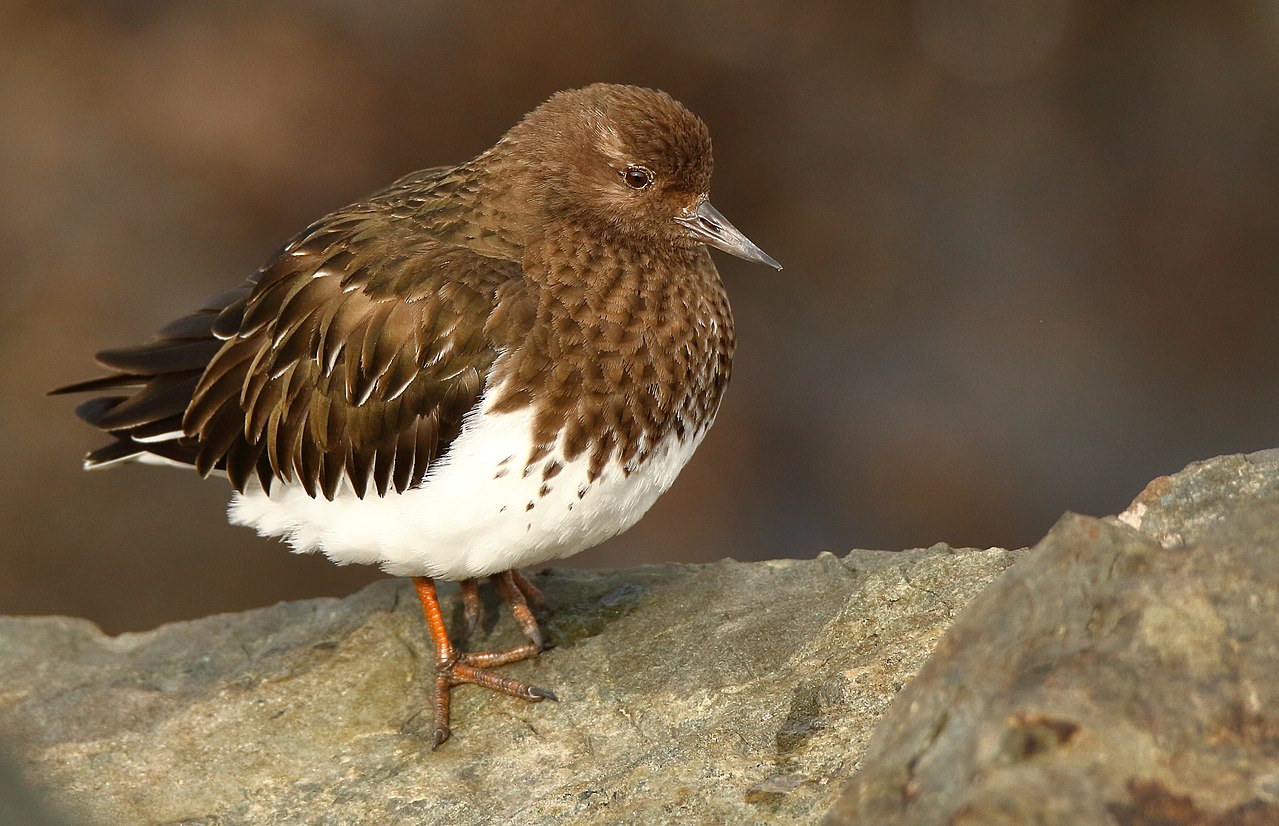
Black turnstone in Humboldt County, California

Winter-plumaged bird in California
Temperament
social and active
Flight Pattern
low, direct flight with short rapid wingbeats
Social Behavior
Breeds in pairs that defend small territories on coastal tundra; both sexes incubate and tend the brood. Outside the breeding season it often forages in loose flocks, especially at productive tide lines and reef edges. Strong site fidelity to both breeding and wintering locations is common.
Migratory Pattern
Seasonal migrant
Song Description
Generally quiet, giving sharp tik or kip notes and dry rattling calls on the shore. On breeding grounds it adds a more rapid chattering series during display flights and territorial interactions.
Plumage
Dark brown to blackish upperparts and breast contrasting with white belly and vent; crisp white shoulder patch and broad white wingbar visible in flight; white tail base with a black terminal band.
Diet
Primarily intertidal invertebrates, including barnacles, mussels, limpets, snails, amphipods, and isopods. It may hammer at shells or pry prey from rocks and kelp, and it frequently flips stones and seaweed to expose hidden animals. During breeding it takes more insects and larvae, and occasionally fish eggs or carrion.
Preferred Environment
Feeds on exposed rocky shores, reef edges, and man-made structures like jetties, especially where surf and tidal action concentrate prey. On the breeding grounds it forages along tundra pools, river margins, and coastal flats.


