

The black-tailed godwit is a large, long-legged, long-billed shorebird first described by Carl Linnaeus in 1758. It is a member of the godwit genus, Limosa. There are four subspecies, all with orange head, neck and chest in breeding plumage and dull grey-brown winter coloration, and distinctive black and white wingbar at all times.
Region
Eurasia and Africa
Typical Environment
Breeds across Iceland, parts of northern and western Europe, and into central Asia in lowland wetlands and damp meadows. In the non-breeding season, it migrates to western Europe, the Mediterranean, sub-Saharan Africa, the Middle East, and the Indian subcontinent, with eastern birds reaching Southeast Asia and Australia. During breeding it favors open, grassy wetlands with shallow water; in winter it frequents estuaries, tidal mudflats, flooded fields, and rice paddies. It forages by probing soft mud and saturated soils, often in loosely formed flocks.
Altitude Range
Sea level to 2000 m
Climate Zone
Temperate
Ease of Keeping
Beginner friendly: 1/5
A tall, elegant shorebird with very long legs and a straight, slender bill, the black-tailed godwit shows rich orange on the head, neck, and breast in breeding season and turns grey-brown in winter. It performs energetic aerial displays over wet meadows and marshes. Populations have declined in many areas due to drainage of wetlands and changes in agricultural practices, though some northern populations (e.g., Iceland) remain relatively strong.


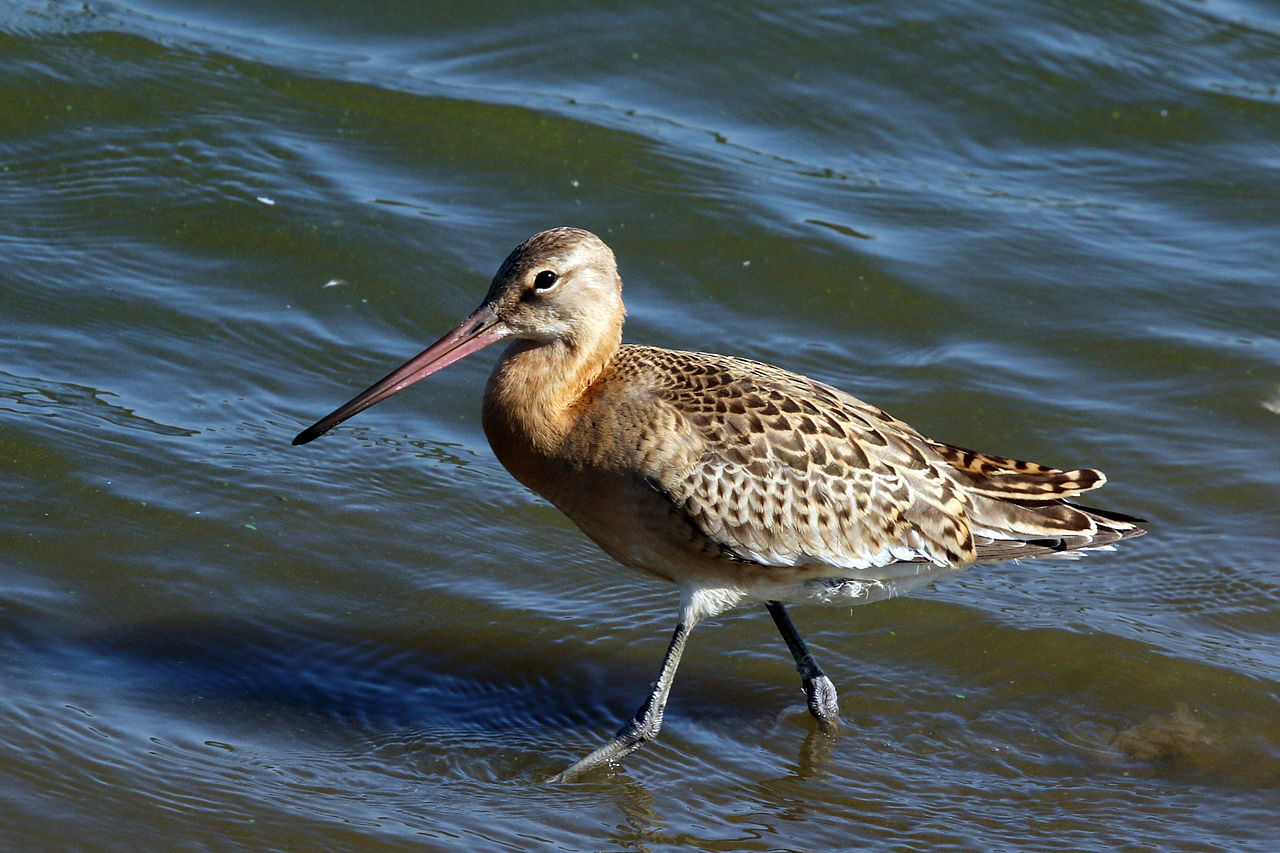
Juvenile (with pink bill)

In flight

Displaying black-tailed godwit

Limosa limosa - MHNT
Temperament
social and alert
Flight Pattern
strong flier with swift, direct wingbeats and buoyant display flights
Social Behavior
Often nests in loose colonies or scattered pairs in open wetlands, with ground nests hidden in vegetation. Typically seasonally monogamous, with males performing display flights and calls over territories. Outside the breeding season it forms flocks, sometimes large, at feeding and roost sites.
Migratory Pattern
Seasonal migrant
Song Description
Display calls are loud, ringing and disyllabic, often rendered as a repeated 'weeka-weeka' or 'god-wit' quality. Contact calls are sharp and carry well over open marshes.
Plumage
In breeding plumage, bright orange head, neck, and chest with barred underparts; in non-breeding, smooth grey-brown upperparts with paler underparts. Always shows a bold white wing stripe, white rump, and a black tail band. Feathers are sleek and close-fitting, aiding in streamlined flight.
Diet
Primarily probes for aquatic and soil invertebrates including worms, insect larvae, beetles, small crustaceans, and mollusks. It may also take small amounts of seeds and grains, especially in agricultural habitats. Foraging is mainly by tactile probing with the long bill, supplemented by visual pecking in shallow water or on soft substrates.
Preferred Environment
Feeds on tidal mudflats, estuarine shallows, saltmarsh edges, flooded fields, and wet meadows. During migration and winter it often uses rice paddies and managed wetlands, roosting on nearby sandbars or shallow lagoons.


