

The black sicklebill is a large member of the birds of paradise family, Paradisaeidae. This species is found throughout most of central New Guinea and the Vogelkop region to the northwest in montane forests at altitudes from 1,800 to 2,150 m.
Region
New Guinea Highlands
Typical Environment
Occurs throughout much of central New Guinea and west to the Vogelkop (Bird’s Head) Peninsula, primarily in montane cloud and mossy forests. Prefers dense, mature forest but also uses forest edges and ridgelines where fruiting trees are available. Forages from the mid-story to the canopy, often on mossy limbs and among epiphytes. It is typically localized by elevation and is scarce below montane zones.
Altitude Range
1800–2150 m
Climate Zone
Highland
Ease of Keeping
Beginner friendly: 1/5
The black sicklebill is a striking bird-of-paradise known for the male’s extremely long, decurved bill and elongated tail streamers used in elaborate courtship displays. It inhabits high montane forests where it forages methodically along mossy branches and epiphyte-laden trunks. Females are cryptically patterned and handle all nesting duties. Its range spans central New Guinea and the Vogelkop (Bird’s Head) region.


Black Sicklebill male

Male specimen of race atratus at the Naturalis Biodiversity Center.

Nominate female specimen at the Naturalis Biodiversity Center.
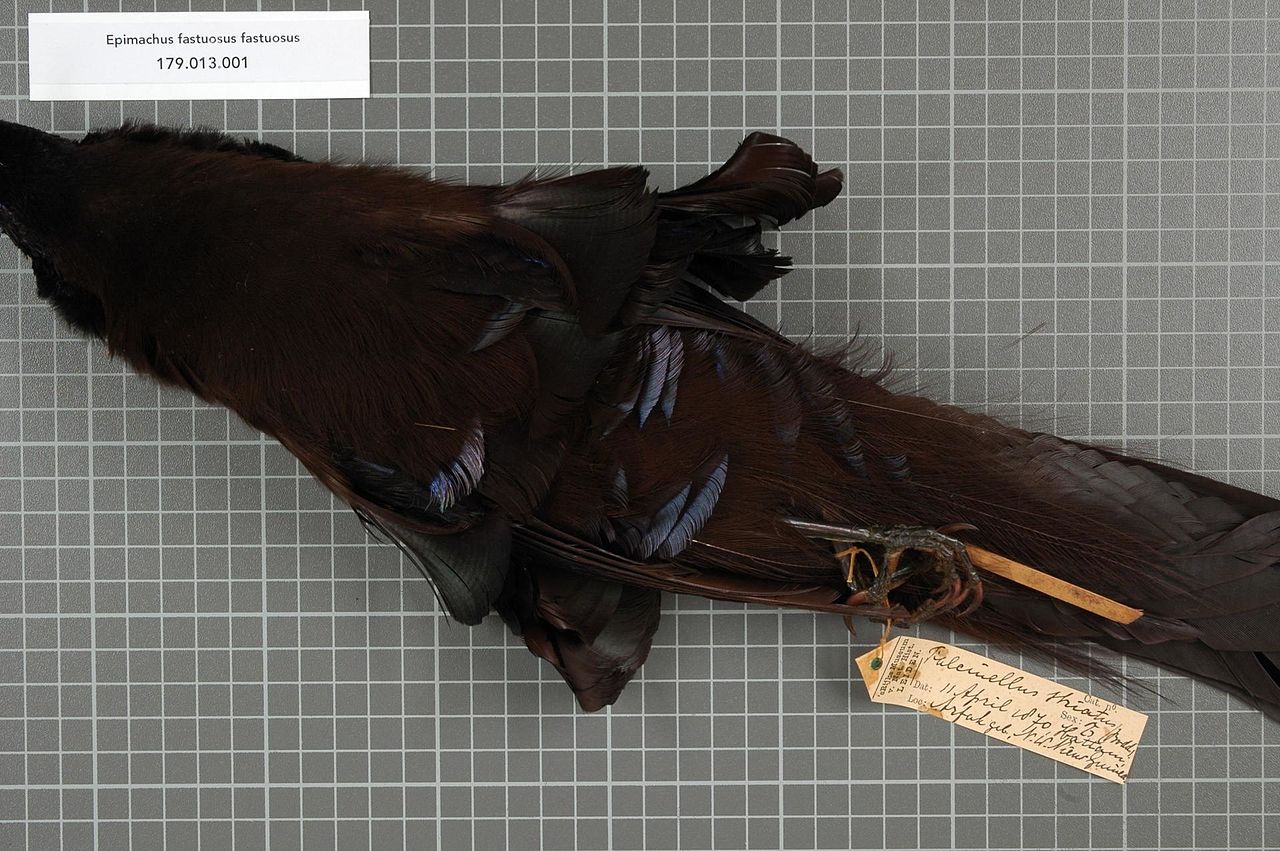
Nominate male specimen at the Naturalis Biodiversity Center. Note the pectoral fans, which are folded on this specimen.

Illustration of male and female.
Temperament
solitary and territorial
Flight Pattern
short rapid wingbeats between perches
Social Behavior
Males display singly at traditional perches, adopting tall postures to show off tail streamers and iridescence. Females build a small cup nest and raise the young alone, usually laying a small clutch. The species is generally inconspicuous outside display periods and forages quietly through mid-levels of the forest.
Migratory Pattern
Resident
Song Description
Gives loud, far-carrying, high-pitched whistles and metallic notes, often delivered from a prominent perch. Calls can be repeated in measured sequences and cut through the forest canopy.
Plumage
Male is velvet-black with a bronzy to greenish iridescent sheen and very long, narrow central tail streamers; female is brown with heavy barring and mottling for camouflage.
Diet
Eats a mix of fruits and arthropods, including berries, figs, beetles, caterpillars, and other insects. Uses its long curved bill to probe into moss, bark crevices, and epiphytes for hidden prey. Will glean and sally short distances to snatch insects and also visits fruiting trees regularly.
Preferred Environment
Forages in the mid-story to canopy of montane cloud forests, often along mossy branches and among epiphytes. Frequently visits forest edges and ridgelines where fruiting trees are abundant.


