

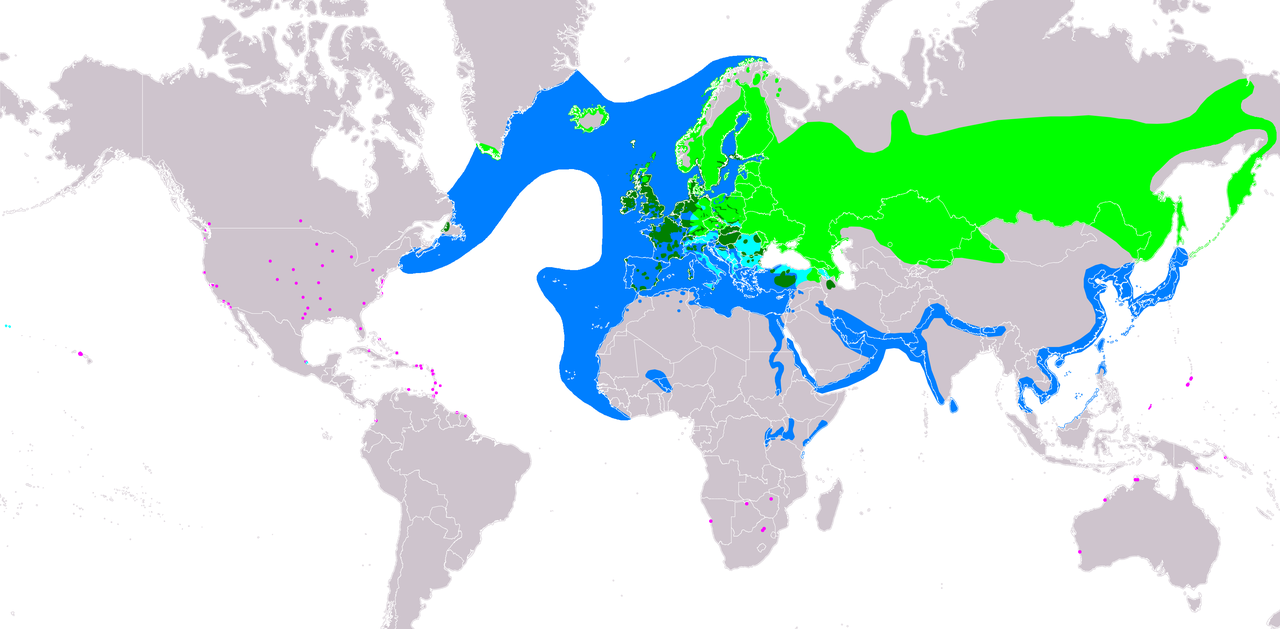
The black-headed gull is a small gull that breeds in much of the Palearctic in Europe and Asia, and also locally in smaller numbers in coastal eastern Canada. Most of the population is migratory and winters further south, but many also remain in the milder areas of northwestern Europe. It was formerly sometimes cited as "common black-headed gull" to distinguish it from "great black-headed gull".
Region
Europe and Asia (Palearctic)
Typical Environment
Breeds widely across temperate Europe and much of Asia in marshes, reedbeds, wet meadows, and along lakes and coastal lagoons. Winters further south into the Mediterranean, North Africa, the Middle East, South Asia, and along ice-free coasts of northwestern Europe. Small numbers occur in coastal eastern Canada. It readily exploits urban and agricultural landscapes, roosting on reservoirs and large lakes and foraging at shorelines, fields, and refuse sites.
Altitude Range
Sea level to 2000 m
Climate Zone
Temperate
Ease of Keeping
Beginner friendly: 2/5
Despite its name, the black-headed gull has a chocolate-brown hood in breeding plumage that disappears in winter, leaving just a dark ear-spot. It is highly adaptable, thriving in wetlands, coastal areas, farmland, and even urban parks and landfills. Often seen following tractors to catch unearthed invertebrates, it also deftly hawks insects in flight.




Temperament
social and active
Flight Pattern
buoyant flier with quick, shallow wingbeats interspersed with short glides
Social Behavior
Highly gregarious year-round, forming large flocks at feeding and roost sites. Nests colonially on the ground near water, often on islets or in dense vegetation. Pairs are seasonally monogamous and defend small territories within colonies.
Migratory Pattern
Partial migrant
Song Description
Vocal and noisy in colonies, giving sharp, yelping calls and scolding notes. Typical calls include a rasping “kree-ar” and chattering “kek-kek” sequences, often delivered in bursts during displays and alarm.
Plumage
Pale grey upperparts with white underparts; blackish primaries with white leading edge. In breeding, a rich chocolate-brown hood; in non-breeding, white head with a dark ear-spot. Feathers appear smooth and sleek, suited to agile flight.
Diet
An opportunistic omnivore that takes insects, earthworms, crustaceans, small fish, and amphibians, as well as seeds and human refuse. Frequently follows ploughs to capture exposed invertebrates and will hawk flying insects over fields and water. Also scavenges at shorelines and urban waste sites, and may practice occasional kleptoparasitism.
Preferred Environment
Feeds along muddy shores, estuaries, and tidal flats, as well as inland fields, wetlands, and parks. Common at landfills and harbors where food is abundant, and often forages in mixed-species gull flocks.


