

The black-billed magpie, also known as the American magpie, is a bird in the corvid family found in the western half of North America. It is black and white, with the wings and tail showing black areas and iridescent hints of blue and blue-green. It was once thought to be a subspecies of Pica pica, which was known as the black-billed magpie at the time, but was placed into its own species in 2000 based on genetic studies. Currently, Pica pica is the scientific name of the Eurasian magpie.
Region
Western North America
Typical Environment
Occurs from southern Alaska and western Canada through the Great Plains and Intermountain West into the southwestern United States. Prefers open habitats with scattered trees or shrubs such as riparian corridors, ranchlands, agricultural edges, and suburban parks. Avoids dense forests and unbroken deserts but thrives in human-modified landscapes. Commonly found near watercourses and in sagebrush, cottonwood groves, and pastures.
Altitude Range
Sea level to 3000 m
Climate Zone
Temperate
Ease of Keeping
Beginner friendly: 1/5
The black-billed magpie is a bold, intelligent corvid common across western North America, often seen in open country and around ranches and towns. Its long iridescent tail makes up more than half its body length. Pairs build large, domed stick nests and may be assisted by helpers. It was split from the Eurasian magpie based on genetic differences and is now recognized as a separate species.


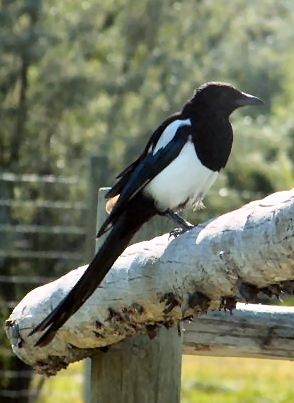
In Yellowstone Bear World (near Idaho Falls, Idaho)

A pair of magpies showing iridescent blue-green wings and tail
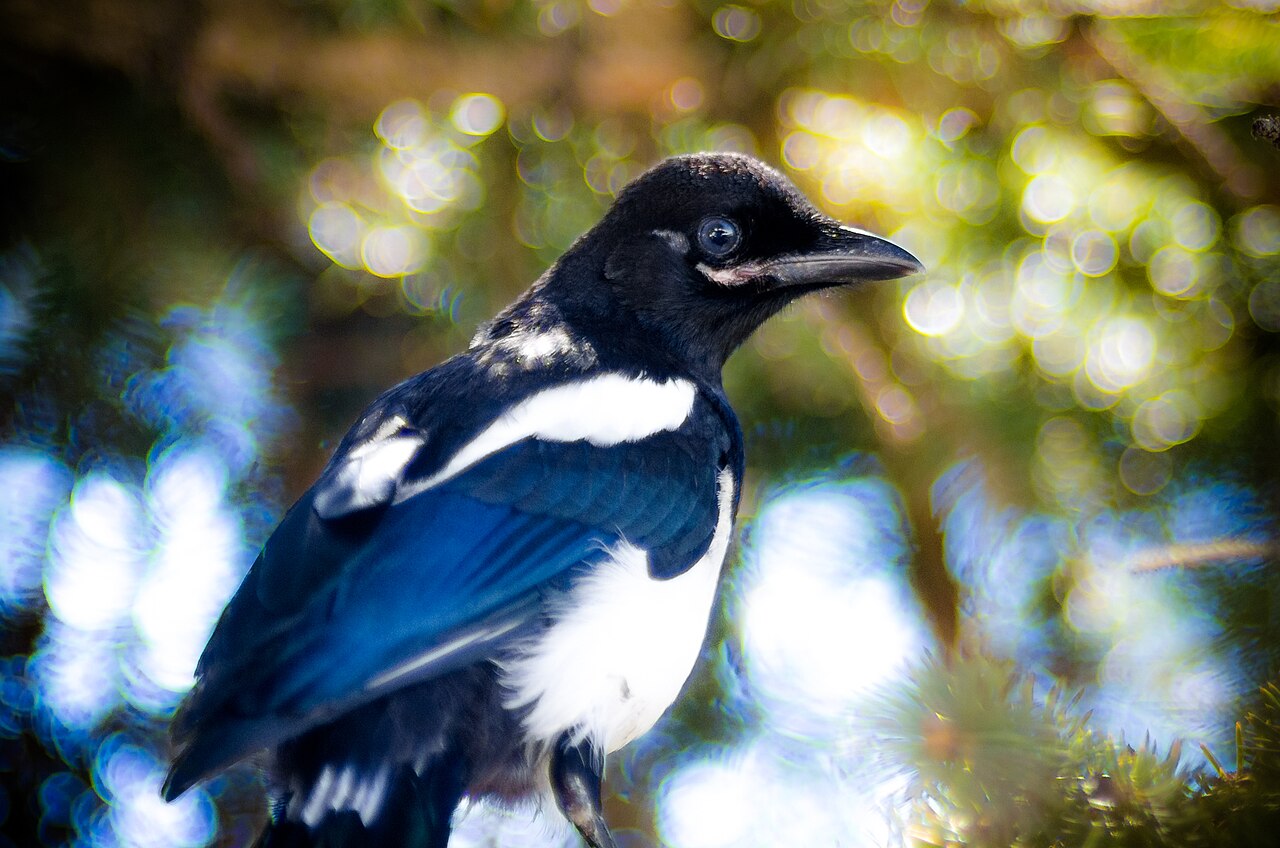
A juvenile with grey irises and slightly visible pink mouth-lining

Magpie vocalizing in Flagstaff County, Alberta

An abandoned nest seen in the fall

Scavenging the remains of an animal

Eating insects off the back of a cow

Seen in flight
Temperament
social and bold
Flight Pattern
short rapid wingbeats with glides
Social Behavior
Typically found in pairs or small groups, forming larger flocks outside the breeding season. Pairs are largely monogamous and build a large domed nest of sticks lined with softer materials, often in trees or tall shrubs. Cooperative breeding with helpers at the nest can occur, and birds cache food for later use.
Migratory Pattern
Partial migrant
Song Description
Vocalizations are harsh, rapid chattering and scolding calls, often rendered as mag-mag-mag and rattling series. They also give whistles and varied chatter used in social interactions and alarm.
Plumage
Glossy black head, back, and long wedge-shaped tail with iridescent blue-green sheen; contrasting white shoulders, belly, and wing patches.
Diet
An opportunistic omnivore taking insects, spiders, and other invertebrates, as well as carrion and small vertebrates. Also consumes eggs and nestlings, seeds and grains, berries, and human food scraps. Frequently caches surplus food. Occasionally picks ectoparasites from large mammals and scavenges around human activity.
Preferred Environment
Forages mostly on the ground in open fields, pastures, and along roadsides, as well as in riparian thickets and suburban greenspaces. Often associates with livestock and agricultural areas where food is abundant.


