
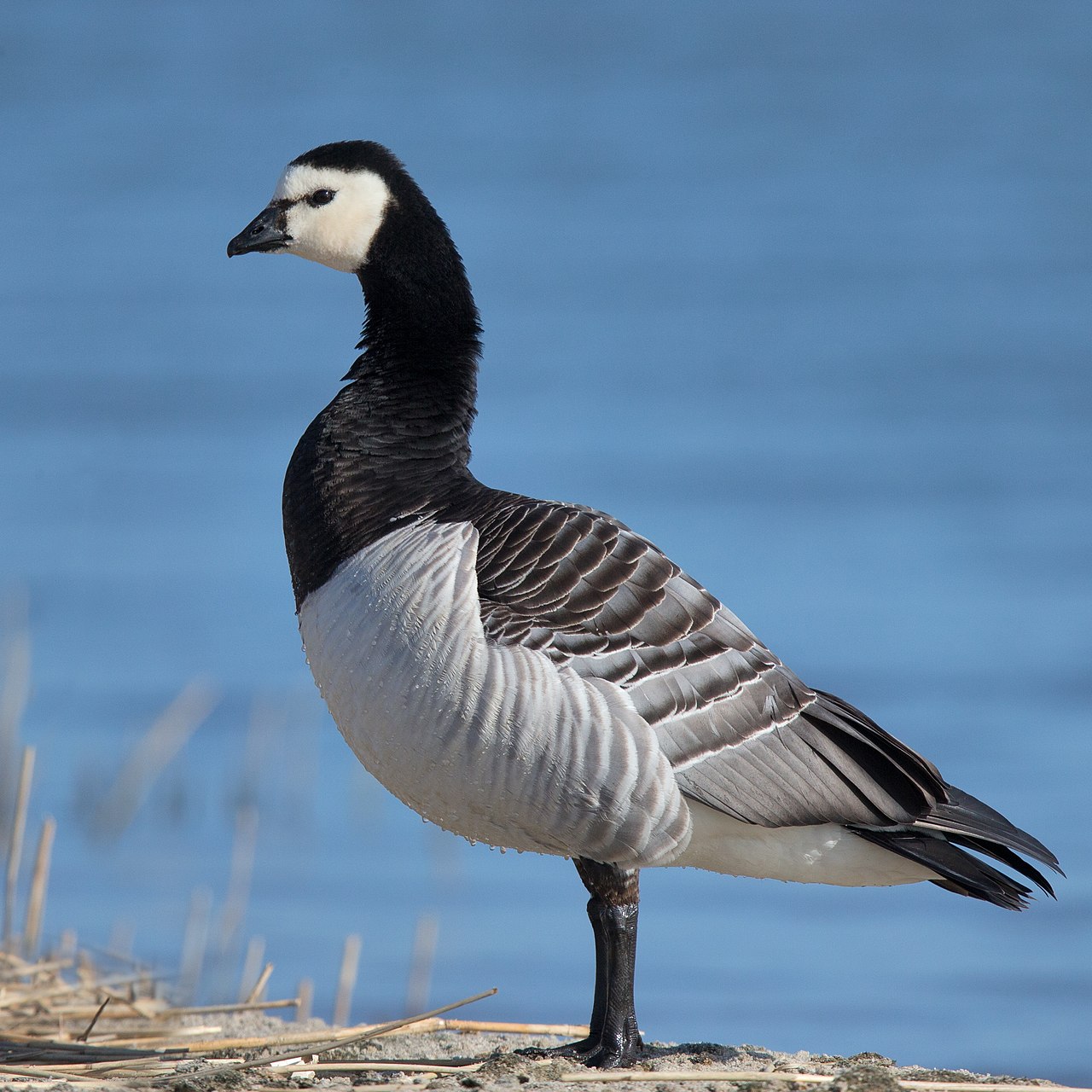
The barnacle goose is a species of goose that belongs to the genus Branta of black geese, which contains species with extensive black in the plumage, distinguishing them from the grey Anser species. Despite its superficial similarity to the brant goose, genetic analysis has shown its closest relative is the cackling goose.
Region
North Atlantic and Arctic Europe
Typical Environment
Breeds on coastal Arctic tundra and sea-cliffs in Greenland, Svalbard (Norway), and arctic Russia. In winter it moves to temperate coastal lowlands, saltmarshes, estuaries, and adjacent agricultural fields across the British Isles, the Netherlands, Germany, and Denmark. Nesting often occurs on steep cliffs to avoid predators, with broods moving to lowland feeding areas soon after hatching. It frequently roosts on islands or offshore sandbanks and forages on short, nutrient-rich swards.
Altitude Range
Sea level to 600 m
Climate Zone
Polar
Ease of Keeping
Beginner friendly: 2/5
Medieval Europeans believed barnacle geese emerged from driftwood barnacles, which influenced fasting rules; in reality they breed in the Arctic. Genetic studies show they are closer to the cackling goose than to the superficially similar brant goose. Three main flyway populations breed in Greenland, Svalbard, and Arctic Russia and winter around the North Sea and British Isles.


Temperament
social and alert
Flight Pattern
strong flier with rapid wingbeats; often travels in tight V-formations
Social Behavior
Highly gregarious outside the breeding season, forming large flocks on feeding grounds and roosts. Pairs are monogamous and nest colonially on cliffs or rocky outcrops. Goslings famously leap from cliff ledges to reach feeding areas under parental supervision. Adults maintain strong family groups during migration and winter.
Migratory Pattern
Seasonal migrant
Song Description
Calls are sharp, high-pitched yipping and barking notes, higher and more yelping than many other geese. In flight, flocks give a rapid, conversational chorus of yaps and honks that carries over long distances.
Plumage
Crisp black-and-white contrast with barred gray mantle; black neck and breast with clean white face and belly.
Diet
Primarily grazes on short grasses, sedges, and leaves, clipping vegetation close to the ground. In winter it feeds on saltmarsh plants, winter cereals, and pasture grasses, and will glean spilled grain. It may also take mosses and some aquatic vegetation near roosts.
Preferred Environment
Most feeding occurs on coastal saltmarshes, estuarine meadows, and nearby agricultural fields. Birds favor short, nutrient-rich swards near safe roosting sites on islands or sandbanks.


