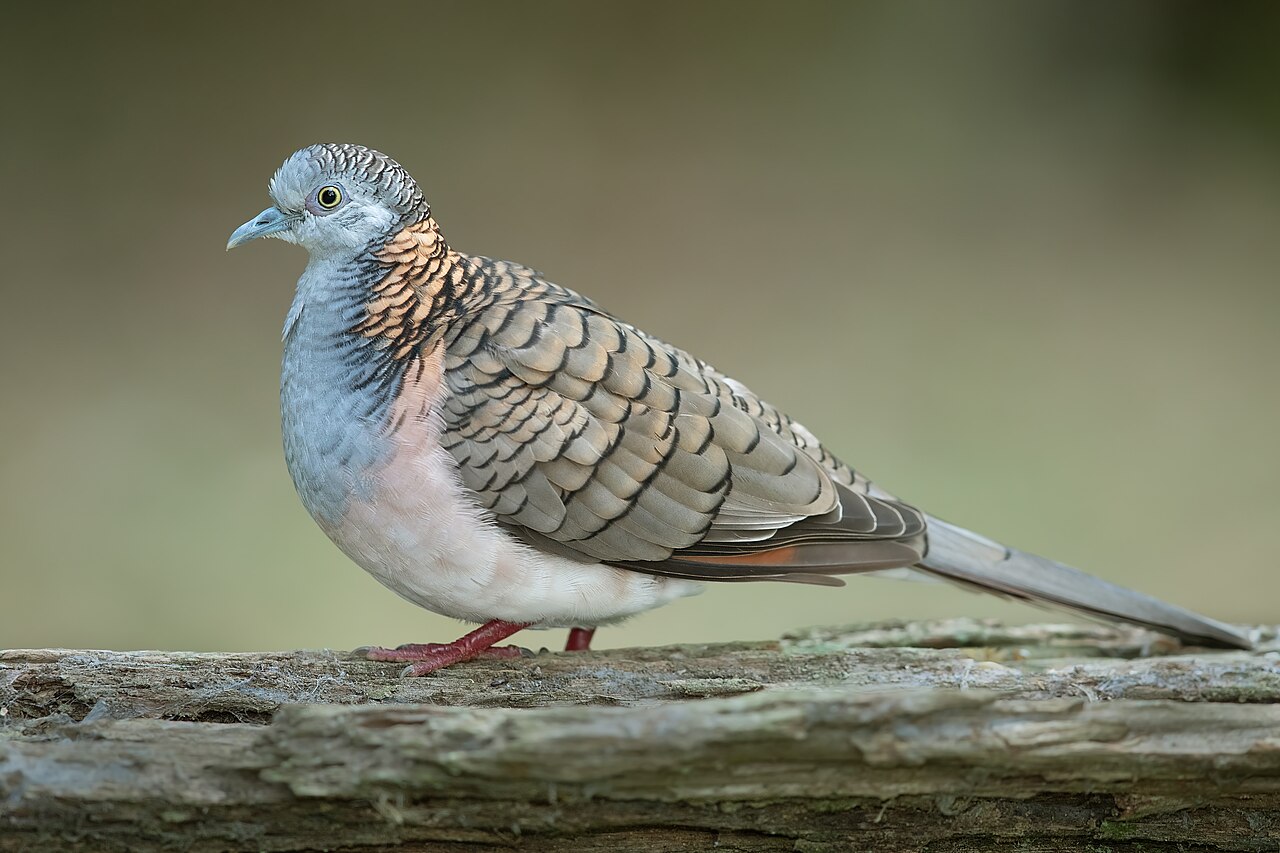
The bar-shouldered dove is a species of long tailed dove native to Australia and Southern New Guinea. It is protected under the National Parks and Wildlife Act 1974. It is a medium-sized pigeon varying in size from 26–30 cm (10–12 in). Its voice is a distinctive and melodious "cook-a-wook" or "coolicoo".
Region
Northern Australia and southern New Guinea
Typical Environment
Occurs across coastal and subcoastal northern and eastern Australia, extending into southern New Guinea. Favors open forests, eucalypt and paperbark woodlands, riparian margins, mangroves edges, and town parks and gardens. Most common near permanent water and along forest edges, tracks, and clearings. Avoids the most arid interior and dense closed forest. Frequently enters suburban areas where suitable cover and seed sources are available.
Altitude Range
Sea level to 1000 m
Climate Zone
Tropical
Ease of Keeping
Beginner friendly: 3/5
A long-tailed, ground-foraging dove best known for the coppery, barred 'shoulders' and nape that give it its name. Its mellow, repetitive cook-a-wook call is commonly heard in woodlands and suburban parks across northern and eastern Australia and southern New Guinea. It often stays near water and adapts well to lightly modified habitats. Nests are simple stick platforms placed in shrubs or trees, and both parents share incubation.


Temperament
quiet and wary, often tame in suburban settings
Flight Pattern
short rapid wingbeats with swift, direct flight
Social Behavior
Usually seen singly, in pairs, or small loose groups; forms larger gatherings at good water or food sources. Courtship includes bowing and soft cooing by the male. The nest is a flimsy stick platform, typically 1–5 m above ground, with two glossy white eggs. Both adults incubate and feed the young with crop milk.
Migratory Pattern
Resident
Song Description
A mellow, resonant cook-a-wook or coolicoo, repeated in steady sequences. Calls carry well through open woodland, often delivered from a perch. Soft contact coos and wing claps may be heard during display or takeoff.
Plumage
Fine coppery-rufous barring on the nape and shoulders with a subtly scaled appearance; head and breast grey-blue grading to buff underparts. Long, graduated tail with pale edges and tips; upperparts brownish-grey with delicate patterning. Feathers appear smooth and close-fitting, giving a neat, sleek look.
Diet
Primarily takes small seeds of grasses, herbs, and weeds gleaned from the ground. Also eats fallen grains in farmlands and around human settlements. Occasionally supplements with small invertebrates such as ants or beetles and ingests grit to aid digestion.
Preferred Environment
Feeds mostly on open ground along tracks, lawns, and edges of woodland near cover. Common around water points, picnic areas, and lightly grazed pastures. Will forage under shrubs and in leaf litter in parks and gardens.