

The Australian wood duck, maned duck or maned goose is a dabbling duck found throughout much of Australia. It is the only living species in the genus Chenonetta. Traditionally placed in the subfamily Anatinae, it might belong to the subfamily Tadorninae (shelducks); the ringed teal may be its closest living relative.
Region
Australia
Typical Environment
Occurs across most of Australia, including Tasmania, but is scarce in the driest interior deserts. Prefers open woodlands, grasslands, farm dams, and urban parks rather than large open water. Nests in tree hollows and uses nearby wetlands, rivers, and creeks for drinking and refuge. Readily occupies human-modified habitats such as golf courses and pastures where short grass is available.
Altitude Range
Sea level to 1500 m
Climate Zone
Temperate
Ease of Keeping
Beginner friendly: 2/5
Also called the maned duck or maned goose, it is the sole living member of the genus Chenonetta. Pairs are typically long-term and nest in tree hollows, sometimes far from water, with ducklings leaping to the ground shortly after hatching. Unlike many ducks, it grazes on land like a small goose and often frequents parks and farmland. It is common across much of Australia and adapts well to human-modified landscapes.


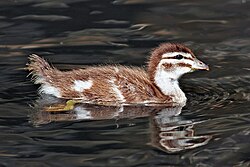
Chenonetta jubata - MHNT


Temperament
social and alert
Flight Pattern
strong flier with swift, direct flight and rapid wingbeats
Social Behavior
Usually seen in pairs or small family groups, forming larger flocks outside the breeding season. Largely monogamous; nests in tree hollows lined with down, sometimes far from water. Ducklings leap from the nest to follow parents to feeding areas, and families often graze together on short grass.
Migratory Pattern
Resident
Song Description
Vocalizations are sexually dimorphic: males give soft, high-pitched whistles and gurgling notes. Females produce louder, harsh honks and cackles, especially in flight or when alarmed.
Plumage
Fine grey scalloping on the breast and flanks with a grey-brown back; pale underparts and darker tail. Male has a rich dark brown head and a short black mane on the nape; female is paler with strong white facial stripes and speckled underparts. Both sexes show a white panel in the wing visible in flight.
Diet
Primarily grazes on grasses, clover, herbs, and seeds taken on land. Also consumes agricultural grains when available. Will opportunistically take insects and other small invertebrates, especially during the breeding season. Rarely dabbles compared to other ducks, spending much feeding time away from open water.
Preferred Environment
Short-grass areas such as pastures, lawns, golf courses, roadside verges, and open woodland clearings near water. Frequently forages at farm dams and along creek margins but may feed hundreds of meters from water.


