

The Australian pelican is a large waterbird in the family Pelecanidae, widespread on the inland and coastal waters of Australia and New Guinea, also in Fiji, parts of Indonesia and as a vagrant in New Zealand. It is a predominantly white bird with black wings and a pink bill. It has been recorded as having the longest bill of any living bird. It mainly eats fish, but will also consume birds and scavenge for scraps if the opportunity arises.
Region
Australasia
Typical Environment
Found widely across Australia, Tasmania, and southern New Guinea, with vagrants to New Zealand and nearby Pacific islands. Occupies coastal estuaries, bays, and lagoons, as well as large inland lakes, rivers, and reservoirs. It readily exploits temporary inland wetlands after rain and congregates in large numbers where fish are concentrated. Roosting occurs on sandbars, islands, and occasionally in trees near water.
Altitude Range
Sea level to 1500 m
Climate Zone
Other
Ease of Keeping
Beginner friendly: 1/5
This species has the longest bill of any living bird, with males reaching close to 50 cm. Australian pelicans often feed cooperatively, corralling fish into tight groups. Breeding can be highly opportunistic and may boom after heavy inland rains when temporary lakes form. Their elastic gular pouch drains water before swallowing prey.


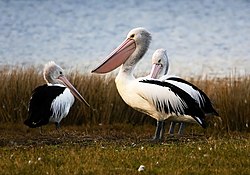
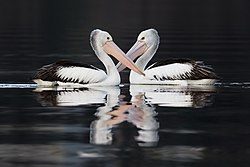
Pelican showing length of beak and size of pouch



Temperament
social and active
Flight Pattern
soaring glider
Social Behavior
Often forms large flocks and feeds cooperatively, driving fish into shallow water. Breeds colonially on islands or remote sandbanks, constructing simple ground nests. Breeding is opportunistic and tied to water availability, with chicks sometimes forming crèche groups.
Migratory Pattern
Partial migrant
Song Description
Generally quiet, issuing deep grunts, croaks, and low honks around colonies. Wingbeats may produce an audible whoosh in flight.
Plumage
Predominantly white with contrasting black flight feathers and upperwing coverts; clean white neck and body.
Diet
Primarily consumes fish caught near the surface using the bill and expandable pouch. Also takes crustaceans, amphibians, and occasionally small birds or carrion. Will scavenge at fishing harbors and cleaning stations. Cooperative foraging lines and leap-frogging tactics help concentrate prey.
Preferred Environment
Feeds in shallow coastal lagoons, estuaries, river mouths, and inland lakes and reservoirs. Often hunts along shorelines, sandbars, and around fish schools at the surface. Takes advantage of ephemeral inland waters where fish are trapped in receding pools.


