

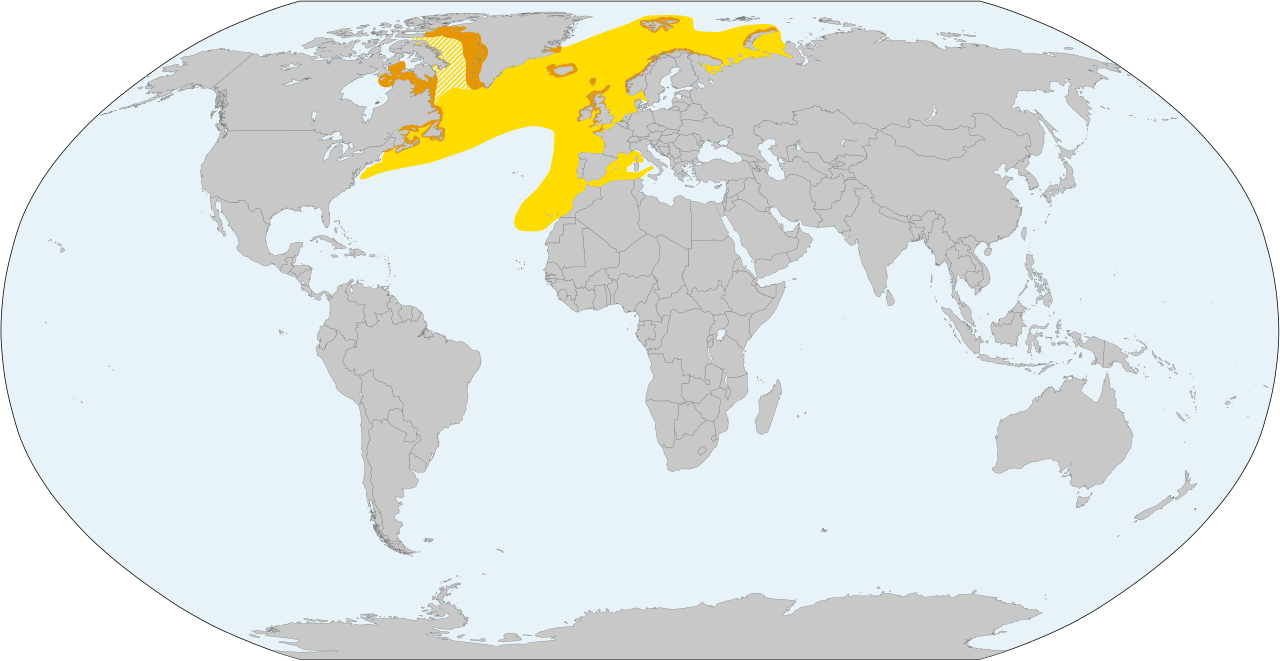
The Atlantic puffin, also known as the common puffin, is a species of seabird in the auk family. It is the only puffin native to the Atlantic Ocean; two related species, the tufted puffin and the horned puffin, are found in the northeastern Pacific. The Atlantic puffin breeds in Russia, Iceland, Ireland, Britain, Norway, Greenland, Newfoundland and Labrador, Nova Scotia, and the Faroe Islands, and as far south as Maine in the west and France in the east. It is most commonly found in the Westman Islands, Iceland. Although it has a large population and a wide range, the species has declined rapidly, at least in parts of its range, resulting in it being rated as vulnerable by the IUCN. On land, it has the typical upright stance of an auk. At sea, it swims on the surface and feeds on zooplankton, small fish, and crabs, which it catches by diving underwater, using its wings for propulsion.
Region
North Atlantic Ocean
Typical Environment
Breeds on rocky islands and coastal cliffs across the high-latitude North Atlantic, including Iceland, the British Isles, Norway, the Faroe Islands, Greenland, and parts of eastern Canada and the northeastern United States. It nests in burrows dug into grassy slopes or in crevices among rocks. Outside the breeding season, it disperses widely over the open ocean, often far from land. Foraging is concentrated over productive shelf waters and fronts where small schooling fish aggregate. It avoids enclosed seas and is only rarely seen inland.
Altitude Range
Sea level to 300 m
Climate Zone
Temperate
Ease of Keeping
Beginner friendly: 1/5
Atlantic puffins can carry several fish crosswise in their bill at once thanks to spiny tongues and specialized palatal spines. They spend most of the year far out at sea and come to land only to breed in dense colonies. Lifelong pair bonds are common, and both parents share incubation and feeding duties.


Atlantic puffing spreading its wings

Adult puffins have boldly coloured beaks in the breeding season.

Appearance of beak and eyes during the breeding season (left) and after the moult (right; lettered items have been shed)

Atlantic puffin approaching for a landing at a colony in Bakkagerði, Iceland


With lesser sand eels (Ammodytes tobianus)


Typical Atlantic puffin breeding habitat in Iceland

Puffin Island, County Kerry, Ireland, a dedicated puffin conservation area

In flight over the Isle of May, Scotland

This diagram shows how oil spills can affect the Atlantic Puffin and their population. Key: 1) Oiled plumage makes Atlantic Puffin less buoyant and reduces its ability to be insulated. 2) The Atlantic Puffin dies. 3) The Atlantic Puffins that live try to remove oil by preening. 4) The Atlantic Puffin ingests and inhales toxins from oil, inflaming their airway and gut. 5) This causes traumatic damage to the liver and kidneys.6) The damage contributes to loss of reproductive success.

Photographing birds


Faroe Islands 1978 postal stamp by Holger Philipsen
Temperament
social and active
Flight Pattern
short rapid wingbeats, low over water
Social Behavior
A highly colonial breeder, forming dense nesting aggregations on islands and sea cliffs. Pairs often remain together for many years, nesting in burrows or rock crevices and laying a single egg. Both adults share incubation and provisioning, delivering strings of fish held crosswise in the bill.
Migratory Pattern
Seasonal migrant
Song Description
Vocal at the nest with low growls, grumbles, and purring calls rather than melodious song. Sounds carry through burrow systems and are used in pair and territory interactions.
Plumage
Crisp black upperparts and white underparts with a white face and black cap; smooth, tight plumage adapted for diving.
Diet
Primarily small schooling fish such as sand eels (sandeels), capelin, herring, and sprat. Will also take small crustaceans and other marine invertebrates, especially outside the breeding season. It is a pursuit diver, using its wings to propel underwater and catching prey on repeated dives. Specialized bill and tongue spines allow it to hold multiple fish while continuing to hunt.
Preferred Environment
Feeds over productive coastal and shelf waters, tidal fronts, and upwelling zones near breeding colonies during chick-rearing. In the nonbreeding season it forages far offshore across the open North Atlantic, often in cold, nutrient-rich waters.


