
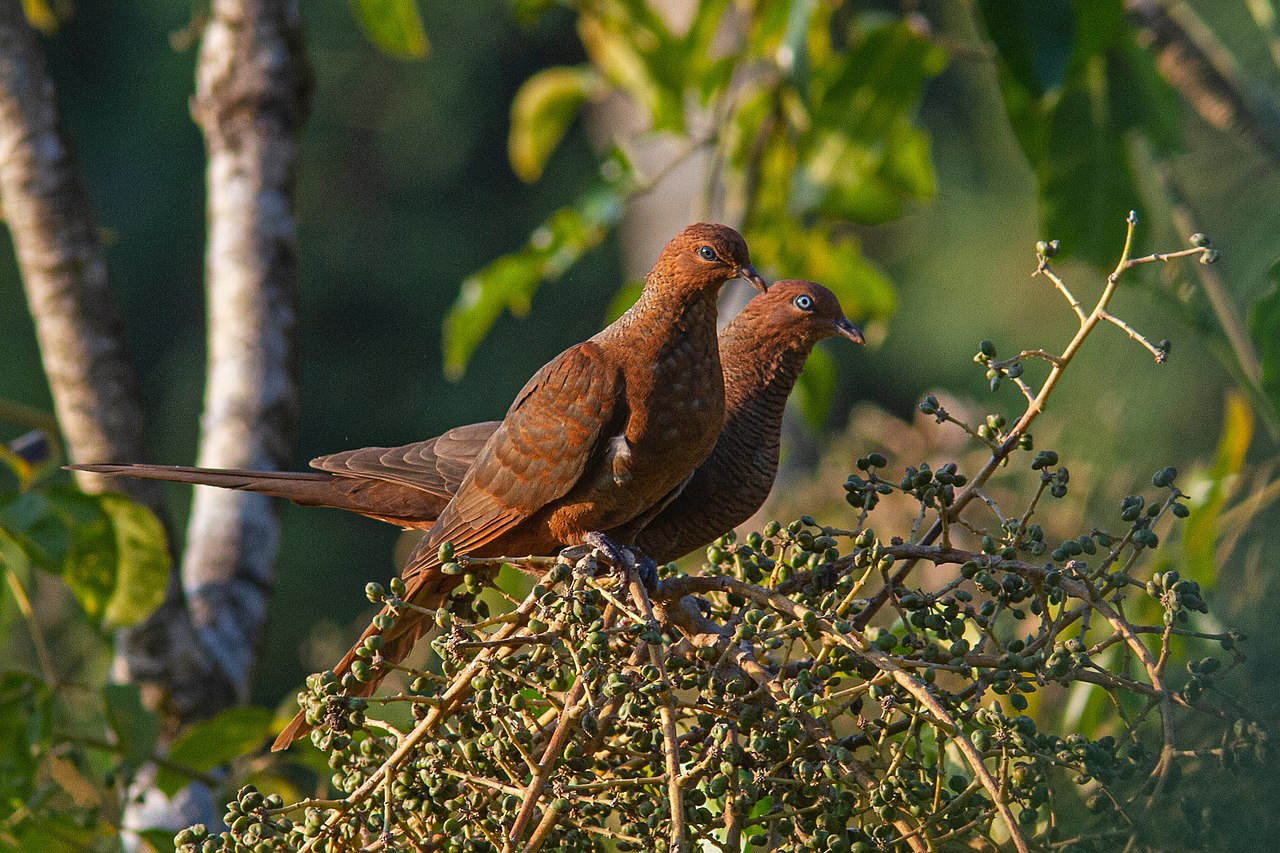
The Andaman cuckoo-dove is a species of bird in the family Columbidae. It is endemic to the Andaman and Nicobar Islands. It is characterized by its small body and rusty color. Its call is a repeated cooing "koo". Due to habitat loss and hunting, the species is becoming rare, yet it is listed as Least Concern. The Department of Environment and Forests, Andaman and Nicobar Islands, and the Zoological Survey of India are monitoring, surveying, and bringing awareness to the species' population. The species is frequently discovered in or around forest areas, with a diet that consists of mostly fruits and berries. The Andaman cuckoo-dove's breeding season is believed to be from February to April, but little information is known about this species.
Region
Andaman and Nicobar Archipelago
Typical Environment
Occupies primary and secondary evergreen forests, forest edges, and scrubby clearings. Often follows fruiting trees such as figs and other native drupes, and may venture into plantations and orchards near villages. Generally keeps to the mid-story but will feed in the canopy and occasionally on the ground along quiet tracks. It is most frequently encountered in relatively undisturbed woodland, but persists in patchy habitats where fruit is available.
Altitude Range
Sea level to 700 m
Climate Zone
Tropical
Ease of Keeping
Beginner friendly: 2/5
The Andaman cuckoo-dove is a shy, forest-dwelling dove restricted to the Andaman and Nicobar Islands. Its mellow, repeated koo calls carry far in the early morning and late afternoon. It favors fruiting trees and can sometimes be seen at forest edges and village orchards. Habitat loss and occasional hunting have affected local numbers, though it is currently assessed as Least Concern.


Temperament
shy and skulking
Flight Pattern
direct flight with rapid wingbeats
Social Behavior
Usually seen singly or in pairs, occasionally in small loose groups at fruiting trees. Nests are flimsy twig platforms placed in dense foliage or a small tree, with a brief nesting period. The breeding season is reported mainly from February to April in the islands, though timing may vary with fruit availability.
Migratory Pattern
Resident
Song Description
A series of deep, mellow koo notes delivered at measured intervals, often repeated from a shaded perch. Calls carry well through forest, especially at dawn and late afternoon.
Plumage
Warm rufous-brown overall with a long, graduated tail; males show a vinous-rufous wash on the breast with faint darker barring on the mantle and wings. The nape can show a subtle bronzy or greenish gloss in good light. Tail shows a darker subterminal band and paler tip; underparts are otherwise fairly plain.
Diet
Feeds primarily on small fruits and berries, especially figs (Ficus), drupes, and other soft forest fruits. Will also take seeds and tender buds when fruit is scarce. Foraging is mostly deliberate and quiet, picking food directly from branches or gleaning from the forest floor. Seasonal fruiting strongly influences local movements.
Preferred Environment
Mid-story and canopy of evergreen and semi-evergreen forest, edges, and secondary growth. Frequently visits fruiting trees along trails, clearings, and village orchards.


