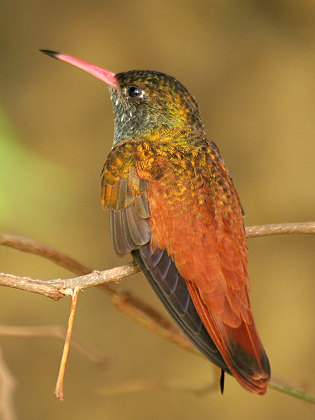
The Altamira yellowthroat is a New World warbler. It is a resident breeding bird endemic to the Gulf slope of north-eastern Mexico.
Region
Northeastern Mexico (Gulf Coast)
Typical Environment
Found in the lowland Gulf coastal plain, it inhabits freshwater and brackish marshes with dense stands of cattails and bulrushes, as well as grassy edges of lagoons and slow-moving streams. It favors emergent vegetation with standing water and scattered shrubs. The range is highly localized around coastal Tamaulipas, including the Altamira area, with populations in small, fragmented wetlands. It occurs most often where water levels persist year-round and reedbeds are tall and continuous.
Altitude Range
Sea level to 200 m
Climate Zone
Subtropical
Ease of Keeping
Beginner friendly: 1/5
The Altamira yellowthroat is a marsh-dwelling New World warbler restricted to the Gulf slope of northeastern Mexico. Males have a striking black facial mask that contrasts with bright yellow underparts, while females are duller and lack the mask. It is threatened mainly by drainage and alteration of coastal wetlands, leading to fragmented populations.


Temperament
secretive and territorial
Flight Pattern
short rapid wingbeats, low over vegetation
Social Behavior
Typically seen in pairs during the breeding season, maintaining small territories within marsh vegetation. Nests are cup-shaped and placed low in cattails, sedges, or dense grasses. Both parents attend the young, and adults often skulk within cover, occasionally singing from exposed reed tops.
Migratory Pattern
Resident
Song Description
Song is a bright, repetitive series of chattering phrases reminiscent of other yellowthroats but with a distinctive, ringing quality. Calls include sharp chips and scolding notes given from cover.
Plumage
Male with olive upperparts and bright yellow underparts, a bold black facial mask bordered by pale gray; female olive-brown above and dull yellow below, lacking the mask. Both sexes show smooth, close-fitting plumage adapted to moving through dense reeds.
Diet
Primarily takes insects and other small arthropods, including caterpillars, beetles, flies, and spiders. It gleans and probes among reeds and grasses, often hopping low over water or clinging to stems. Occasional small snails or larvae may be taken, and very rarely small berries when insects are scarce.
Preferred Environment
Feeds within dense emergent vegetation such as cattails, bulrushes, and sedge beds in marshes and lagoon margins. Edges with scattered shrubs and stable shallow water are favored for foraging.