
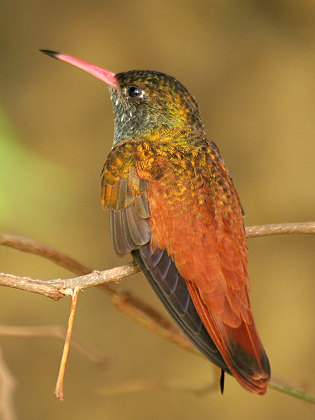
The amazilia hummingbird is a hummingbird in the "emeralds", tribe Trochilini of subfamily Trochilinae. It is the only species placed in the genus Amazilis. It is found in Ecuador and Peru. Its six subspecies differ primarily in their throat and belly colors.
Region
Pacific slope of Ecuador and Peru
Typical Environment
Occurs from coastal lowlands to Andean foothills on the western side of the Andes. It favors arid to semi-arid habitats, including dry scrub, open deciduous woodland, river valleys, and agricultural edges. Frequently found in towns and cities where ornamental flowering plants and feeders are available. It uses both natural desert vegetation and human-modified green spaces, often becoming quite tolerant of people.
Altitude Range
Sea level to 2500 m
Climate Zone
Arid
Ease of Keeping
Beginner friendly: 1/5
The Amazilia hummingbird is the sole species in the genus Amazilis and belongs to the 'emeralds' group of hummingbirds. It is common along the Pacific slope of Ecuador and Peru, including urban areas where it readily visits gardens and feeders. Six recognized subspecies vary mainly in throat and belly coloration, ranging from whitish to rich rufous. Like other hummingbirds, it can hover precisely and has a rapid, high‑pitched call.


Temperament
territorial and bold
Flight Pattern
short rapid wingbeats with precise hovering; agile darting between flowers
Social Behavior
Generally solitary away from breeding, defending rich nectar sources aggressively against other hummingbirds. The female builds a small cup nest of plant fibers bound with spider silk, usually placed on a branch or human structure. Clutch is typically two eggs; the female incubates and raises the young without male assistance.
Migratory Pattern
Resident
Song Description
Vocalizations are thin, high-pitched chips and rapid, metallic trills. Songs are simple and repetitive; calls accelerate during territorial chases and when at feeders.
Plumage
Upperparts shimmering green to bronze-green with a rufous to cinnamon tail; underparts vary by subspecies from whitish or buffy to warm rufous, sometimes with green speckling on the throat. Feathers are smooth and iridescent on the head and back. Tail is slightly forked and typically rich rufous.
Diet
Primarily consumes nectar from a wide variety of native and ornamental flowers, including shrubs, vines, and cacti. Supplements its diet with small insects and spiders for protein, captured in mid-air or gleaned from foliage. Frequently visits garden feeders offering sugar water when available.
Preferred Environment
Feeds along edges, in open scrub, desert oases, gardens, and city parks where flowers are abundant. Often follows blooming cycles and patrols favored flower patches or feeders.


