

The yellow-tufted honeyeater is a passerine bird found in the south-east ranges of Australia. A predominantly black and yellow honeyeater, it is split into four subspecies.
Region
Southeast Australia
Typical Environment
Occurs along the Great Dividing Range and adjacent foothills from southeastern Queensland through New South Wales to Victoria and parts of South Australia. It occupies tall eucalypt forests, box–ironbark woodlands, and riparian corridors. The species often uses edges, clearings, and regrowth, and may visit orchards and gardens near native woodland. Local movements track flowering events and insect flushes, especially in dry years.
Altitude Range
Sea level to 1500 m
Climate Zone
Temperate
Ease of Keeping
Beginner friendly: 1/5
The yellow-tufted honeyeater is a striking black-and-yellow honeyeater of southeastern Australia, best known for its bright yellow ear-tufts and bold black facial mask. It favors flowering eucalypt forests where it follows nectar flows and insect abundance. The species comprises four subspecies, including the critically endangered Helmeted Honeyeater (L. m. cassidix) restricted to Victoria.

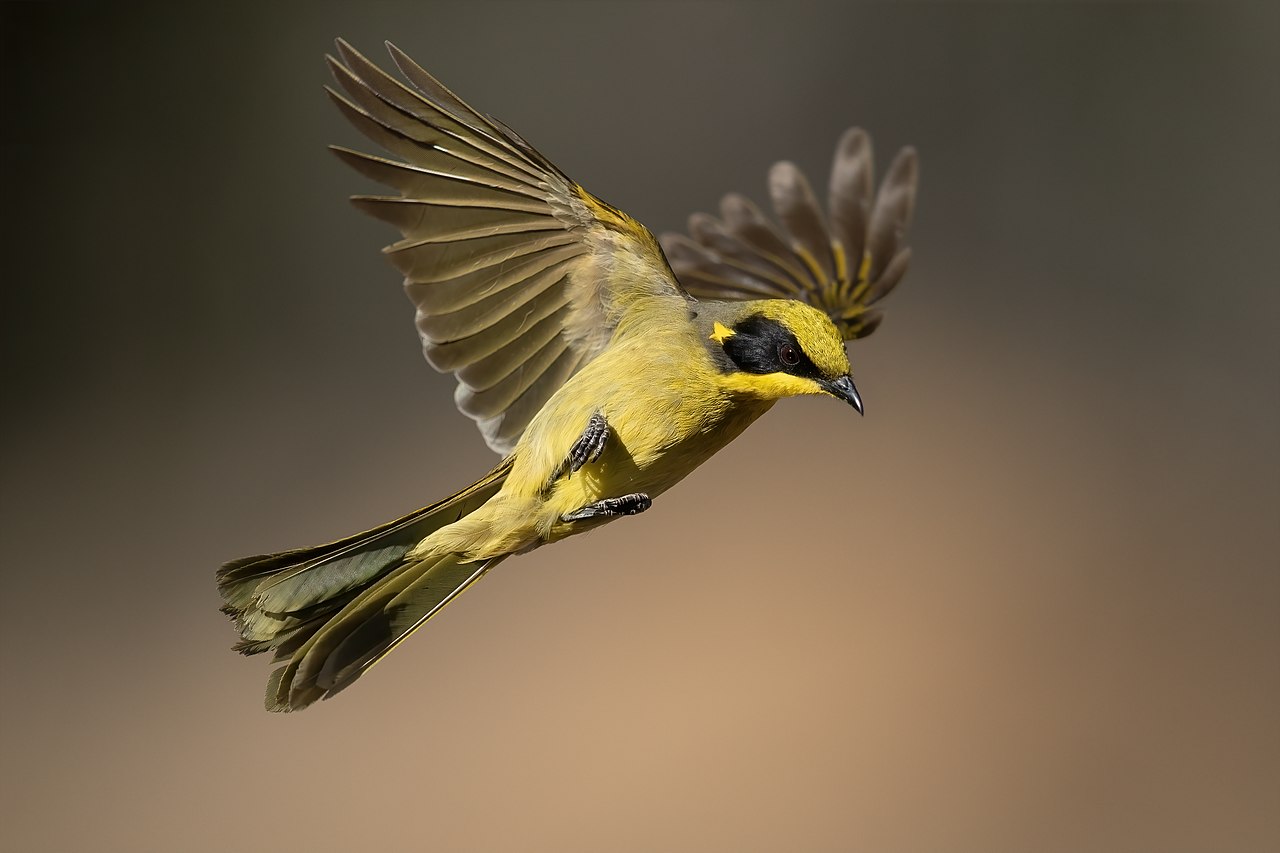
Yellow-tufted honeyeater near Lithgow, New South Wales
Temperament
social and active
Flight Pattern
short rapid wingbeats between trees
Social Behavior
Often seen in small, noisy groups that move through the canopy and midstory while foraging. Pairs defend nesting territories in suitable habitat, building cup nests in dense foliage. In some populations, loose colonies form where food is abundant, and cooperative behaviors may occur around nesting sites.
Migratory Pattern
Partial migrant
Song Description
The voice is a bright, ringing series of metallic chinks and clear, tinkling phrases, interspersed with scolding chatters. Calls carry well through eucalypt forests and are often given in chorus by small groups.
Plumage
Olive-green upperparts with yellow-olive underparts; head shows a glossy black mask and crown contrasting with bright yellow ear-tufts. The wings and tail are olive with yellow fringes; throat and breast are yellow-washed. Feathers are sleek, with subtle streaking on the flanks in some individuals.
Diet
Feeds primarily on nectar from flowering eucalypts and other native plants, supplemented heavily with insects and spiders gleaned from foliage and bark. It also takes lerp, honeydew, and occasionally soft fruits. Foraging involves probing blossoms, gleaning leaves and twigs, and short sallies to catch flying insects.
Preferred Environment
Most often forages in the canopy and midstory of eucalypt forests and woodlands, especially along gullies and riparian zones. Will use edges, regrowth, and flowering street trees in rural towns when nearby native habitat is present.


