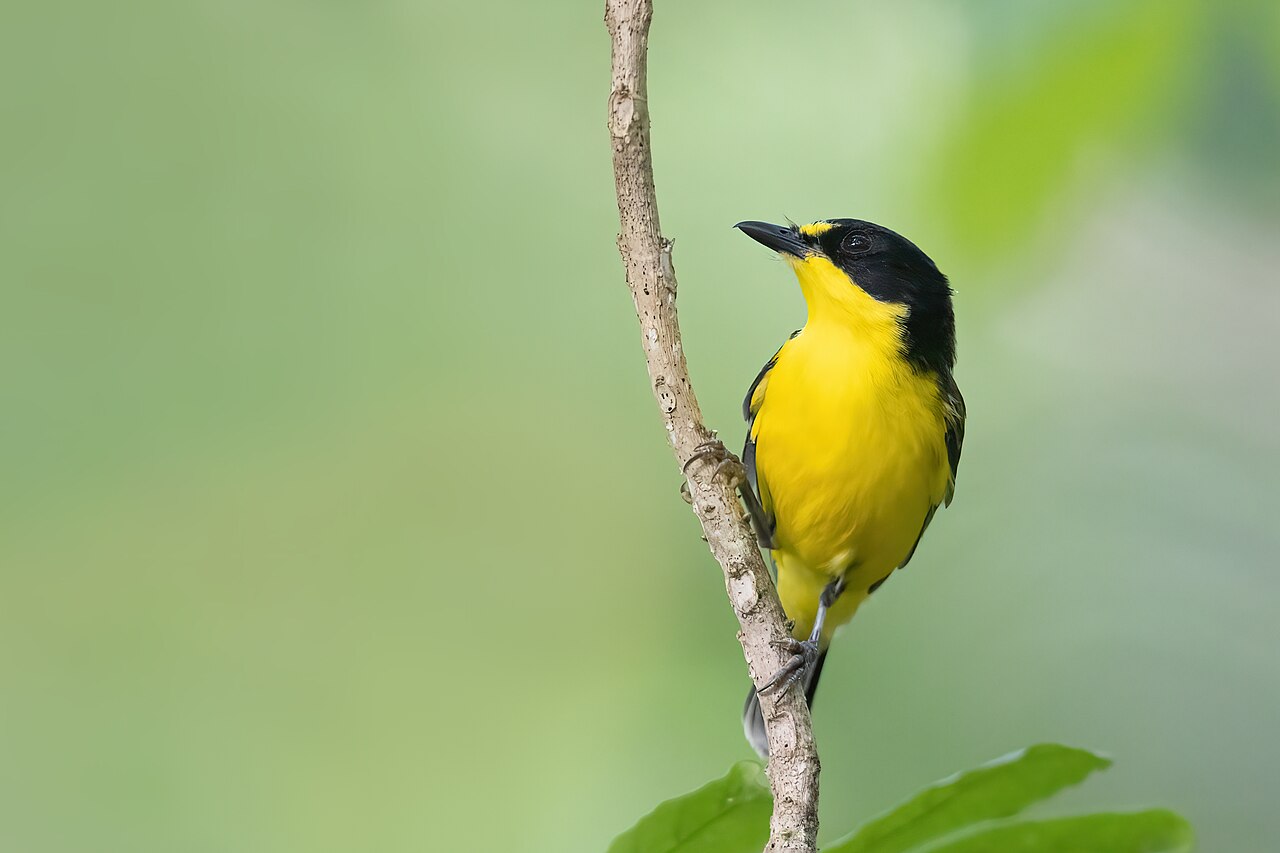
The yellow-throated euphonia is a species of songbird in the family Fringillidae. It is found in southeastern Mexico and throughout Central America with its range stretching from Belize south to western Panama. It inhabits primarily both humid and dry regions where it prefers the forest edge, open woodland, and shaded plantations. It has two subspecies, the nominate subspecies Euphonia hirundinacea hirundinacea and Euphonia hirundinacea gnatho. This finch is a small bird with pointed wings and a short bill and short tail. Males of this species have dark glossy blue-black upperparts excluding a yellow forecrown, and bright yellow underparts, while females have olive green upperparts and whitish-gray breast and lower parts. It has a shrill song that alternates between high-pitched and moderately pitched and appears to be able to mimic some calls of other birds.
Region
Central America and southeastern Mexico
Typical Environment
Occurs from southeastern Mexico south through Belize, Guatemala, Honduras, El Salvador, and Nicaragua to western Panama. It favors forest edges, second-growth woodland, and shaded plantations, especially where fruiting trees and mistletoes are abundant. The species also uses gardens and hedgerows near forest. It is generally more common in lowlands and foothills, avoiding dense interior rainforest except along edges and gaps.
Altitude Range
Sea level to 1800 m
Climate Zone
Tropical
Ease of Keeping
Beginner friendly: 1/5
Yellow-throated euphonias are accomplished fruit specialists that often swallow small berries whole and help disperse seeds, especially mistletoe. They frequently occur in pairs or small family groups and can join mixed-species flocks at forest edges. Their enclosed, globular nests are tucked into vine tangles or dense foliage, and males sometimes mimic calls of other birds during song.


Male E. h. hirundinacea feeding on custard apple (Annona reticulata)

Female

Female (left) and male (right)
Temperament
social and active
Flight Pattern
short rapid wingbeats
Social Behavior
Usually found in pairs or small groups, sometimes joining mixed-species flocks at fruiting trees. Builds a globular, domed nest with a side entrance hidden in vine tangles or dense foliage. Pairs maintain small territories during breeding, and males often feed females during courtship and incubation.
Migratory Pattern
Resident
Song Description
A series of thin, high-pitched whistles and twitters that alternate between very high and mid-pitched notes. Phrases are delivered in short bursts, and individuals may incorporate mimicry of other species’ calls.
Plumage
Male glossy blue-black upperparts with a bright yellow forecrown and throat, and vivid yellow underparts; short tail and pointed wings. Female olive-green above with a grayish-white to pale buff breast and belly, and duller yellowish throat. Both sexes have a short, thick bill.
Diet
Primarily small fruits and berries, with a strong preference for mistletoe and other soft, lipid-rich fruits. They swallow fruits whole and later regurgitate seeds, acting as important seed dispersers. Insects and other small arthropods are occasionally taken, especially when feeding young.
Preferred Environment
Feeds at forest edges, canopy gaps, and in fruiting trees within second growth and shaded plantations. Often visits gardens and hedgerows with abundant berries.