

The yellow-rumped cacique is a passerine bird in the New World family Icteridae. It breeds in much of northern South America from Panama and Trinidad south to Peru, Bolivia and central Brazil. However, they have been sighted as far north as Nayarit state in Mexico.
Region
Northern South America, Panama, and Trinidad
Typical Environment
Occurs from Panama and Trinidad through northern South America including Colombia, Venezuela, the Guianas, and much of the Amazon basin south to Peru, Bolivia, and central Brazil. Prefers forest edges, gallery forests, riparian zones, and secondary growth, and readily uses plantations and semi-open countryside. Often found near water and along river corridors. Common around human-altered landscapes where tall trees remain for nesting.
Altitude Range
Sea level to 1200 m
Climate Zone
Tropical
Ease of Keeping
Beginner friendly: 1/5
This colonial nester weaves long, pendulous pouch nests that often hang near active wasp nests, which may deter predators. Its striking black body with a vivid yellow rump makes it easy to spot along forest edges and rivers. It is widespread and adaptable, commonly seen in open woodland, plantations, and village outskirts.


The yellow vent

Nesting in Peru
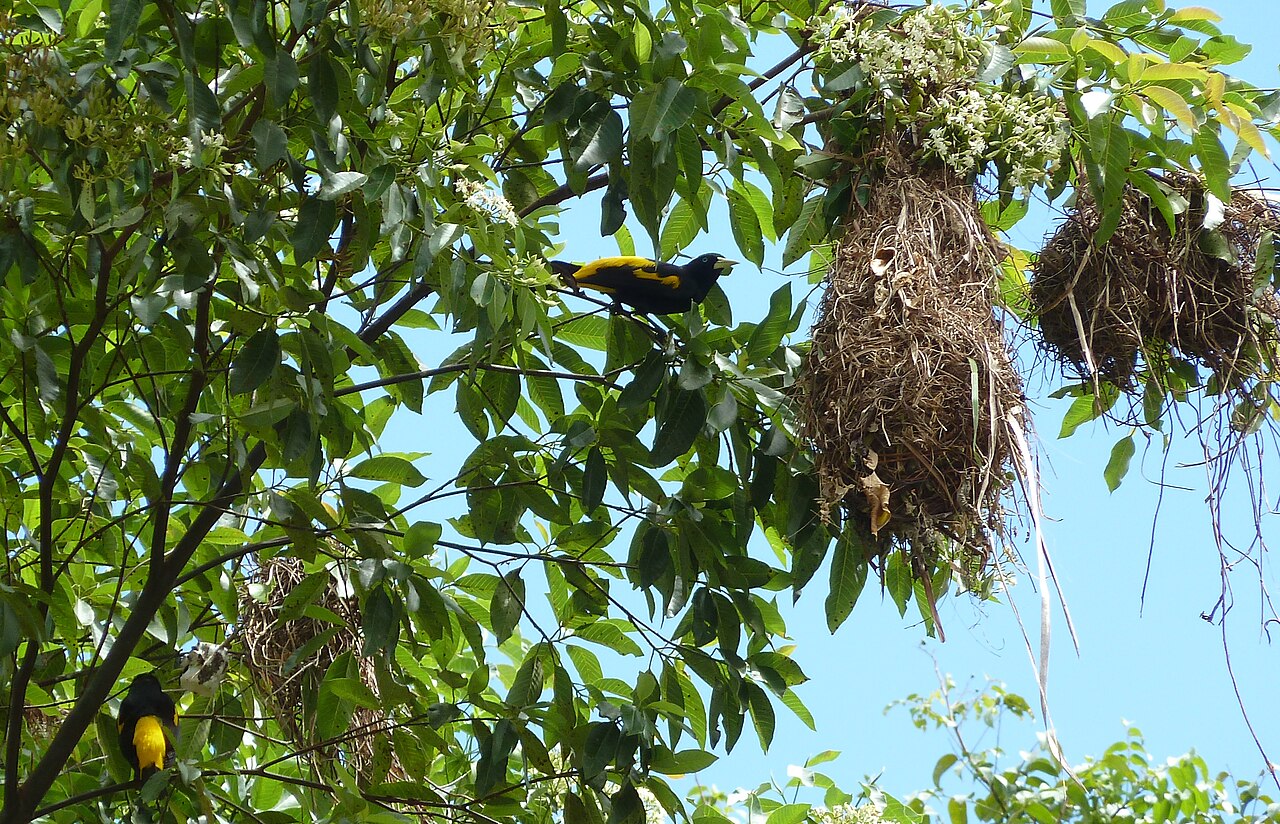
Yellow-rumped cacique nest
Temperament
social and active
Flight Pattern
strong flier with rapid, direct wingbeats
Social Behavior
Highly colonial, forming noisy breeding colonies in tall trees where many long, woven nests hang together. Males display prominently and may be polygynous. Nests are often placed near wasp colonies, likely gaining protection from predators. Outside breeding, birds forage in loose groups and may join mixed-species flocks.
Migratory Pattern
Resident
Song Description
Vocal repertoire includes liquid whistles, chatters, and harsh buzzing notes delivered in short sequences. Males often sing from exposed perches near colonies, interspersing whistles with mechanical-sounding rattles.
Plumage
Mostly sleek, glossy black with a contrasting bright yellow rump and lower belly; wings show small yellow patches in flight.
Diet
Takes a variety of insects and other arthropods gleaned from foliage and bark, and also consumes fruits and berries. Will sip nectar and occasionally take small vertebrates or eggs. Uses probing and picking in the canopy and mid-story, sometimes sallying for flying insects. Diet composition varies seasonally with fruiting and insect abundance.
Preferred Environment
Feeds along forest edges, riverbanks, and in secondary growth where fruiting trees and flowering plants are abundant. Frequently forages in plantations, gardens, and open woodland with scattered tall trees.


