
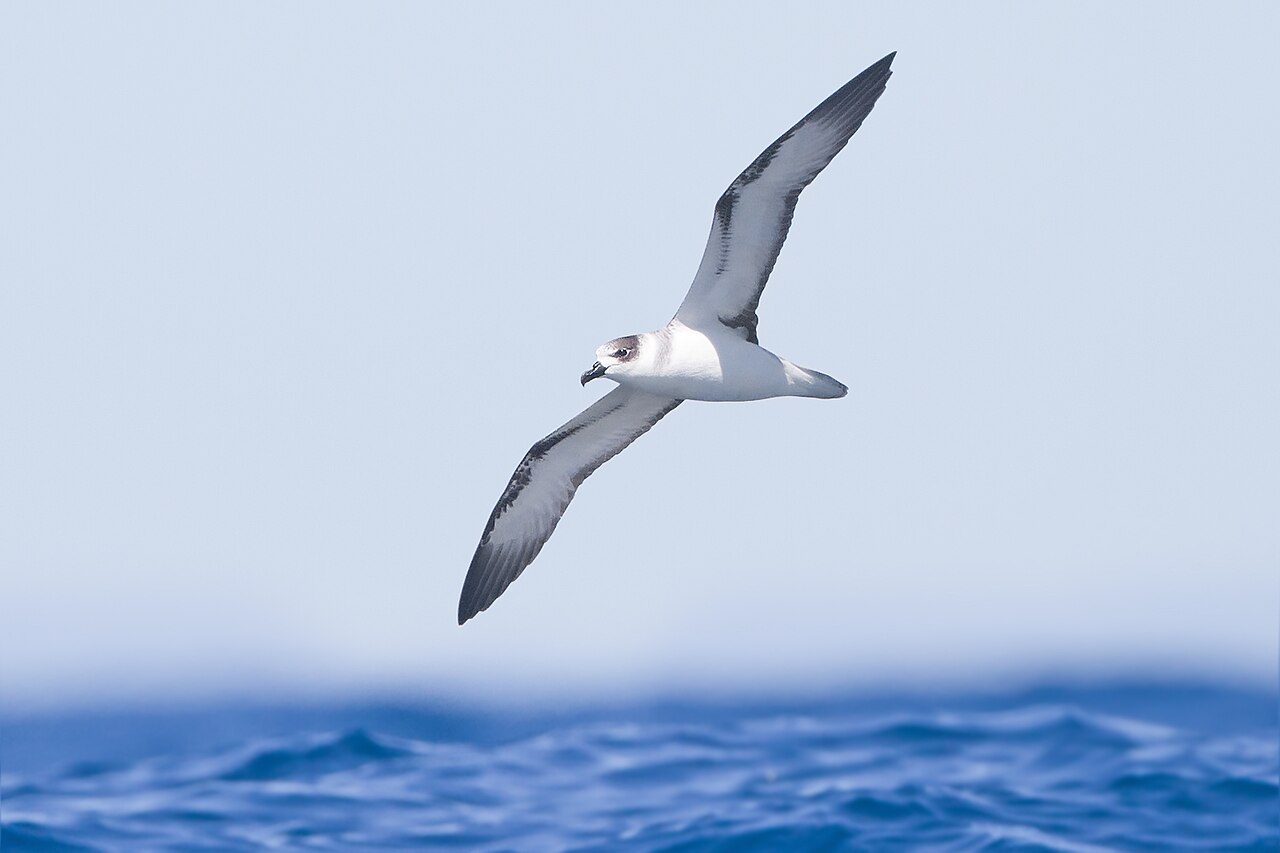
The white-necked petrel, also known as the white-naped petrel, is a species of seabird in the family Procellariidae. During the non-breeding season it occurs throughout a large part of the Pacific, but it is only known to breed on Macauley Island in New Zealand's Kermadec Islands and the Australian territory of Norfolk Island and Phillip Island. It formerly bred on Raoul Island, but has now been extirpated from this locality due to predation by rats and cats. Reports of breeding on Merelava, Vanuatu, are more likely to be the very similar Vanuatu petrel, P. occulta, which some consider to be a subspecies of the white-necked petrel. The IUCN rating as vulnerable is for the "combined" species.
Region
South and Central Pacific Ocean
Typical Environment
Breeds on Macauley Island in the Kermadec Islands (New Zealand) and on Norfolk and nearby Phillip Island (Australia). Outside the breeding season it ranges widely over the subtropical and temperate Pacific, often far from land. At sea it favors productive waters and oceanic fronts where prey concentrates. It rarely approaches coastlines except when returning to colonies.
Altitude Range
Sea level to 600 m
Climate Zone
Subtropical
Ease of Keeping
Beginner friendly: 1/5
Also called the white-naped petrel, this tubenose breeds on a handful of remote islands and spends the rest of the year roaming the open Pacific. It nests in burrows on steep, vegetated slopes and visits colonies only at night. Invasive predators like rats and cats have caused historical colony losses, making protection of breeding islands crucial.


Pterodroma cervicalis Male Mount, Auckland Museum Collection

Temperament
pelagic and elusive
Flight Pattern
long arcing glides with stiff, slightly bowed wings
Social Behavior
A colonial nester that digs burrows or uses crevices on steep slopes, visiting colonies strictly at night to avoid predators. Pairs are typically long-term and lay a single egg per season, with both adults sharing incubation and chick-rearing. Outside the breeding season it is solitary or in loose associations at sea where food is abundant.
Migratory Pattern
Seasonal migrant
Song Description
Mostly silent at sea. At colonies it gives mournful, wailing and yelping calls at night, with softer chatter exchanged between mates near burrow entrances.
Plumage
Crisp white underparts with dark grey-brown upperparts and a contrasting white hindneck forming a collar. Underwings mostly white with a bold dark border and tip; upperwings show a dusky M-pattern. The head has a dark cap and eye patch offset by the white nape.
Diet
Feeds mainly on squid, small fish, and crustaceans captured near the surface. It often takes prey at night when squid rise, and may snatch items flushed by predatory fish or oceanic fronts. It occasionally scavenges scraps but is primarily an active hunter over open water.
Preferred Environment
Forages over deep, pelagic waters, especially along convergence zones and shelf edges where prey aggregates. Seldom enters nearshore waters except in transit to colonies.


