

The white-eared bulbul is a member of the bulbul family. It is found in south-western Asia from India to the Arabian peninsula.
Region
Southwest Asia and the Arabian Peninsula
Typical Environment
This species occurs from southern Iraq and southwestern Iran through Kuwait, Bahrain, Qatar, eastern Saudi Arabia, and into southern Pakistan and northwestern India. It favors riverine thickets, scrub, palm plantations, orchards, and urban gardens. In desert regions it is most common around oases and irrigated farmland. It tolerates human presence well and often nests close to settlements.
Altitude Range
0–1800 m
Climate Zone
Arid
Ease of Keeping
Beginner friendly: 3/5
The white-eared bulbul is a familiar garden and oasis bird across parts of Southwest Asia, easily recognized by its white ear patch and bright yellow vent. It thrives in human-altered landscapes such as date groves, parks, and suburban gardens. Vocal and conspicuous, it often forages in pairs or small groups and adapts well to arid and semi-arid environments.




Temperament
social and active
Flight Pattern
short rapid wingbeats with brief glides
Social Behavior
Usually seen in pairs or small family groups, loosely territorial during the breeding season. Nests are neat open cups placed in shrubs, palms, or low trees. Both parents participate in feeding the young and will defend the nest vigorously.
Migratory Pattern
Resident
Song Description
A lively series of whistles, chirps, and chatters delivered from exposed perches. Calls are bright and conversational, often repeated and responsive to nearby birds.
Plumage
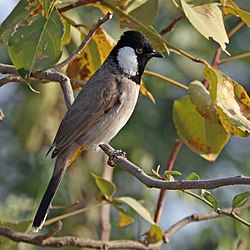
Smooth, plain brownish-grey upperparts with paler underparts; black head and face contrasting with a clean white ear patch; bright yellow vent and white-tipped tail feathers.
Diet
Feeds on a mix of soft fruits (figs, dates, berries), flower buds and petals, nectar, and a variety of insects and other small invertebrates. It will glean from foliage, pick fruit directly from trees, and occasionally forage on the ground. In urban areas it readily exploits garden plantings and ornamental shrubs. Seasonal fruiting strongly influences its foraging routes.
Preferred Environment
Common around date groves, orchards, riverine vegetation, and landscaped parks and gardens. Frequently visits flowering shrubs and fruiting trees within towns and villages. Uses hedges and low trees for foraging and cover.


